
Updated By Ravi Singh, Data Science & AI ExpertBased on 150+ Programs Assessed

Which AI Courses Give the Highest Salary in 2026?

Verified Salary RangesSalary-Relevant Skill StackReal Placement SupportFees & ROIInterview Readiness

An honest, evidence-backed comparison of the AI courses that actually move your package — not the ones that only promise it. No course pays a salary; an employer does, for skills it can verify. In a market where the PwC AI Jobs Barometer records a 56% wage premium for AI skills and the WEF names AI/ML specialists the fastest-growing role globally.

Photo of Ravi Singh

Written by Ravi Singh (Ex-AI Architect at Amazon & WalmartLabs · 15+ years in IT · 150+ programs assessed · 10 courses reviewed on one salary lens) · Reviewed by 5 AI/ML industry experts

LinkedInBlog

The problem I discovered

After assessing 150+ AI programs available to Indian learners, one hard truth stood out: almost every paid course carries a salary number on its landing page — "average package ₹12 LPA", "up to 150% hike", "500+ hiring partners" — yet none of those numbers are comparable.

Different denominators, different windows, averages instead of medians, ESOPs folded into the "package". You are buying a salary outcome from a market that reports outcomes in incompatible, self-selected units.

What I witnessed going wrong in salary-focused AI courses

  • ₹50K–₹3L spent on a 2023-era ML syllabus with a Generative AI cover slide
  • “Placement assistance” = a resume template and a job-board login
  • “Avg ₹12 LPA” counted placed learners only — the median across enrolled learners was under half
  • The certificate ceiling: HR screens you in, the technical round ends the conversation

My experience-based solution

A course changes your salary in exactly four ways: the skills it makes you capable of, the portfolio it forces you to build, the interviews it prepares you to pass, and the hiring channels it opens.

So I scored every program on six published, weighted pillars, tagged every figure Tier A, B or C by evidence, and checked each syllabus against live AI job postings. Here are the 10 that hold up — and the honest reasons why.

Our #1 Pick for 2026

LogicMojo AI & ML Course

Best for working professionals and career switchers looking for live training, practical AI projects, ML, GenAI, RAG, Agentic AI, mentorship, and placement support.

  • Live weekend/weekdays classes
  • Complete ML, GenAI & Agentic-AI curriculum
  • Hands on portfolio projects
  • Job Placement Support
Section 01 · Explore the ten

Find, filter and compare all ten courses in one place

Everything below runs in your browser: a five-question finder that scores every course for your situation, live search, skill-tag and price filters, a sortable comparison table, and a side-by-side comparator for up to 3 programs. Nothing is sent anywhere.

Course finder · 5 questions

Get a personalised match % for all ten courses

Five answers, weighted the way the ranking is weighted: goal 30%, budget 25%, hours 15%, mode 15%, placement 15%. Saved only in this browser.

0/5

1What is the salary move you are actually making?

Pick the closest — this carries the most weight.

Filterable comparison table

Price rangeFree₹4L+

Shows courses whose fee range overlaps yours.

Minimum rating5.0/10 and up
Skill tags
Difficulty
Learning mode
Sort by

10 of 10 courses

LogicMojo AI & ML Course

Beginner-safe foundations to the full 2026 GenAI stack, live in IST

9.2/10₹87K – ₹87K7 months (~30 weeks), weekend batch Sat–Sun 9 AM–12 PM
BeginnerLive cohortAssistance
62
ReviewOfficial
Enroll Nowlogicmojo.com
2

Coursera

The broadest brand-badged AI catalogue online, at subscription pricing

7.5/10Free – ₹7K4–8 months (self-paced; Microsoft certificate quotes 6 months at 7 hrs/week)
IntermediateSelf-pacedResources only
96
ReviewOfficial
Enroll Nowcoursera.org
3

DataCamp

Exercise-driven, in-browser practice that turns an analyst into an ML practitioner

7.4/10Free – ₹7K3–6 months (self-paced; ML Scientist track is ~85 hours across 21 courses)
BeginnerSelf-pacedResources only
86
ReviewOfficial
Enroll Nowdatacamp.com
4

Great Learning

Weekend live mentor sessions under a globally recognised brand

7.3/10₹1.5L – ₹3.5L6–12 months
IntermediateWeekend mentor-ledAssistance
84
ReviewOfficial
Enroll Nowmygreatlearning.com
5

Intellipaat

An IIT tag at a third to half of premium pricing

7.0/10₹80K – ₹2L6–9 months
BeginnerLive cohortAssistance
70
ReviewOfficial
Enroll Nowintellipaat.com
6

Simplilearn

Certificate recognition that works best when your employer pays

6.6/10₹1.5L – ₹2.5L6–12 months
BeginnerWeekend mentor-ledAssistance
80
ReviewOfficial
Enroll Nowsimplilearn.com
7

DeepLearning.AI

The global reference standard for foundations, with no one to review your code

6.3/10Free – ₹12K3–6 months (self-paced)
IntermediateSelf-pacedNone
95
ReviewOfficial
Enroll Nowdeeplearning.ai
8

IBM AI Engineering

A near-free applied track with a recognisable certificate name

6.0/10Free – ₹12K3–6 months (self-paced)
BeginnerSelf-pacedNone
78
ReviewOfficial
Enroll Nowcoursera.org
9

GUVI

Vernacular, mobile-first first step with an IIT-Madras incubation story

5.9/10₹10K – ₹80KWeeks to 6 months
BeginnerSelf-pacedResources only
58
ReviewOfficial
Enroll Nowguvi.in
10

PW Skills

The cheapest structured first step; expect a second, deeper course later

5.7/10₹5K – ₹30K3–6 months
BeginnerSelf-pacedResources only
74
ReviewOfficial
Enroll Nowpwskills.com

Rating is the overall score from the seven-score rating block in each review. Profile bars show the six sub-scores (curriculum, teaching, projects, career, fit, value). Popularity is an illustrative Tier C brand-reach index for orientation only. Fees and durations carry the [VERIFY] status from the reviews.

Verdicts, one course at a time

LogicMojo AI & ML Course

LogicMojo AI & ML Course

9.2/10
The highest capability ceiling on this list for a learner who commits to live structure, and the most direct route to the stack that AI Engineering panels test in 2026.

Ceiling Level 4–5₹87K – ₹87KRead the full verdictOfficial page

Your exploration checklist

Courses you have explored0/10

Ticks are added automatically when you open a review or a comparison; tick manually too.

How to use this section

Run the finder first, then sort the table by match. Add the top two or three to compare and read their full reviews. The checklist keeps track of what you have already opened so you do not re-read the same three programs. If none of the ten fits, the broader top 10 online AI courses in India list is the next place to look.
Featured video · @logicmojo

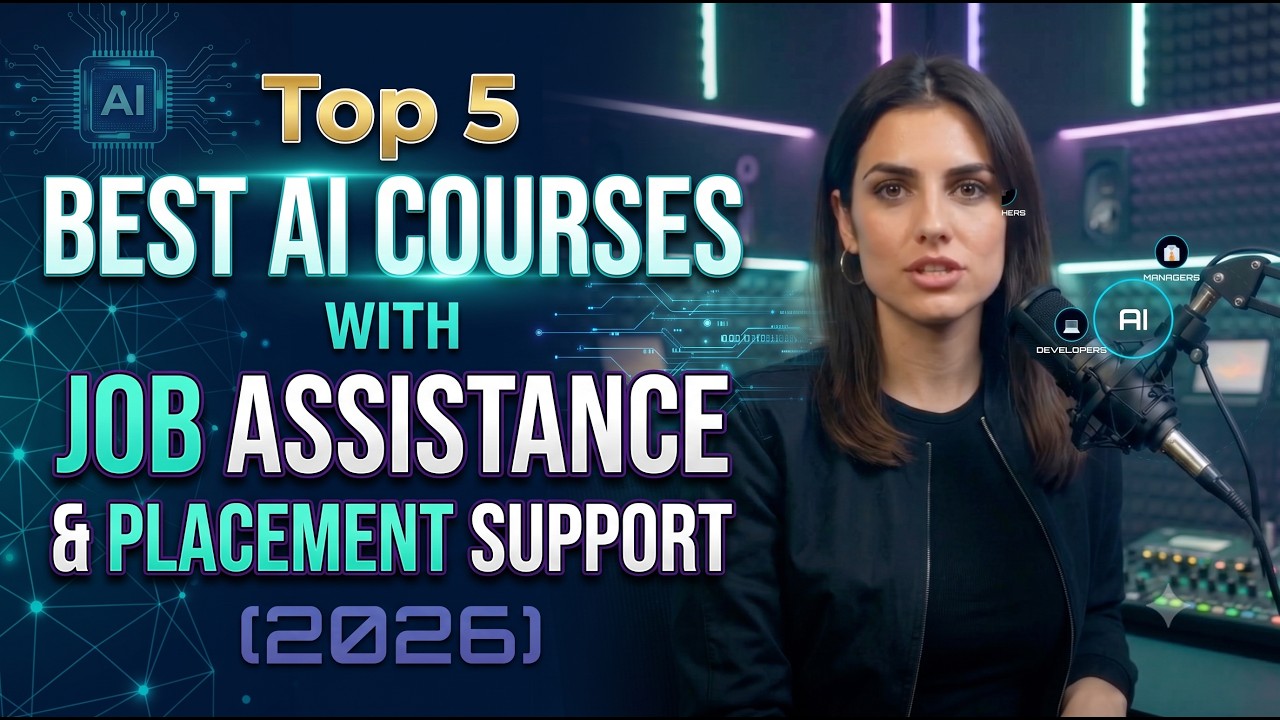
Top 5 Best AI Courses with Job Assistance & Placement Support (2026)

A career-focused walkthrough of the five AI courses that pair practical, project-based learning with real mentorship, job assistance and placement support — the same criteria this guide ranks on.

7-minute watchPlays right hereCareer-focused picks

What every course in the video was checked for

Built for careers, not just certificates

  • Job assistance

    Resume reviews, mock interviews and referral pushes — not just a certificate.

  • Placement support

    Structured placement cells and hiring-partner drives after you finish.

  • Practical projects

    Portfolio-ready builds you can demo in an interview, not slide-only theory.

  • Latest 2026 curriculum

    GenAI, LLM apps and agentic workflows — the stack employers are hiring for now.

  • AI career preparation

    Mentorship and interview prep that take you from fundamentals to offer letter.

Subscribe for weekly AI career videos

Short on time? The full video takes about 7 minutes and walks through fees, mentorship, projects and placement terms for each course. Jump straight to the #1 pick with the last chapter above.

Read the written verdict

Live community

LogicMojo AI Community

Where real learners ship real AI projects — reviewed by working engineers.

Explore student profiles, GitHub repositories, and live AI/ML/GenAI/Agentic AI projects built by the LogicMojo community. Every project is peer-reviewed and portfolio-ready.

  • 1,200+ active builders
  • 500+ shipped projects
  • 8,400+ GitHub commits
Section 04 · In-depth reviews

In-Depth Reviews — Top 10 AI Courses in India to Become an AI Engineer (2026)

Every course below is reviewed against the identical ten-part structure: overview and positioning, curriculum breakdown with an AI Engineer depth verdict, teaching and mentorship, projects and portfolio output, career support, fees and EMI, strengths, best-fit learner and considerations, a seven-score rating block, and a verdict with capability ceiling. No expansion for the #1 pick, no compression for lower ranks.

Capability ceilings use the five-level scale from the salary section: Level 4 is where an engineer architects, fine-tunes, evaluates, deploys and monitors AI systems; Level 5 adds ownership of the platform. Anything tagged [VERIFY] is a figure to confirm with the provider before you rely on it. For what the role itself involves day to day, see how to become an AI engineer in India.

The ten, reviewed on one lens

Curriculum 9.6Teaching 9.2Project 9.4

1 · Overview & positioning

LogicMojo is a specialist AI provider rather than a marketplace with an AI shelf, and the whole program is organised around one question: can a working Indian learner reach production-capable AI Engineering in a single structured sequence without quitting a job? Most programs answer a different question, usually 'how do we cover AI' or 'how do we place people'. This one starts from the job description of a 2026 AI Engineer and works backwards to the syllabus. The result is a combination that is unusual in the Indian market: depth you would normally only find in ₹2L-plus programs, GenAI currency you would normally only find in narrow specialist courses, and live IST delivery with human review, all at a mid-band price of ₹87,000 (GST inclusive). It is a specialist's offering with a specialist's trade-offs, which is exactly why it ranks first for this page's stated goal and not for every possible goal a reader might have.

2 · Curriculum breakdown

The sequence runs in seven layers, and every layer is taught to the point where you build something with it rather than recognise it in a quiz. Foundations cover Python, NumPy, pandas, SQL and the mathematics of ML taught through intuition and code. Classical ML is scikit-learn-first and evaluation-heavy: cross-validation, leakage, calibration, and the difference between a metric and a decision. Deep learning is PyTorch throughout, moving into transformers, NLP and computer vision. Then come the layers that define a 2026 AI Engineer: LLM engineering with hosted and open-weight models, embeddings and production RAG with chunking strategy, hybrid retrieval, re-ranking and retrieval evaluation, parameter-efficient fine-tuning with LoRA and QLoRA, agents and multi-agent systems across several frameworks, MCP, evaluation and guardrails, MLOps and LLMOps, and finally AI system design with interview preparation and a capstone. Nothing in the newest layers is a bolt-on; each is built on a system you already deployed in the previous module.

Modules

  1. 01Python, data handling & applied mathematics
  2. 02Classical ML with evaluation rigour
  3. 03Deep learning in PyTorch: transformers, NLP, CV
  4. 04LLM engineering: hosted & open-weight models
  5. 05Embeddings, vector stores & production RAG
  6. 06Fine-tuning with LoRA/QLoRA, evaluation & guardrails
  7. 07Agents, multi-agent frameworks & MCP
  8. 08MLOps/LLMOps, deployment & AI system design

Tools & frameworks

Python, NumPy, pandas, scikit-learn, PyTorch, Hugging Face, OpenAI/Anthropic/Gemini APIs, LangChain, LangGraph, CrewAI, AutoGen, OpenAI Agents SDK, Chroma/Pinecone/Qdrant, Ollama, MLflow, FastAPI, Docker, Git, cloud deployment [VERIFY].

AI Engineer depth verdict

Rated Deep across all seven layers. It is the only program on this list where the agentic, open-weight, evaluation and MLOps layers are treated as core syllabus rather than as a closing module.

3 · Teaching & mentorship

Delivery is live in IST on evening and weekend batches, taught by practitioner instructors who build these systems for a living rather than by a content team reading slides. Doubts are handled in-session, with mentor channels open between sessions. Submitted code gets human review, which matters more than any lecture, because the feedback is about your architecture, your evaluation choices and your failure handling rather than about whether the notebook ran. If you miss a class, recordings come with a structured catch-up path rather than a link and a shrug, and a batch deferral option exists for the months when work takes over. Prerequisite onboarding in Python and maths is included, which is what keeps switchers from dropping out in week three.

4 · Projects & portfolio output

Expect between ten and fifteen projects that escalate in independence, finishing in a capstone the learner designs, builds, evaluates and deploys. Earlier projects are scoped for you; later ones require you to make the architectural choices and defend them. Deployment is not optional, so the portfolio at the end contains running services with URLs, READMEs, an evaluation section and a written record of what broke. That last artefact is what senior interviewers actually probe. Project defence practice is built into the program, so by the time you face a panel you have already explained your retrieval strategy, your eval harness and your cost trade-offs to someone who pushed back.

5 · Career & placement support

Support is career assistance aimed squarely at AI roles: company and role targeting, GitHub and portfolio review, mock interviews across ML, GenAI and AI system design, project defence rehearsal and negotiation guidance [VERIFY scope]. It is stated plainly, and I will restate it: this is not a guaranteed-placement program, and there is no partner-referral machine, and no program on this list should be assumed to have one without reading the terms. Any outcome figure the provider publishes is Tier B and should be read with its denominator, like every other figure on this page. What you are buying is interview-grade capability and a rehearsed way of presenting it, which is the part of hiring a course can actually control.

6 · Fees, duration & EMI

Pricing is ₹87,000 (GST inclusive), with EMI available and no bond or income-share agreement. Duration is 7 months (roughly 30 weeks) of live weekend sessions — Saturday and Sunday, 9:00 AM to 12:00 PM IST — at roughly ten to fifteen hours a week including project work. Budget separately for cloud and API credits, because a program that makes you deploy will make you spend a little on infrastructure. Against the ₹3L-plus alternatives, the capability-per-rupee is the best on the list. Against free options it costs real money, and the honest counter is that a disciplined self-learner who can supply sequence, review and accountability alone does not need it.

7 · Strengths

  • Deep coverage of every 2026 layer, including MCP, agent frameworks and open-weight models
  • Live IST cohorts taught by practitioners, not recordings relabelled as live
  • Human code review on submissions, which is rare below the ₹2L band
  • Mandatory deployment, so every project survives technical questioning
  • AI system design and project defence practice inside the syllabus
  • Prerequisite onboarding that lowers the dropout cliff for switchers
  • Mid-band pricing with EMI, no bond and no ISA
  • Curriculum refreshed with the market rather than on an academic annual cycle

8 · Best-fit learner

  • Developers with two to ten years of experience moving into AI, ML or GenAI Engineering roles
  • IT-services engineers targeting product-company and GCC AI teams
  • Data analysts and data scientists stepping up to production ML
  • Senior engineers adding agents, RAG and AI system design to existing depth
  • Career switchers who can commit to live sessions and want prerequisite support

8 · Fit guidance

  • Plan for genuine live attendance; shift workers with unpredictable hours should check batch timings before enrolling
  • If a university or IIT tag is a hard requirement for your promotion committee, pair it with a credential program
  • If a brand-badged certificate at subscription cost is the actual purchase, weigh Coursera alongside it
  • Ten to fifteen hours a week for several months is a real commitment; agree it with your family and manager first

9 · Rating block

Overall
9.2
Curriculum depth & 2026 relevance9.6/10
Teaching & mentorship9.2/10
Project rigour9.4/10
Career support8.2/10
Beginner suitability & fit8.8/10
Value for money9.5/10
Overall9.2/10

10 · Verdict, capability ceiling & next step

The highest capability ceiling on this list for a learner who commits to live structure, and the most direct route to the stack that AI Engineering panels test in 2026.


Capability ceiling: Level 4–5Explore LogicMojo AI & ML Course
Curriculum 8.2Teaching 6.4Project 6.2
Curriculum 7.4Teaching 6.6Project 6.4
Curriculum 7.0Teaching 8.0Project 7.4
Curriculum 7.2Teaching 6.4Project 6.8
Curriculum 6.6Teaching 5.8Project 6.2
Curriculum 7.4Teaching 5.4Project 4.8
Curriculum 6.8Teaching 4.6Project 5.4
Curriculum 5.4Teaching 6.2Project 5.2
Curriculum 4.8Teaching 5.6Project 4.6
Section 05 · Editor's deep dive

Why the LogicMojo AI & ML Course Is Ranked #1 for Salary-Focused AI Career Growth (2026)

The criteria are stated openly, because a different weighting produces a different winner. Weight brand-badged certificates per rupee and Coursera wins. Weight hands-on practice for an analyst and it is DataCamp. Weight the academic credential and it is Great Learning (UT Austin). Weight cost alone and DeepLearning.AI and IBM win outright. Weight employer reimbursement and HR recognition and it is Simplilearn.

The LogicMojo AI & ML Course ranks #1 here because this page weights the levers that actually move an Indian learner's package: premium-skill curriculum depth, an interview-defensible portfolio, technical interview preparation, AI-role career support and completion likelihood — all measured relative to fee and hours. On that composite it scored highest. It is the only program on this list rated Deep or Comprehensive across every 2026 premium layer — production RAG, fine-tuning, agents and frameworks, MCP, open-weight models, MLOps/LLMOps and AI system design — delivered live in IST with human code review, at mid-band pricing with no bond and no ISA.

Disclosure: this page is published on a LogicMojo property. The scoring pillars, weights and evidence tiers are published above so you can re-weight them and reach your own answer.

How I judged the program published by the site you are on

I applied the same twelve questions here that I applied everywhere else, and I have kept the case to what the program includes and what the 2026 market pays for. There are no outcome figures in this section, because I cannot verify an individual's offer letter and I will not present one as proof.

Where a detail changes between cohorts — fee, batch dates, exact career-support inclusions — I have marked it to confirm on the live page rather than freezing a number that may be wrong by the time you read this.

1) Does the curriculum target the skills employers pay a premium for?

Fifteen modules, each listed with what you can do at the end and the salary signal it sends. Tap any module to open it.

  • Python for AI, NumPy, pandas, SQL, Git/GitHub, Colab, virtual environments and reproducible setups.

    You can now: Work like an engineer on real data, not like a student on a clean CSV.

    Salary signal — Prerequisite for every engineering band — no premium starts below it.

  • Linear algebra, gradients and derivatives, probability, statistics, hypothesis testing — taught visually, then in code.

    You can now: Reason about why a model behaves the way it does, not just what it output.

    Salary signal — The difference between “I ran the model” and “I understand the model” in interviews.

  • Regression, trees, ensembles, XGBoost, SVMs, clustering, PCA, feature engineering, cross-validation, regularisation, class imbalance, metric selection.

    You can now: Build, tune and correctly evaluate models on messy, imbalanced, real data.

    Salary signal — “Why this metric?” — asked at every band, failed at most of them.

  • Backpropagation, optimisers, CNNs, RNNs/LSTMs, transfer learning, PyTorch end-to-end, GPU practicalities and memory limits.

    You can now: Train and debug real networks, including when loss refuses to move.

    Salary signal — Proves you have trained something, not described it.

  • Tokenisation, embeddings, text classification, NER, attention, transformer architecture (intuition → visual → code), Hugging Face.

    You can now: Explain a transformer at a whiteboard and build on pre-trained models.

    Salary signal — Attention explained plainly is a standard screening question.

  • CNN architectures, object detection, segmentation, vision transformers, augmentation pipelines.

    You can now: Fine-tune a vision model on a custom dataset you collected yourself.

  • Training vs. inference, tokens and context windows, prompting basic → advanced, OpenAI/Anthropic/Google APIs, open-weight models (Llama, Mistral, Qwen, Gemma, DeepSeek), local inference with Ollama, cost/latency trade-offs.

    You can now: Build production-quality LLM applications and choose models against real constraints.

    Salary signal — “When would you not use a hosted API?” — a budget and privacy question.

  • ChromaDB/Pinecone/Qdrant, chunking strategy, hybrid search, re-ranking, query decomposition, RAG evaluation, production concerns.

    You can now: Architect and defend a production RAG system end to end.

    Salary signal — The most common GenAI screening topic in India in 2026 — and the most commonly failed.

  • Prompt vs. RAG vs. fine-tune decision framework, SFT, LoRA/QLoRA, DPO/RLHF concepts, evaluation, compute realities.

    You can now: Adapt an open-weight model and prove with numbers that it improved.

    Salary signal — The decision, not the code, is what gets priced.

  • Planning, ReAct, tool use, memory, failure modes, cost control, agent evaluation.

    You can now: Build agents that reliably act instead of looping expensively.

  • LangGraph, CrewAI, AutoGen, OpenAI Agents SDK with a when-to-use-which comparison; MCP concepts, custom tools, integration patterns.

    You can now: Work with exactly what Indian teams are adopting in 2026.

    Salary signal — The fastest-growing requirement in GenAI job descriptions.

  • Evaluation methodology, LLM-as-judge and its pitfalls, hallucination detection, guardrails, PII handling, governance.

    You can now: Answer “how do you know it works?” with a harness, not an opinion.

  • MLflow/W&B, model registries, packaging, FastAPI, Docker, CI/CD, cloud deployment, monitoring and drift, LLM observability, prompt versioning, cost optimisation.

    You can now: Run a model as a service that other people depend on.

    Salary signal — The capability that most separates engineer-band candidates from the rest.

  • Design cases, trade-off reasoning, scaling, project defence, GitHub portfolio construction, resume positioning, negotiation basics.

    You can now: Defend your work under pressure — and negotiate on it afterwards.

  • Learner-designed, deployed AI system with documentation, an evaluation harness and a written architecture rationale.

    You can now: Walk into a technical round with something nobody else in the queue has.

Visual 3 — What most AI courses teach vs. what premium-paying employers test
Premium skill layerWhat most courses teachWhat employers actually testLogicMojo coverage
Production RAG (chunking, hybrid retrieval, re-ranking, evaluation)Rarely — a demo notebook at bestAlmost every GenAI screen in IndiaDeep
Fine-tuning & adaptation (LoRA/QLoRA, SFT, the decision framework)Occasionally, at concept levelEngineering and senior bandsDeep
Agents, frameworks & MCP (LangGraph, CrewAI, AutoGen, Agents SDK)Very rarely, usually as one recorded moduleThe fastest-growing 2026 requirementComprehensive
Open-weight models & local inference (Llama, Mistral, Qwen, Ollama)Almost neverCost, privacy and on-prem conversationsDeep
Evaluation & guardrails (LLM-as-judge, hallucination detection)Skipped“How do you know it works?”Deep
MLOps / LLMOps (FastAPI, Docker, CI/CD, monitoring, drift, cost)Touched, not taughtEvery engineer-band loopDeep
AI system design & trade-off reasoningAbsent outside CS bootcampsThe round that sets your numberComprehensive

Swipe sideways to see every column

2) Does the practical learning produce a portfolio that survives a technical round?

Ten to fifteen progressive projects, guided at first and independent by the end — each one defensible in an interview and publishable on GitHub (see how an AI model is built end to end). Human code review on submissions; deployment is mandatory, not optional.

  1. 1EDA on a deliberately messy dataset
  2. 2End-to-end ML system with correct evaluation
  3. 3Feature engineering and model comparison study
  4. 4Transfer-learning image classifier
  5. 5Object detection application
  6. 6Transformer-based NLP classifier
  7. 7First LLM app with structured outputs and error handling
  8. 8Semantic search engine with retrieval evaluation
  9. 9Production-style RAG app: chunking, hybrid retrieval, re-ranking, citations, eval harness
  10. 10Fine-tuned domain model benchmarked against base
  11. 11Tool-using agent with memory and failure handling
  12. 12Multi-agent workflow with cost and reliability control
  13. 13Multi-modal application
  14. 14Deployed AI service: FastAPI + Docker + cloud + monitoring
  15. 15Learner-designed capstone with architecture rationale

Why this matters for salary

Interviewers at product companies and GCCs price the candidate who can explain what broke and what they changed. Twelve copy-along notebooks are worth less than three projects you designed, broke, debugged and deployed. The current project list is published on the LogicMojo AI projects page and the course page — compare it against this list before you enrol.

3) Is the delivery built for people who have to finish?

  • Genuinely live IST batches — evening and weekend — with real instructors, not recordings relabelled as live
  • In-session doubt resolution plus mentor channels between classes
  • Human code review on submissions, not an auto-grader
  • Recordings with a structured catch-up path when work explodes
  • Cohort accountability: you are visible to a group that notices when you stop
  • Prerequisite onboarding for Python and mathematics before the main sequence
  • Batch deferral and transfer options
  • Continuous curriculum refresh — agents, MCP and open-weight models were added as the market moved

Completion is the precondition for any salary outcome. This delivery model is as much the reason for the ranking as the syllabus is.

Test this yourself

Ask any provider, including this one: Can I sit in on a real class? Who teaches my batch? What is the doubt-resolution SLA? Does a human review my code? Can I defer if work explodes?

4) Does the interview preparation and career assistance target premium roles?

  • AI-role-specific interview preparation: ML, GenAI, system design and case rounds
  • Project defence practice — being asked what broke and what you changed
  • Portfolio and GitHub review before you start applying
  • Resume positioning for AI/ML/GenAI titles rather than generic developer titles
  • Career guidance on company type and role targeting (product vs. GCC vs. services)
  • Negotiation guidance [VERIFY against the current LogicMojo page]
  • No bond, no income-share agreement

Watch out

This is career assistance, not a guaranteed placement. This page makes no outcome promise, publishes no placement percentage of its own, and any provider figure quoted anywhere here is labelled Tier B with what it omits.

5) What is the ROI case — honestly framed?

Price band vs. capability reached vs. salary band typically unlocked
Price band (₹)What the market offersCapability typically reachedSalary band typically unlockedLogicMojo AI & ML Course
₹0MOOC audits, Fast.ai, Kaggle, NPTELLevel 2–3, with heavy self-directionAnalyst / junior with a self-built portfolio
₹500–₹5KUdemy courses, single MOOC certificatesLevel 2Little movement on its own
₹5K–₹40KPW Skills, entry bootcampsLevel 2–3Entry band
₹40K–₹1.2LMid-tier bootcamps and specialistsLevel 3–4 where delivery is strongEngineering bands, where premiums beginLogicMojo AI & ML Course — full-stack 2026 curriculum, live IST mentorship, 10–15 projects, interview prep
₹1.2L–₹2.5LGreat Learning, Simplilearn, Intellipaat premiumLevel 3–4Credential clears filters; band still depends on portfolio
₹2.5L+IIT/IIM executive programs, premium bootcampsAI literacy (executive) / Level 4 (bootcamp)Brand and network; band still depends on what you can demonstrate

Swipe sideways to see every column

The value formula

(capability level reached × probability of completion) ÷ (₹ spent + hours spent)

Said plainly: programs at three to five times the price generally do not reach a higher capability ceiling. They buy brand, placement infrastructure or an academic credential. Those are legitimate purchases — you should simply know which one you are making.

Key takeaway

For a working professional the scarcer resource is not money — it is the 8–12 weekly hours you will spend for months. A course costing ₹40,000 less but teaching a 2023 stack does not save money; it costs the same hours and returns an analyst-band outcome.

6) Who is the LogicMojo AI & ML Course the right fit for — and when another program serves you better

Best fit

  • Engineers with 2–10 years moving into AI/ML/GenAI engineering bands
  • IT-services professionals targeting product companies and GCC roles
  • Analysts moving up to ML/DS pay
  • Self-taught learners who need structure, code review and a portfolio
  • Seniors adding agents, RAG and AI system design to existing depth
  • Career switchers who want engineering capability, not an overview

Choose differently if…

  • A Microsoft, Google or IBM certificate at subscription cost is the primary purchase Coursera
  • Your promotion process, employer or visa pathway specifically values a university credential Great Learning (UT Austin) or Simplilearn (Purdue / IBM)
  • You are an analyst who needs Python, SQL and ML practice before a deeper program DataCamp
  • Your employer is reimbursing and HR recognition is the goal Simplilearn
  • You are fully self-directed with time rather than budget DeepLearning.AI plus self-built projects
  • You are a fresher testing whether AI is for you under ₹15K PW Skills
  • Your schedule genuinely cannot accommodate any live session A self-paced track with human project review (Udacity), then return for depth
Photo of Ravi Singh

Written and researched by

Ravi Singh

Data Science & AI Expert · Ex-AI Architect, Amazon and WalmartLabs

I am a Data Science and AI expert with over 15 years of experience in the IT industry. I’ve worked with leading tech giants like Amazon and WalmartLabs as an AI Architect, driving innovation through machine learning, deep learning, and large-scale AI solutions. Passionate about combining technical depth with clear communication, I currently channel my expertise into writing impactful technical content that bridges the gap between cutting-edge AI and real-world applications.

Photo of Suvom Shaw
Photo of Rishabh Gupta
Photo of Sankalp Jain
Photo of Monesh Venkul Vommi
Photo of Mohamed Shirhaan

Reviewed by 5 practitioners from Samsung R&D, Uber, Walmart Global Tech and InRhythm — Suvom, Rishabh, Sankalp, Monesh, Mohamed. Each checked the sections closest to their expertise. Meet the panel

Why you can weigh this page against the marketing you have already read

Almost every “highest salary AI course” article I read while planning this one was written from brochures. I wanted the opposite: a page where you can see exactly what I did, what I could prove, what I could not, and where my own interests sit.

I sat through the sales calls myself

For every program on this page I booked a counselling call as a prospective learner and asked the same twelve questions — fee inclusive of taxes, who teaches live, how many mentor hours are real, what “placement assistance” covers contractually. What was answered on record is quoted. What was dodged is written down as dodged.

I read the syllabi line by line against live job descriptions

I pulled current AI/GenAI job postings from Indian product companies, GCCs and services firms, listed the skills they actually screen for, then marked each syllabus module against that list. Modules with no counterpart in a real posting score nothing here, however impressive they sound.

I have been on both sides of the interview table

I have prepared candidates for AI interview loops and I have sat in loops where candidates were rejected for reasons the course never warned them about — no evaluation story, a RAG demo they could not debug, no idea what their model cost per request. Those rejections shaped this page more than any brochure did.

I include the outcomes that did not work

The ROI section carries a case where the learner stops in month three and the return is negative, because that is the most common outcome I see and leaving it out would make this page a sales asset rather than research.

What I am qualified to judge

  • Curriculum auditing against live hiring requirements, not marketing copy
  • AI/GenAI compensation analysis for the Indian market — bands by company type, not single averages
  • The 2026 production stack: LLMs, prompting, RAG, LangChain, vector databases, agents, fine-tuning, evaluation and guardrails
  • Interview-loop structure for AI roles, and the gap between course projects and hiring-grade projects

What I am not: a recruiter with access to anyone’s offer letters. I cannot verify an individual’s package, so I never present one as proof.

The four rules this page is held to

1Every figure carries an evidence tier

Tier A is independently verified with a named source and access date, Tier B is provider-reported and shown with what it omits, Tier C is a labelled model. Nothing appears without one.

2The commercial relationship is stated, not buried

This page is published by LogicMojo and LogicMojo is ranked on it. That conflict is disclosed at the top of the ranking, inside the recommendation, and again in the methodology — with the criteria published so you can re-score the list yourself.

3No invented proof

No testimonial, salary figure, placement rate, rating or hiring-partner logo is written here unless it can be traced to a public source. Where a number could not be verified it is marked [VERIFY] instead of being published as fact.

4Dated and re-checked

Fees and salary bands drift fast. Each is re-verified quarterly and the last review date is shown, so you can judge how stale the page is before you trust it.

How to read every number here

Three evidence tiers, tagged on every figure

Tier A

Independently verified

Salary ranges from named third-party aggregates, each with a source and access date. Shown as ranges with medians, never single 'typical' numbers.

Tier B

Course-reported

Any placement percentage or 'average package' a provider publishes — always shown alongside what the claim leaves out.

Tier C

Illustrative

Modelled examples: ROI scenarios, payback periods, 'a learner in this profile might see…'. Clearly hypothetical.

Start here

The quick answer, then the disclosure

Quick Answer: No AI course pays a salary — employers do, for skills they can verify. The AI courses most likely to move your package in 2026 are the ones that teach the skills currently priced at a premium (production RAG, fine-tuning, agents, MLOps/LLMOps on top of solid ML foundations), force you to build a defensible portfolio, and prepare you for technical interviews. On that composite, LogicMojo AI & ML Course ranks #1 for salary-focused growth: the deepest 2026 GenAI + MLOps stack here, live IST mentorship, 10–15 interview-defensible projects and structured career support at mid-band pricing. Coursera leads on brand-badged certificates at subscription cost; DataCamp leads on hands-on practice for analysts, and Great Learning (UT Austin) leads on credential signal. Full salary-by-role data, evidence labels, ROI math and honest comparisons below.

Commercial disclosure: This page is published by LogicMojo, which offers the course ranked #1 here. The full scoring methodology (six weighted pillars) is published in this article so you can re-weigh it yourself. Competitor curricula, fees and claims were checked against their current public pages on 5 September 2026, and every salary figure on this page is labelled by evidence tier — Tier A (independently verified aggregate — AmbitionBox, PayScale India, Indeed India, Levels.fyi and the Michael Page India Salary Guide 2026), Tier B (course-reported), or [ILLUSTRATIVE].

The scoring system, published in full

Six weighted pillars. Re-weigh them yourself if your situation differs — that is the point of publishing them.

  • 25%

    Salary-relevant curriculum depth

  • 20%

    Portfolio & interview readiness

  • 20%

    Placement & career infrastructure

  • 15%

    Outcome transparency & credibility

  • 10%

    Accessibility & completion likelihood

  • 10%

    ROI & value per rupee

The ranked shortlist

"#1" means strongest composite for salary-focused growth — not the highest package for everyone.

  1. LogicMojo AI & ML Course

    Best overall for salary-focused AI growth

  2. 2

    Coursera (Microsoft / Google / IBM)

    Best brand-badged certificates at subscription cost

  3. 3

    DataCamp career tracks

    Best hands-on practice for analyst-to-ML moves

  4. 4

    Great Learning (UT Austin)

    Best mentor-led weekend program

  5. 5

    Intellipaat (IIT-affiliated)

    Best IIT tag at mid-tier pricing

  6. 6

    Simplilearn (Purdue/IBM)

    Best for employer-funded upskilling

  7. 7

    DeepLearning.AI

    Best foundations at near-zero cost

  8. 8

    IBM AI Engineering

    Best low-cost applied track

  9. 9

    GUVI (IIT-Madras incubated)

    Best vernacular, mobile-first first step

  10. 10

    PW Skills DS + GenAI

    Best ultra-affordable entry for freshers

Section 07

Introduction: the question behind "which AI course gives the highest salary"

If you typed which AI courses give the highest salary, you have already decided that AI pays more. What you want to know is which door to walk through — and how much the walk costs.

Here is what you walk into. Hundreds of programs priced from ₹0 to ₹4,00,000+, and almost every paid one carries a number on its landing page: "average package ₹12 LPA," "highest package ₹45 LPA," "up to 150% salary hike," "500+ hiring partners." None of those numbers are comparable with each other. They are computed on different denominators, over different windows, using averages instead of medians, with variable pay and ESOPs (employee stock options) folded into the "package," and with the phrase "AI role" stretched to cover support engineering, annotation and testing work.

That is the core trap: you are trying to buy a salary outcome from a market that reports outcomes in incompatible, self-selected units.

Three failure patterns cost Indian learners the most money:

1. The certificate ceiling. The course produces a credential and a completion badge but no interview-grade portfolio. You apply, HR screens you in on the certificate, and the technical round ends the conversation. Same package, minus the fee.

2. The wrong-stack premium. A 2023 machine-learning curriculum — regression, random forests, a Titanic notebook — with a Generative AI cover slide. You finish and get priced as a junior data analyst when you were aiming at an AI engineer band.

3. The placement mirage. You paid for access to product-company and GCC (Global Capability Centre — the India engineering arm of a multinational; NASSCOM's GCC 4.0 report tracks the sector) hiring channels. You received a resume template and a job board login.

A course changes your salary in exactly four ways: the skills it makes you actually capable of, the portfolio it forces you to build, the interviews it prepares you to pass, and the hiring channels it opens. Everything else on a landing page — brand, "average CTC," partner logos — is either a proxy for one of those four or noise.

What the wrong choice actually costs

  • The ₹2,00,000 program finished with a certificate and a ₹0 hike, because the portfolio was three copy-along notebooks with the instructor's variable names still in them.
  • The backend developer who learned prompting and API calls, then met a screening round on chunking strategy, hybrid search, re-ranking and retrieval evaluation.
  • The IT-services engineer who chose by university logo and was told by a GCC interviewer, plainly, that the logo was irrelevant and the deployed project was everything.
  • The fresher who believed the "₹12 LPA average" and later learned the median across enrolled learners was under half of it.
  • The career switcher promised an "AI role" who landed a data-entry-adjacent title at a lower package than their previous job.
  • The "highest package ₹40 LPA" alumnus who had eight years of prior engineering experience before enrolling — the course was a line on an already strong CV.
  • The learner paying month 14 of a 24-month EMI on a program abandoned in month three.
  • The professional who finished a genuinely strong course, never applied outside their current employer, and received a standard 8% appraisal.
  • The analyst who collected four certificates in two years and never once deployed anything a stranger could run.

Contrast them with the learners whose packages moved: 6–12 documented projects, at least one deployed RAG (Retrieval-Augmented Generation — grounding a language model in your own documents; see the original 2020 paper) or agent system with a public URL, the ability to whiteboard an architecture and defend a metric choice under pressure, and applications sent to companies that actually pay AI premiums.

The financial cost of the wrong course is ₹50,000 to ₹3,00,000. The real cost is 12 months of effort that produced a certificate instead of a raise — in a market that reprices skills every 18 months.

How I assessed these programs

I looked at 150+ programs available to Indian learners through a single question: If a learner completes this course and does the work, what skills, portfolio, interview readiness and hiring access do they end up with — and how does the 2026 Indian market price those?

Six weighted pillars, used consistently in every review below:

  1. Salary-Relevant Curriculum Depth (25%) — rigorous ML and evaluation, deep learning, production RAG, fine-tuning, agents and frameworks (LangGraph, CrewAI, AutoGen), MCP (Model Context Protocol — the emerging standard for exposing tools to models), MLOps/LLMOps, AI system design. Or the 2023 stack, priced at analyst level.
  2. Portfolio & Interview Readiness (20%)projects you can defend in a technical round. Anything deployed? Human code review? Project defence, system design and case practice?
  3. Placement & Career Infrastructure (20%) — AI-role-specific support, hiring-partner access, referrals, mock interviews, negotiation guidance; and whether it targets product/GCC bands or generic tech roles.
  4. Outcome Transparency & Credibility (15%) — are claims published with denominators, windows, medians and eligibility? Is the credential recognised by employers who pay well?
  5. Accessibility & Completion Likelihood (10%) — IST timings, live vs. self-paced, prerequisite support, deferral, refund policy. An unfinished course produces no salary change.
  6. ROI & Value (10%) — expected salary movement relative to fee, EMI interest and hours, with completion probability factored in.

Shortlist criteria: completable online from anywhere in India; substantive AI curriculum verified for 2025–2026; hands-on building; realistic price and schedule; career support describable item by item; outcome claims that can at least be interrogated.

Visual 1 — The AI Capability-to-Salary Ladder (India, 2026)

LevelWhat You Can DoHow the 2026 Indian Market Prices ItIndicative Band (₹ LPA)Courses That Typically Stop Here
0 — AI AwareRead about AI, used ChatGPTNo premium; baseline literacyNo changeFree webinars, 2-day workshops
1 — AI UserStrong prompting, uses AI tools in current roleSmall productivity premium in existing job, no role change[ILLUSTRATIVE: no band change]"GenAI in 7 days," prompt workshops
2 — AI LiterateExplains training, embeddings, transformers, evaluationPasses screening; priced as analyst / junior[VERIFY: Tier A analyst band]MOOC intro tracks, survey programs
3 — AI BuilderTrains models, builds RAG apps, writes pipelinesEntry bar for junior ML/AI roles[VERIFY: Tier A junior ML/DS band]Good bootcamps, strong self-paced tracks
4 — AI EngineerArchitects, fine-tunes, evaluates, deploys, monitorsWhere meaningful AI premiums begin[VERIFY: Tier A AI/ML engineer band]Programs with MLOps + deployment + agents
5 — AI ProfessionalOwns AI systems in production; makes trade-off callsSenior/lead bands, ₹20L+ territory[VERIFY: Tier A senior band]Experience built on a Level 4 foundation

Most AI courses in India deliver Level 1–2 and advertise Level 4 packages. Salary premiums in 2026 concentrate at Level 4. Every course here is scored on the highest level it can realistically take a committed learner to — because that, not the brochure, determines the band you are priced in.

Tier A sources for the indicative bands above: AmbitionBox — Data Analyst, AmbitionBox — Machine Learning Engineer, AmbitionBox — AI Engineer, AmbitionBox — AI Architect, PayScale India — ML Engineer, Levels.fyi — India, ML/AI. The AI-skills wage premium itself is documented in the PwC Global AI Jobs Barometer and the WEF Future of Jobs Report 2025.

Section 08

What Actually Determines AI Salary in India (2026)

Before you rank courses, understand what actually moves the number. Then you can judge whether a course targets any of it.

The seven salary levers, in order of impact

1. Company type. Product companies, GCCs and AI-native startups price the same role well above IT services and non-tech enterprises. A course influences this only through hiring-channel access and interview readiness — never directly. (Cross-check the company-type gap yourself on Levels.fyi India, ML/AI focus and AmbitionBox company salary pages; GCC hiring scale is documented in NASSCOM's GCC 4.0 report and Zinnov research — [date of access to be inserted].)

2. Role and skill stack. AI/ML/GenAI engineering roles sit above analyst roles; production skills (RAG, fine-tuning, agents, MLOps) sit above notebook skills. This is the lever a course influences most directly — and the reason curriculum depth carries the heaviest weight in my scoring.

3. Demonstrable portfolio. Deployed, documented, defensible work. Course-influenced through project rigour and human code review. Two candidates with identical CVs are separated here.

4. Prior experience and domain. Years of engineering plus domain expertise (BFSI, healthcare, supply chain) stack with AI skills into a premium. A course cannot create this, but a good one helps you position it.

5. City and remote status. Bengaluru, Hyderabad, Pune, NCR, Chennai and Mumbai carry premiums over Tier-2/3 locations; remote and hybrid AI roles narrow that gap materially. Course-independent. (Both AmbitionBox and Levels.fyi break the same title out by city, so the metro premium is checkable in a minute.)

6. Credential signals. A university or IIT tag helps you past HR filters and internal promotion committees. It rarely changes the final number once you are in a technical round. Course-influenced.

7. Negotiation and application strategy. Multiple offers, referrals, and timing routinely move the final figure more than an extra month of study (LogicMojo's AI engineer salary guide walks through the negotiation levers by band). Course-influenced only where career support is real rather than nominal.

Why "average package" is the wrong number to trust

Take a cohort of 100 enrolled learners. Suppose 40 complete, 25 become "placement eligible" after clearing internal assessments, and 18 report offers. One of them — an eight-year engineer moving internally — reports ₹42 LPA total CTC including variable and ESOPs. The other 17 sit between ₹6L and ₹11L.

The average of those 18 is roughly ₹10.5 LPA. The median is around ₹8.5 LPA. And the honest denominator is not 18 out of 25 — it is 18 out of 100 enrolled. [ILLUSTRATIVE]

That is how "average package ₹10.5 LPA, 72% placement" is manufactured without anyone writing a false sentence. Three levers do the work: average instead of median, eligible instead of enrolled, and total CTC instead of fixed pay. A fourth is title elasticity — counting any tech offer as an "AI role."

The ASCI Guidelines for Advertising of Educational Institutions, Programs and Platforms already require that placement and salary claims be substantiated, so asking for the substantiation is not rude — it is what the advertising code expects. Ask any provider these five questions before you pay:

  1. What percentage of enrolled learners (not "eligible") received offers?
  2. Over what window after completion?
  3. What is the median package, and is it fixed or total CTC?
  4. Were those AI/ML roles specifically, or any tech role?
  5. Can I speak to two alumni from the last six months whom you did not select as testimonials?

AI course vs. data science course vs. GenAI course — which pays more?

Data Science CourseAI / ML CourseGenAI-Only Course
Core focusInsight from dataBuilding systems that learn and predictBuilding on foundation models
Typical rolesData Analyst, Data Scientist, BIML Engineer, AI Engineer, Applied ScientistGenAI Engineer, LLM App Developer
Where 2026 premiums sitModerate; analyst roles are crowdedBroadest access to engineering bandsHigh for production-capable; low for prompting-only
Salary ceiling reached aloneModerateHighest optionalityHigh but narrow; foundation gaps get exposed
Durability of premiumStableMost durableFastest-moving; requires continuous updating
Best for salary if…You are analyst-track and domain-strongYou want the widest set of high-paying doorsYou already have ML foundations and want to ship fast

Verdict: for most Indian learners optimising for salary in 2026, a full AI/ML program with a serious GenAI, agents and MLOps module is the highest-optionality choice — it qualifies you for data science, ML engineering and GenAI bands simultaneously. GenAI-only narrows the door; pure data science increasingly under-serves the engineering bands where premiums concentrate.

Demand evidence: the Coursera Job Skills Report 2026 records a 234% year-on-year rise in GenAI enrolments among enterprise learners; the PwC AI Jobs Barometer quantifies the wage premium for AI-skilled roles; the WEF Future of Jobs Report 2025 ranks AI and big data among the fastest-growing skills; the Stanford AI Index and Lightcast track posting volumes; NASSCOM's Strategic Review 2025 covers the Indian technology sector specifically.

Section 09

The High-Salary AI Skill Stack — What Employers Actually Pay a Premium For in 2026

Seven layers. Use this as an audit checklist against any syllabus, including every one on this list.

Layer 1 — Foundations. Python for AI, NumPy, pandas, SQL, Git/GitHub, linear algebra and calculus intuition, probability, statistics. Salary signal: none on its own — but every higher layer collapses without it, and its absence is exactly what caps career switchers at analyst bands.

Layer 2 — Core machine learning with evaluation rigour. Supervised and unsupervised learning, ensembles, XGBoost, feature engineering, cross-validation, bias–variance, metric selection, imbalanced data. Salary signal: "why this metric, not accuracy?" is asked at nearly every band, and most production AI in Indian companies is still classical ML.

Layer 3 — Deep learning. Backpropagation, optimisers, CNNs, RNNs/LSTMs, transformers and attention, transfer learning, PyTorch, GPU training. Salary signal: separates candidates who can train something real from those who can only describe it; prerequisite for reasoning about LLMs.

Layer 4 — Applied domains. NLP, computer vision, time series, recommenders. Salary signal: matches the actual wording of job descriptions; specialisation stacks with prior domain experience.

Layer 5 — Generative AI, LLMs and agents. LLM fundamentals, advanced prompting, LLM APIs, open-weight models (Llama, Mistral, Qwen, Gemma via Ollama), vector databases (Chroma, Qdrant), production RAG (chunking, hybrid search, re-ranking, evaluation with Ragas), fine-tuning with SFT/LoRA/QLoRA/DPO, agents and multi-agent orchestration, LangGraph/CrewAI/AutoGen/Agents SDK, MCP and tool integration, multi-modal, guardrails. Salary signal: the 2026 premium layer — but only the production half. Prompting and a single API call are baseline literacy now, priced at zero premium.

Layer 6 — Production: MLOps and LLMOps. Packaging, FastAPI, Docker, CI/CD, MLflow/Weights & Biases, model registries, monitoring and drift, cloud deployment (Google's MLOps reference architecture), LLM observability, prompt versioning, cost and latency optimisation. Salary signal: the single largest gap between "trained a model" and "engineer band." "How would you serve this to 10,000 users?" is the question that moves you from the bottom of a band to the top.

Layer 7 — Professional. Portfolio construction, GitHub hygiene, AI system design, case interviews, technical communication, responsible AI and governance, negotiation. Salary signal: capability you cannot demonstrate and defend does not get priced. Negotiation alone routinely changes the final number.

Visual 2 — Skill-to-Premium Map (2026)

SkillPremium Signal in 2026 Indian HiringWhere Most Courses StopInterview Question That Tests It
Rigorous ML evaluationHigh — asked at every bandMetrics listed, not practised"Why this metric and not accuracy?"
Transformers (intuition + code)HighOne diagram, one lecture"Explain attention to a PM."
Production RAGHigh — standard GenAI screenOne basic demo"Design RAG for 50,000 internal documents."
Fine-tuning decisionsHigh and rising"Too advanced""Prompt, RAG or fine-tune here — and why?"
Agents & frameworksFastest-growingRarely covered"How does your agent fail, and how do you contain it?"
MCP / tool integrationEmergingAlmost never"How do you expose internal tools to an LLM safely?"
MLOps / deploymentVery high"Run it in the notebook""How would you serve and monitor this at scale?"
Open-weight / local modelsRising (cost, privacy)API-only mindset"When would you not use a hosted API?"
Evaluation & guardrails (LLM-as-judge and its limits)HighAbsent"How do you know it works?"
AI system designVery high at senior bandsNot covered"Design an AI feature end-to-end."
Portfolio defenceThe actual filterResume template"Walk me through what you got wrong and changed."

The Seven-Layer Salary Audit: take any syllabus — including any on this list — and mark which layers it covers hands-on, which as theory, and which it skips. If Layer 5 is only prompting, or Layer 6 is absent, the market will price you at Level 2–3 regardless of what the landing page promises.

Section 10

AI Salary by Role in India (2026) — Verified Ranges, Not Brochure Numbers

Read this first. Figures vary widely by city, company type, prior experience and negotiation. Every range below must be filled from a named Tier A aggregate source with an access date — the sources linked in each row are AmbitionBox, PayScale India, Indeed India and Levels.fyi — and fresher figures are never blended with experienced-professional figures. Where a source distinguishes fixed pay from total CTC, that distinction is stated. Cells marked [VERIFY] are unfilled pending a sourced sweep — I would rather show you a gap than invent a number.

RoleCore Skills PricedEntry BarFresher / 0–2 yrs (₹ LPA)2–5 yrs (₹ LPA)5–10 yrs (₹ LPA)EvidenceCourses Best Aligned
Data Analyst (AI-augmented)SQL, Python, statistics, promptingFreshers welcome[VERIFY][VERIFY][VERIFY]AmbitionBox · PayScale · LogicMojo guide — [date]PW Skills, IBM, DeepLearning.AI
Data ScientistML, statistics, feature engineeringPortfolio + 0–3 yrs[VERIFY][VERIFY][VERIFY]AmbitionBox · PayScale · Indeed · LogicMojo guide — [date]LogicMojo, DataCamp, Coursera
ML EngineerML, DL, Python engineering, MLOps2+ yrs typical[VERIFY][VERIFY][VERIFY]AmbitionBox · PayScale · Indeed · Levels.fyi — [date]LogicMojo, Coursera
AI EngineerLLMs, RAG, APIs, deployment, evaluation1+ yr or strong portfolio[VERIFY][VERIFY][VERIFY]AmbitionBox · AmbitionBox AI/ML · Levels.fyi · LogicMojo guide — [date]LogicMojo
GenAI / LLM EngineerEmbeddings, RAG, fine-tuning, evaluationPortfolio-driven[VERIFY][VERIFY][VERIFY]AmbitionBox GenAI · AmbitionBox LLM — [date]LogicMojo
AI Agent DeveloperAgents, frameworks, MCP, orchestrationPortfolio-driven, fast-growing[VERIFY][VERIFY][VERIFY]AmbitionBox GenAI · Levels.fyi ML/AI (no separate agent title yet) — [date]LogicMojo
MLOps / LLMOps EngineerDocker, CI/CD, cloud, monitoringDevOps background helps[VERIFY][VERIFY][VERIFY]AmbitionBox — [date]LogicMojo, Intellipaat
NLP EngineerNLP, transformers, embeddings2+ yrs typical[VERIFY][VERIFY][VERIFY]AmbitionBox — [date]LogicMojo, Coursera
Computer Vision EngineerCV, CNNs, deployment2+ yrs typical[VERIFY][VERIFY][VERIFY]AmbitionBox — [date]Great Learning, LogicMojo
AI Architect / LeadSystem design, breadth, communication7+ yrs[VERIFY]AmbitionBox AI Architect · Solution Architect — [date]LogicMojo, Coursera
AI Product ManagerAI literacy, evaluation thinkingPM background[VERIFY][VERIFY]AmbitionBox AI PM — [date]DeepLearning.AI, Great Learning (PM-specific picks)

Sources cited per cell: AmbitionBox, PayScale India, Indeed India, Levels.fyi India, the Michael Page India Salary Guide 2026 and NASSCOM sector reporting — each with an access date. Glassdoor India and LinkedIn Salary are consulted as login-gated cross-checks and are not linked. This table is reviewed quarterly; next review December 2026.

Which AI roles pay the most in India in 2026?

Engineering roles with production responsibility — AI Engineer, ML Engineer, GenAI/LLM Engineer, MLOps/LLMOps Engineer, AI Architect — sit above analyst and AI-literacy roles. Within any of those titles, company type shifts the band again: product companies, GCCs and funded AI-native startups sit above IT services and non-tech enterprises for identical work. And within any single band, the candidates who can deploy, evaluate and defend their systems are priced at the top of it while those who can only describe them sit at the bottom. (Compare the title bands on AmbitionBox — AI Engineer, GenAI Engineer, MLOps Engineer and AI Architect, and the ML/AI compensation distribution on Levels.fyi India; access date [to be inserted]. LogicMojo's best-paying jobs in technology guide puts the same roles beside non-AI engineering bands.)

How much salary hike can you realistically expect after an AI course?

All figures below are [ILLUSTRATIVE] and must be read against the Tier A table above. They assume you finish, build a real portfolio, and apply outside your current employer.

  • Fresher (BTech/BCA/MCA/MSc): the course sets your starting band, not a hike. Realistic outcomes cluster at entry engineering bands; ₹8L+ first packages exist but are the minority and go to candidates with deployed projects, not certificates.
  • 2–5 year developer: the largest and most reliable movement on this list, especially when it comes with a company-type switch from services to product/GCC. Expect the switch to do more work than the course badge.
  • IT-services engineer on a flat band: the meaningful jump comes from moving employer, not from an internal AI tag. Internal moves typically deliver a role change first and a pay correction a cycle later.
  • Data/BI analyst: moving from analyst pricing to ML engineer pricing is a genuine band change, and it depends almost entirely on whether you can ship and serve models, not on whether you can model them.
  • Non-tech switcher: plan for a first AI-adjacent role that may be flat or slightly below your current pay, then a real jump at the 18–24 month mark. Anyone promising more than that is selling.
  • Senior 8+ years: AI skills reset a plateaued ceiling mainly through architecture and lead roles. The premium comes from your judgement plus AI, not from your LoRA config.

Where AI hiring with premium pay actually happens

GCC expansion across Bengaluru, Hyderabad, Pune, NCR and Chennai is the largest single source of well-paid AI roles for experienced Indian engineers (NASSCOM–Zinnov track the GCC landscape annually; LinkedIn's Economic Graph and Indeed Hiring Lab publish AI-hiring trend data). Product companies shipping GenAI features hire smaller numbers at higher bands. IT-services AI practices hire in volume at moderate pay — a real route in, especially for internal switchers. AI-native startups pay with higher variance and heavier ESOPs. Enterprise BFSI, healthcare and retail teams pay well for domain-plus-AI. Remote and hybrid roles are the single best lever for Tier-2/3 learners.

Honest counterpoint: entry-level AI hiring is competitive, titles are inconsistent, and a "GenAI Engineer" posting at one company is a prompt-writing job at another. Read the responsibilities, not the title.

Section 11

Top 10 AI Courses for the Highest Salary Potential (2026) — At a Glance

This ranking weighs salary-relevant curriculum depth (25%), portfolio and interview readiness (20%), placement and career infrastructure (20%), outcome transparency (15%), completion likelihood (10%) and ROI (10%). It deliberately does not rank on brand recognition or advertised packages, because neither survives a technical round.

"#1" here means strongest composite for salary-focused AI growth — not "highest package for everyone." A senior manager who needs AI literacy plus a credential for an internal promotion has a different best answer than a 4-year Java developer targeting a GCC AI engineering band. That is exactly why every table on this page carries a "Best For" column, and why I name a different winner for several specific profiles.

The ranked list

  1. LogicMojo AI & ML Course — best overall for salary-focused AI growth: deepest 2026 stack + interview-defensible projects + career support + strongest capability-per-rupee
  2. Coursera — Microsoft AI & ML Engineering Professional Certificate (Coursera Plus) — best brand-badged certificates (Microsoft, Google, IBM, universities) at subscription cost
  3. DataCamp — Machine Learning Scientist in Python & Associate AI Engineer Tracks — best hands-on, exercise-driven practice for analysts moving into ML
  4. Great Learning — PGP-AIML (UT Austin / Great Lakes) — best mentor-led weekend program with global brand signal
  5. Intellipaat — Advanced Certification in AI & ML (IIT-affiliated) — best IIT tag at mid-tier pricing with deployment exposure
  6. Simplilearn — PGP in AI & ML (Purdue / IBM) — best for employer-funded corporate upskilling and internal mobility
  7. DeepLearning.AI (Coursera) — best foundations at near-zero cost; salary impact only with a self-built portfolio
  8. IBM AI Engineering Professional Certificate (Coursera) — best low-cost applied track with an enterprise-recognised name
  9. Udacity — AI / ML Engineer Nanodegrees — best human project review in the self-paced band
  10. PW Skills — Data Science with Generative AI — best ultra-affordable entry for freshers testing the field

Table 1 — Overview at a glance

#CourseDeliveryFees (₹)DurationDifficultyCapability CeilingBest For (Salary Lens)
1LogicMojo AI & ML CourseLive IST cohort + recordings₹87,000 incl. GST (EMI)7 months (~30 weeks)Moderate–HighLevel 4–5Engineers and switchers targeting AI/ML/GenAI engineering bands
2Coursera (Microsoft AI & ML Engineering)Fully self-pacedFree to audit; Coursera Plus ₹7,499/yr [VERIFY]4–8 moModerateLevel 3 (with self-built projects)Brand-badged certificate at subscription cost for self-directed learners
3DataCamp ML Scientist / AI Engineer tracksSelf-paced, in-browser exercisesFree tier; Premium ₹591/mo billed annually [VERIFY]3–6 moLow–ModerateLevel 2–3Analysts and beginners who learn by doing
4Great Learning PGP-AIMLWeekend live mentor + recorded₹1.5–3.5L (EMI) [VERIFY]7–12 moModerateLevel 3–4Working professionals wanting structure + brand
5Intellipaat AI & MLLive + self-paced hybrid₹80K–₹2L (EMI) [VERIFY]6–12 moModerateLevel 3–4IIT-tag credential with deployment exposure at mid price
6Simplilearn PGP (Purdue/IBM)Masterclasses + self-paced core₹1.5–2.5L (EMI) [VERIFY]11 moModerateLevel 3–4Employer-sponsored upskilling
7DeepLearning.AIFully self-pacedFree–₹4K/mo [VERIFY]3–6 moModerateLevel 2–3Foundations before or alongside a paid program
8IBM AI EngineeringFully self-pacedFree–₹4K/mo [VERIFY]3–6 moModerateLevel 2–3Budget applied practice with a recognised name
9Udacity NanodegreesSelf-paced + human project review[VERIFY]3–6 moModerate–HighLevel 3Self-directed learners wanting reviewed projects
10PW Skills DS + GenAIRecorded + live doubt sessions₹5K–₹30K [VERIFY]4–8 moLow–ModerateLevel 2–3Freshers and budget-constrained beginners

Fees are indicative as of [VERIFY: month/year], change frequently, and are often negotiable. Confirm current fee, GST, EMI interest and refund window in writing before paying — the published refund terms are here: LogicMojo, Intellipaat, Simplilearn, Udacity, GUVI, Coursera.

Table 2 — Salary-relevant curriculum scorecard (the most important table)

One vocabulary throughout: Deep / Good / Moderate / Basic / Not Covered. Competitor cells to be re-verified against current published syllabi on 5 September 2026.

Skill AreaLogicMojoCourseraDataCampGreat LearningIntellipaatSimplilearnDeepLearning.AIIBMUdacityPW Skills
Python, pandas, SQLDeepGoodDeepGoodGoodGoodModerate (assumed)GoodGoodGood
Maths for AIGoodGoodModerateGoodModerateModerateGoodBasicModerateModerate
Classical MLDeepGoodGoodGoodGoodGoodDeepGoodGoodGood
Model evaluation rigourDeepGoodGoodGoodModerateModerateDeepGoodGoodBasic
Deep learning fundamentalsDeepGoodGoodGoodGoodGoodDeepGoodGoodModerate
Transformers & attentionDeepModerateBasicModerateModerateModerateGoodModerateModerateBasic
Applied NLP / CVDeepGoodModerateGoodGoodGoodGoodGoodGoodModerate
PyTorch / TensorFlowDeep (PyTorch-first)GoodGood (PyTorch)GoodGoodGood (TF/Keras)GoodDeepGoodModerate
LLM fundamentalsDeepGoodModerateGoodGoodModerateGoodModerateModerateGood
Embeddings & vector DBsDeepModerateModerateModerateModerateBasicModerateBasicModerateModerate
RAG (basic → production)DeepModerateBasic–ModerateModerateModerateBasicModerateBasicModerateModerate
Fine-tuning (SFT, LoRA, QLoRA, DPO)DeepBasicBasicModerateModerateLimitedModerateLimitedLimitedBasic
AI agents & agentic patternsDeepLimitedLimitedModerateModerateLimitedLimitedLimitedLimitedBasic
Agent frameworks (LangGraph, CrewAI, AutoGen)ComprehensiveLimitedLimitedLimitedLimitedNot CoveredLimitedNot CoveredLimitedLimited
MCP & tool integrationCoveredNot CoveredIntroducedLimitedLimitedNot CoveredNot YetNot CoveredNot CoveredNot Covered
Open-weight models + local inferenceComprehensiveLimitedLimitedLimitedModerateLimitedLimitedLimitedLimitedModerate
LLM evaluation & guardrailsDeepModerateLimitedModerateModerateLimitedModerateModerateLimitedBasic
MLOps (tracking, CI/CD, monitoring)DeepModerate (Azure)Not CoveredModerateGoodModerateNot CoveredModerateGoodBasic
Deployment (Docker, FastAPI, cloud)Production-gradeModerate (Azure)Not CoveredModerateGoodModerateNot CoveredModerateGoodBasic
AI system designDeepBasicNot CoveredModerateModerateBasicNot CoveredBasicBasicBasic
Portfolio-grade projects10–155–10 (labs)6–12 (guided)8–126–125–105–10 (labs)6–10 (labs)4–6 (reviewed)4–8
Premium-layer coverage (Layers 5–6)DeepModerateBasicModerateModerateBasicModerate (foundations only)Basic–ModerateModerateBasic

The rows that decide the band you are priced in are the last third: production RAG, fine-tuning, agents, frameworks, MCP, open-weight models, evaluation, MLOps, deployment and system design. Prompting and basic API use are baseline literacy in 2026 and carry no premium.

Honest counterpoint: depth is not the salary lever for every reader. If you are an engineering manager, a PM or a domain lead, your premium comes from AI literacy plus judgement about what to build and how to evaluate it — not from configuring QLoRA. For you, a lighter program with a strong credential can produce a better financial outcome than the deepest technical track on this page.

Table 3 — Placement, career support and interview readiness (second most important)

FactorLogicMojoCourseraDataCampGreat LearningIntellipaatSimplilearnDeepLearning.AIIBMUdacityPW Skills
Career support typeCareer guidance, portfolio review, interview prep, project defenceCareer Academy resources, job boardCertification, certified-jobs boardResume + mock interviewsJob assistance, resume prepCareer services, job boardNoneNoneCareer services (limited India)Growing placement cell
AI-role-specificYesNoNoPartialPartialPartialNoNoPartialPartial
Technical interview prep (ML, GenAI, system design)StrongNoneNoneModerateModerateBasic–ModerateNoneNoneBasicBasic
Project defence / portfolio reviewYes, humanNoNoYes (mentor feedback)PartialLimitedNoNoYes (project reviewers)Limited
Human code reviewYesNoNoYesPartialLimitedNoNoYesLimited
Hiring-channel access (partners, referrals)Career guidance + network [VERIFY scope]NoneCertified-jobs board [VERIFY]Partner events [VERIFY]Partner list [VERIFY currency]Job board [VERIFY]NoneNoneLimitedEntry-level partners [VERIFY]
Negotiation guidanceYes [VERIFY]NoneNoneLimitedLimitedLimitedNoneNoneLimitedLimited
Outcome transparency (denominators, medians)[VERIFY: what is published]None claimed — global surveys onlyNone claimed"Assistance" language [VERIFY][VERIFY]Enterprise-oriented [VERIFY]None claimed — honestNone claimed[VERIFY][VERIFY]
Bond / ISANo bondNoNoNoNoNoNoNoNoVaries [VERIFY]
Completion likelihood (the precondition)High (live cohort, tracking, deferral)LowLow–ModerateModerate–HighModerateModerateLowLowModerateModerate

The last row is the most predictive line in this article. No career support helps a learner who stops in month three. For working professionals with 6–15 hours a week, structure is not a convenience — it is the mechanism that converts a fee into a salary outcome.

Table 4 — Fees, EMI and salary ROI

CourseHeadline Fee (₹)EMINo-Cost EMIRefund WindowHidden CostsRealistic Capability ReachedExpected Salary Impact (Directional, [ILLUSTRATIVE])Payback Framing
LogicMojo₹87,000 (GST inclusive)Yes[VERIFY][VERIFY]Cloud/API creditsLevel 4–5High — engineering-band skills at mid-band feeFastest on this list at Level 4 outcomes
CourseraFree–₹7,499/yr (Coursera Plus) [VERIFY]No (subscription)14-day refund [VERIFY]Subscription creep if you stallLevel 3 with self-built projectsModerate; brand-badged certificate plus your own portfolioFast on cost, slow on capability unless you build
DataCamp₹591/mo billed annually [VERIFY]No (subscription)[VERIFY]Subscription creep, certification exam timeLevel 2–3Moderate for analyst-to-DS moves; low for engineering bands aloneFast to the starting line; needs a second step
Great Learning₹1.5–3.5L [VERIFY]YesOften[VERIFY]Immersion travelLevel 3–4ModerateModerate
Intellipaat₹80K–₹2L [VERIFY]YesOften[VERIFY]Exam feesLevel 3–4ModerateModerate–Good
Simplilearn₹1.5–2.5L [VERIFY]YesOften[VERIFY]Exam vouchersLevel 3–4Moderate; strongest when employer-fundedGood if employer pays
DeepLearning.AIFree–₹4K/mo (Coursera Plus) [VERIFY]N/AN/ACoursera policySubscription creepLevel 2–3Low alone; moderate with self-built portfolioExcellent on cost, poor on completion
IBM (Coursera)Free–₹4K/mo (Coursera Plus) [VERIFY]N/AN/ACoursera policySubscription creepLevel 2–3Low–ModerateExcellent on cost
Udacity[VERIFY][VERIFY][VERIFY]Udacity policySubscription durationLevel 3ModerateModerate
PW Skills₹5K–₹30K [VERIFY]YesPartial[VERIFY]Support add-onsLevel 2–3Low–Moderate; entry-bandVery good on cost

The EMI trap. A 24-month EMI on a program abandoned in month three is the most common financial regret in Indian EdTech, and it produces a negative salary ROI by definition — the MIT study of 12.7 million MOOC enrolments found overall completion rates of roughly 3–6%, and even paying learners finished under half the time. Get the refund policy in writing. Check whether your EMI is a bank loan that continues regardless of whether you attend. And prefer the shortest program that reaches the capability level your target band actually requires.

Table 5 — Salary and placement claims: course-reported vs. independently verifiable

CourseCourse-Reported Placement Claim (Tier B)Course-Reported Package Claim (Tier B)What the Claim OmitsIndependently Verifiable Signal (Tier A)Editorial Read
LogicMojo[VERIFY: exact published wording, date] — success stories[VERIFY]Denominator and window as publishedAmbitionBox AI Engineer · TrustpilotSkill depth is the case here, not outcome guarantees
CourseraNone published for India — Career Academy[VERIFY]Global surveys, no denominatorAmbitionBox ML Engineer · TrustpilotBrand-badged certificate; outcomes are yours to make
DataCampNone published — certification page[VERIFY]Certified-jobs board scopeAmbitionBox Data Scientist · TrustpilotTested certification; analyst-band recognition
Great Learning[VERIFY] — alumni page[VERIFY]Window, denominatorAmbitionBox Data Scientist · TrustpilotBrand-led outcomes
Intellipaat[VERIFY] — program page[VERIFY]Partner-list currencyAmbitionBox ML Engineer · TrustpilotVerify before relying
Simplilearn[VERIFY] — program page[VERIFY]Role titles behind "AI role"AmbitionBox AI Engineer · TrustpilotEnterprise-oriented
DeepLearning.AINone claimedNone claimedCoursera Trustpilot (billing complaints dominate)Honest about scope
IBM (Coursera)None claimedNone claimedCoursera TrustpilotHonest about scope
Udacity[VERIFY] — AI school page[VERIFY]India-specific dataTrustpilotLimited India signal
PW Skills[VERIFY] — placement program page[VERIFY]Entry-level focusAmbitionBox Data Analyst · TrustpilotEntry-band outcomes

A note on the public review pages linked above: as of the September 2026 sweep, Trustpilot had suspended the displayed rating for Intellipaat and GUVI after removing reviews that breached its guidelines, while Great Learning, Simplilearn, Udacity, Coursera and DataCamp carried live ratings and LogicMojo had a small, claimed profile. Read the one-star reviews on every one of them, including ours, and remember that self-selected reviews carry survivorship bias.

Table 6 — Prerequisites, difficulty, duration and suitability by profile

CourseCoding PrerequisiteMaths PrerequisiteDifficultyWeekly HoursDurationFresher FitWorking Professional FitNon-Tech Switcher FitSenior (8+ yrs) Fit
LogicMojoBasic Python helpful; onboarding providedNone assumed; built upModerate–High10–157 months (~30 weeks)Good (with commitment)ExcellentGood (bridge modules)Good (AI system design, agents)
CourseraBasic Python helpsLightModerate5–84–8 moGood (Microsoft / Google names)GoodGoodLow (self-paced)
DataCampNonePractical onlyLow4–83–6 moGood (tested certification)GoodGoodModerate (short sessions)
Great LearningBasic computer comfortBuilt up graduallyModerate8–127–12 moGoodExcellent (weekend)GoodGood
IntellipaatBasic programming helpfulModerateModerate10–156–12 moGoodGoodPartialModerate
SimplilearnBasic programming helpfulModerateModerate8–1211 moPartialGood (employer-funded)PartialGood (literacy + credential)
DeepLearning.AIPython for deeper coursesNotation comfort helpsModerateFlexible3–6 moExcellent (budget)Good (supplement)PartialGood (foundations refresh)
IBM (Coursera)Python requiredBasicModerateFlexible3–6 moGoodGood (supplement)PartialModerate
UdacityPython requiredBasic–ModerateModerate–HighFlexible3–6 moPartialGood (self-directed)PartialGood
PW SkillsNone for entry tracksBasicLow–Moderate8–124–8 moExcellent (budget)PartialGoodPoor
Section 12 · How the ranking was built

How I Researched & Ranked These 10 Highest-Salary AI Courses

A salary-focused ranking has to survive one question: where did the number come from? So the scoring deliberately rewards what is verifiable and what compounds into pay — curriculum depth, 2026 GenAI relevance, deployed and defensible projects, real mentorship, an active hiring network, honest fees — and it refuses to reward the highest package a program has ever announced.

Nine criteria, fixed weights, applied identically to all ten programs. Where a claim could not be independently confirmed, it is labelled instead of quietly promoted.

How I built this scorecard

I started with a spreadsheet and no weights. I listed every criterion I had ever argued about with a hiring manager, then cut the ones I could not evidence. Weighting came last, and it came from rejection patterns: candidates I have seen fail loops mostly failed on evaluation depth and project defensibility, so curriculum depth, GenAI relevance and projects carry more than brand or fee. The same lens, applied to beginner programs, is in my earlier 50-course sweep.

The uncomfortable part of doing this honestly is that the sources contradict each other. A provider's “average package” and the same role's median on a public aggregate were rarely within touching distance of one another. Where they clashed, I published both and told you which one I would plan my finances around.

The nine scoring criteria and their weights

Salary data quality

18%

Whether the salary numbers a program leans on can be traced to a source with a denominator, a time window and a fixed-vs-total-CTC definition — or whether they are marketing highs.

Placement outcomes

16%

What the career service actually does, week by week: referrals, mock interviews, portfolio review, recruiter access. Assistance is scored; guarantees are treated as a red flag, not a plus.

Curriculum depth

14%

Python → maths → classical ML with correct evaluation → deep learning. Programs that skip evaluation, leakage and metrics lose points regardless of how modern the later modules look.

GenAI relevance (2026)

14%

LLM engineering, prompt engineering, embeddings and production RAG, LangChain/LangGraph, vector databases, fine-tuning with LoRA/QLoRA, agents and MCP, evaluation and guardrails. This is the layer employers pay a premium for right now.

Projects and industry readiness

12%

Are projects deployed and defensible, or notebook clones every applicant submits? Human code review counts heavily; auto-graded quizzes count for little.

Mentorship and support

8%

Live instruction in IST, doubt resolution latency, mentor channels between sessions, and whether a real engineer ever reads your code.

Hiring network

8%

Breadth and realism of the recruiter network, and whether 'hiring partners' means an active pipeline or a logo wall.

Affordability

5%

Fee, EMI terms, whether the EMI is a bank loan that continues if you stop attending, bonds, and income-share agreements.

Salary ROI

5%

Capability gained per rupee spent, measured against the realistic band the capability unlocks — not against the highest package ever announced.

What was cross-checked, and how far each source can be trusted

SourceWhat it was used forWhere it stops being reliable
Official course websitesCurrent syllabus, fee, duration, batch mode, career-service wording. Re-checked because syllabi and fees change quarterly.Marketing surface. Everything here is Tier B at best.
Published placement reportsWhere a program publishes one, the denominator, window and CTC definition are read before the headline number.Rarely audited. A report without a denominator tells you nothing.
LinkedIn alumni pathsDo alumni actually hold AI/ML/GenAI titles 12–24 months after finishing, or analytics-adjacent roles with an AI keyword?Self-reported, survivorship-biased. Directional signal only.
Reddit and Quora threadsUnpaid, unfiltered accounts of support latency, refund handling, sales pressure and what career service really delivers.Anonymous and skewed to complaints. Used for patterns, never single stories. Not linked: threads move and are login-gated.
Review platformsVolume and recency of ratings, and specifically what one-star reviews say about billing and career support.Incentivised reviews are common — Trustpilot has suspended ratings for several providers here after removing fake reviews. Weighted low.
YouTube walkthroughs and demo sessionsActual teaching quality, slide currency, and whether 'live' sessions are live.Selected footage. Confirms delivery style, not outcomes.
Public salary datasets and role listingsCross-checking role bands against live job descriptions and their stated skill requirements.Aggregated, lagging, and city-skewed.

Swipe sideways to see every column

The evidence tiers used everywhere on this page

Tier A

Independently verifiable

Live job listings, public salary datasets (AmbitionBox, PayScale, Indeed, Levels.fyi), published and dated reports with a stated denominator (NASSCOM, PwC, WEF, Stanford AI Index).

Tier B

Course-reported

Anything a provider publishes about its own outcomes, including fees, syllabi and placement figures.

Tier C

Illustrative

Scenario maths used to show how a variable behaves. Not a prediction and not evidence.

Disclosure

Disclosure. This page is published by LogicMojo, and LogicMojo is ranked first on it. The weights above were fixed before scoring and are shown so you can re-weight them for yourself — where a different weighting puts a different program first, that is stated in the relevant review rather than hidden. Every provider-specific figure marked [VERIFY] must be confirmed on that provider's current page before you rely on it, including ours — start with the LogicMojo course page and its refund policy.

Section 13 · Research-backed pick

My Experience-Based Solution: My Research-Backed Recommendations

After scoring all ten programs on the same nine salary-weighted criteria, one answer holds up for the reader this page was written for — a beginner or early-career professional in India who wants a high-paying AI or GenAI role, not just a certificate.

My recommendation for that reader is the LogicMojo AI & ML Course. Not because it advertises the biggest package — it does not, and no program's biggest package should decide your choice — but because it combines beginner-safe foundations, the current premium skill stack, deployed reviewed projects, AI-specific interview preparation and structured career assistance in one sequence you can finish while working.

Why I am comfortable putting my name to this pick

I am recommending the program published by the site you are reading, so I have set the bar higher rather than lower. I have written every reason below as something you can check yourself in one call — module list, live-teaching split, mentor hours, what the career support actually includes — rather than as a claim you have to take from me.

My honest reasoning: for a beginner, the failure mode I see most is not a weak syllabus, it is stopping in month three. What tips that for people is scheduled live sessions, a mentor who notices when you disappear, and interview practice booked into the calendar. That is what I weighted here.

If a claim below does not survive your own call, treat that as the answer and pick differently — the runner-ups are listed for exactly that reason. If you are new to the field entirely, read them alongside my guide to choosing a first AI course.

Best overall for beginners targeting high-paying AI/GenAI roles

LogicMojo AI & ML Course

Live IST cohorts, Python-and-maths onboarding for true beginners, the full 2026 GenAI stack (LLMs, prompt engineering, RAG, LangChain, vector databases, agents, fine-tuning, evaluation, MLOps), 10–15 deployed projects with human code review, AI interview preparation and structured career assistance — at mid-band pricing with EMI and no bond.

Read the success-story page the same way you should read every provider's: named learners, prior background, role and company, and the date. Individual outcomes are individual outcomes — they are not a promise, an average, or a guarantee, and course-published stories are Tier B evidence by definition.

The seven reasons it is my pick, stated as claims you can test

1

Placement-first, without a guarantee it cannot keep

Career support is built into the sequence rather than bolted on at the end: company and role targeting, portfolio and GitHub review, AI-specific mock interviews across ML, GenAI and system design, project-defence practice and negotiation guidance. It is assistance, not a guaranteed placement — and no honest program can promise one. Published learner stories are collected on the LogicMojo success-story page so you can read them with names and roles attached rather than as anonymous screenshots.

2

Structured job assistance you can audit item by item

Before you pay, ask for the list in writing: how many mock interviews, who conducts them, whether referrals exist, how long support continues after the batch ends, and what happens if you finish late. LogicMojo's answers are specific enough to write down — that specificity is the reason it scores where it does, and it is the same test to apply to every other program here. [VERIFY current inclusions on logicmojo.com]

3

Genuinely beginner-friendly foundations

Prerequisite onboarding for Python and intuition-first mathematics means a non-CS beginner is not quietly filtered out in week two. Classical ML is taught with correct evaluation — leakage, metric choice, validation design — which is exactly what interviewers probe and exactly what shortened GenAI-only courses skip.

4

A 2026 GenAI curriculum, not a GenAI module

LLM engineering with hosted and open-weight models, prompt engineering as an engineering discipline, embeddings and production RAG, LangChain and LangGraph, vector databases, fine-tuning with LoRA and QLoRA, agents and MCP, evaluation and guardrails, then MLOps/LLMOps. This is the layer employers are currently paying a premium for, and it is where most legacy syllabi stop short.

5

Projects that survive a code review

10–15 progressive projects ending in a learner-designed, deployed capstone, with human code review on submissions. Deployment is mandatory, so what you show a panel is a running system with an architecture decision you can defend — not the same notebook every other applicant submits.

6

Interview preparation aimed at AI roles specifically

ML depth questions, GenAI and RAG design, agent reliability, evaluation strategy and AI system design, plus the behavioural framing for the role you are targeting. Generic DSA-only preparation does not clear an AI panel, and generic AI theory does not clear a system-design round.

7

Career guidance priced at mid-band, with no bond

₹87,000 (GST inclusive) with EMI, no bond and no income-share agreement, over 7 months of weekend live sessions. Judge it as capability per rupee against the realistic band the capability unlocks — and be honest that a disciplined self-learner can assemble the foundations free. What you are buying is structure, sequencing, review and access.

Where I would recommend something else instead

A single recommendation that fits everyone is a sales pitch. Change one constraint and my answer changes:

Coursera (Microsoft / Google / IBM certificates)

When a brand-badged certificate at subscription cost is the lever and you will supply the projects, discipline and job search yourself.

DataCamp / Great Learning (UT Austin)

DataCamp when you are an analyst who needs Python, SQL and ML practice before anything else; Great Learning when a university-badged credential is the lever inside your company's promotion or shortlisting process.

DeepLearning.AI / IBM on Coursera

When budget is the binding constraint and you can supply your own structure, sequence and accountability.

Simplilearn

When your employer reimburses tuition and the certificate name matters to that process.

Disclosure

Disclosure, plainly. This page is published by LogicMojo and recommends LogicMojo. The scoring weights were fixed before the programs were scored and are published in the methodology section so you can re-weight them. No salary figure on this page is invented: independently verifiable ranges are labelled Tier A, anything a provider says about itself — including us — is Tier B, and scenario maths is Tier C. Nothing here is a placement or salary guarantee.

Section 14 · Roles, GenAI depth, hiring, ROI

Salary Roles, GenAI Depth, Hiring Network and ROI — All 10 Courses Side by Side

The reviews go deep one program at a time. This is the single view that answers the four questions people actually compare on: which high-paying roles the program realistically targets, how far its GenAI stack goes, what the hiring and alumni evidence looks like, and what the fee buys you per rupee.

Fees and career-service inclusions change quarterly. Every value marked [VERIFY] must be confirmed on the provider's current page — including ours — before it decides anything.

How I read this table when someone asks me to choose for them

I read it right to left. Fee and ROI first, because that decides what is even on the table for you. Then the hiring-evidence column, because that is the only column a provider cannot fully control. Curriculum comes last — in 2026 the syllabi have converged, and the differences that show up in interviews are depth of evaluation and guardrails, not topic coverage.

One habit from auditing these: whenever a row looked strong on paper, I searched for a single alumnus doing that exact job today. Where I could not find one, the hiring column says so.

Table 7 — Roles targeted, GenAI depth, hiring evidence, fee and ROI verdict
#CourseHigh-paying roles targetedGenAI stack depth (2026)Hiring network & alumni evidenceFeeROI verdict
LogicMojo AI & ML CourseEditor's pickLearner success storiesRefund policyTrustpilotAI/ML Engineer, GenAI Engineer, LLM/RAG Engineer, AI Agent Engineer, MLOps EngineerLLMs, prompt engineering, RAG, LangChain/LangGraph, vector DBs, LoRA/QLoRA fine-tuning, agents + MCP, evaluation, MLOps — all taught, not sampledCareer assistance with role targeting, referrals and AI mock interviews [VERIFY]; named learner stories published at logicmojo.com/success-story (Tier B)₹87,000 (GST inclusive), EMI, no bondHighest capability-per-rupee in this set for engineering-band targets
2Coursera — Microsoft AI & ML Engineering (Coursera Plus)ML catalogue on CourseraCoursera Plus pricingRefund policyTrustpilotML Engineer, Applied AI Engineer, Data Scientist (with self-built portfolio)Broad GenAI, RAG and Azure AI modules across the catalogue; agents and MCP introduced, not engineeredNo placement team; Career Academy resources and Microsoft / Google / IBM certificates that recruiters recognise (Tier B)Free to audit; Coursera Plus ₹7,499/year [VERIFY]Excellent per rupee if you finish and rebuild the capstones; nil if you collect certificates
3DataCamp — ML Scientist & AI Engineer tracksAssociate AI Engineer trackDataCamp certificationPricingTrustpilotData Scientist, ML practitioner, Analytics-to-ML moverLLM APIs, embeddings, LangChain, Pinecone and MCP at entry level; depth is introductoryNo placement team; exam-based certification and a certified-jobs board (Tier B)Free tier; Premium ₹591/month billed annually [VERIFY]Best for analysts reaching the ML starting line cheaply; needs a second, deeper step for engineering bands
4Great Learning — PGP-AIML (UT Austin)Alumni outcomesTrustpilotData Scientist, ML Engineer, analytics-to-AI transitionsApplied GenAI modules; production RAG/agents lighterMentor-led weekend format with career services (Tier B)Premium band, EMI [VERIFY]Good for professionals with fixed weekends and completion risk
5Intellipaat — Advanced AI & MLRefund policyTrustpilotML Engineer, Data Scientist, AI DeveloperGenAI coverage broad but shallower on evaluation and MLOpsIIT-affiliated tag at mid-tier pricing; support varies (Tier B)Mid band, EMI [VERIFY]Reasonable if the tag matters to your shortlisting
6Simplilearn — PGP AI & ML (Purdue/IBM)Refund termsTrustpilotAI Engineer, Data Scientist, enterprise AI rolesGenAI modules added on top of a classic syllabusCertificate recognition strong in reimbursement processes (Tier B)Mid–premium, often employer-funded [VERIFY]Best ROI when someone else pays the fee
7DeepLearning.AI (Coursera)ML Specialization (Coursera)Deep Learning SpecializationCoursera refund policyML Engineer (with self-built portfolio), AI research-adjacentExcellent short GenAI courses; no placement layer at allNone — you supply the job search entirelySubscription-level costHighest ROI per rupee for disciplined self-learners; zero if you stall
8IBM AI Engineering (Coursera)Coursera Plus pricingCoursera TrustpilotAI Engineer, ML Engineer (entry applied roles)Applied GenAI present; agents and production RAG limitedNone beyond the certificate nameSubscription-level costStrong low-cost applied track; portfolio depth is on you
9Udacity NanodegreesML Engineer NanodegreeRefund policyTrustpilotML Engineer, AI Programmer, deployment-focused rolesSelected GenAI nanodegrees; breadth depends on which you pickCareer resources, no active placement pipelineMid band, subscription [VERIFY]Best self-paced option because a human reviews your project code
10PW Skills — DS with GenAIPlacement programTrustpilotData Analyst → junior DS/AI rolesIntroductory GenAI; not an engineering-band curriculumBasic job-readiness support (Tier B)Lowest paid tier [VERIFY]Cheapest structured first step; expect a second course later

Swipe sideways to see every column

How to read this table without fooling yourself

  • "Roles targeted" is what the curriculum can realistically prepare you for — not a list of roles alumni are guaranteed to get.
  • GenAI depth is scored on production concerns — retrieval quality, evaluation, guardrails, deployment — not on how many model names appear in the brochure.
  • A hiring-partner logo is not a pipeline. Ask how many learners from the last two batches interviewed at that company.
  • Every hiring and alumni claim here is Tier B: it comes from the provider or from self-reported profiles. Treat it as directional.
  • ROI verdicts assume you finish. Nothing in this table survives a course you abandon in month three.

The pattern worth noticing

The pattern worth noticing. The programs that reach the highest salary bands are not the most expensive ones — they are the ones that combine current premium skills with deployed, reviewed work and real interview preparation. Price correlates with career infrastructure and brand, not with capability per rupee.

Instagram Reels · @logicmojo

Learn AI Faster with Short, Practical Reels

Quickly explore AI careers, the skills that pay, Generative AI, the best AI courses and beginner learning paths, each in under a minute of engaging short video.

8 curated reelsBite-sized lessonsPlays right hereFollow @logicmojo

Swipe to explore · Tap any reel to play it here

Section 16 · Also considered

Also Considered — 10 Options That Didn't Make the Top 10 (And Why)

The lens here is the same one used throughout: salary impact for a general Indian learner. Several of these are excellent education — they simply do not add up to a route into the bands where AI premiums live.

01

GUVI (IIT-Madras incubated)

Zen Class pageLearner reviewsTrustpilot

Genuine strength

Vernacular instruction across Tamil, Telugu, Hindi and more, genuine Tier-2/3 accessibility, mobile-first delivery and low fees.

Why it missed the top 10

Outcomes cluster in the entry band. Advanced deep learning, agent frameworks and MLOps are thin, so the ceiling sits below the layers that carry premiums. For a first-generation learner in a smaller city it is often the right first step — just not a complete route to engineering-band pay on its own.

02

Udemy AI / ML / GenAI bootcamps

Free vs paid AI courses (LogicMojo)

Genuine strength

₹500–₹3,000 during sales, and the best instructors update faster than any accredited program can.

Why it missed the top 10

No code review, no accountability, no cohort and no hiring channel. Quality swings wildly between instructors, and lifetime access quietly becomes lifetime postponement. Excellent as a targeted top-up on a specific tool; not a program that changes how a hiring panel sees you.

Genuine strength

Free, and arguably the best top-down pedagogy in the field — you train a working model before you meet the theory.

Why it missed the top 10

It assumes real coding ability and offers no support, no structure enforcement and no mapping to Indian hiring. Learners who can finish it rarely needed a paid course; learners who need structure usually stall in lesson three.

04

NPTEL / SWAYAM

NPTELSWAYAM

Genuine strength

Free, rigorous IIT instruction with genuine academic depth, especially in mathematics and classical ML.

Why it missed the top 10

Lecture-heavy with no portfolio, no deployment and no career pathway. Its highest-value use is as the mathematics supplement alongside a build-focused program, which is exactly how strong self-learners use it.

Genuine strength

A genuine online degree at outstanding value, with real assessment rigour and a formal qualification at the end.

Why it missed the top 10

It is a multi-year degree and not primarily an AI program. For students who want a formal qualification it is a serious option — but it answers a different question than 'how do I move my package in twelve months'.

Genuine strength

Authoritative, employer-recognised and directly valuable for cloud and platform roles.

Why it missed the top 10

Each is bound to a vendor ecosystem with limited modelling depth. As a supplement for MLOps-band candidates they are strong; as a primary AI education they teach you a console rather than a craft.

Genuine strength

Free, current, practitioner-grade material on transformers, diffusion, agents and evaluation, written by people shipping the libraries.

Why it missed the top 10

They are topic modules rather than a sequenced program, with no assessment, portfolio or support. Strongly recommended as a supplement to any paid course — and rarely sufficient as the spine of a career move.

08

Analytics Vidhya

analyticsvidhya.com

Genuine strength

A respected community with competitions, blackbelt-style programs and a genuinely useful content library.

Why it missed the top 10

Depth and outcome transparency vary by program, and career support is inconsistent. The community and competition side delivers more value for most readers than the paid tracks do.

09

iNeuron and similar low-cost providers

ineuron.ai now redirects to PW Skills

Genuine strength

Very low prices, occasionally with surprisingly broad syllabi and lifetime access.

Why it missed the top 10

Delivery consistency, support responsiveness and curriculum currency are all unreliable, and organisational churn has affected learner experience — as of September 2026 the iNeuron domain itself redirects to PW Skills. When a program's price is its only argument, expect to supply the structure yourself.

10

IISc/TalentSprint, IIM and IIT executive programs

TalentSprint program catalogue

Genuine strength

Institutional prestige, senior peer cohorts and strong strategic framing for leaders.

Why it missed the top 10

Premium pricing for strategic rather than build-focused content. They are excellent for directors, product leaders and founders deciding where AI fits — and a poor purchase if the goal is an engineering-band offer.

Any of these can be exactly right for a specific reader — a Tamil-speaking fresher in Coimbatore, a platform engineer who needs one cloud certificate, a VP who needs to evaluate AI proposals. The ranking above optimises for one thing: salary-focused AI capability for a general Indian learner.

Section 17 · Expectations

Realistic Salary Expectations After an AI Course — By Profile and Timeline

The honest answer to "what number should I expect, and when?" depends far more on your starting point than on which course you buy. Below, eight profiles with a realistic first move, a twelve- and twenty-four-month view, and the one variable that decides where in the band you land.

All movement described here is [ILLUSTRATIVE] and anchored to the Tier A role bands cited earlier on this page — no invented averages, no highest-package anecdotes.

Where I get these expectations from

These profiles come from the loops and conversations I have been closest to, cross-checked against public salary aggregates — chiefly AmbitionBox, PayScale India, Indeed India and Levels.fyi — rather than the other way round. When a candidate tells me a number from an ad and I show them the median for the same title and city, the gap is usually two to three times.

The pattern I would bet on: company type sets your band before you open your mouth, and your evaluation and debugging story decides where inside that band you land.

Profile 1

Fresher with a strong portfolio

First move
Entry engineering band, with the top of it reachable
12 months
One step up, often through an internal move once you ship something
24 months
Mid band if you kept building in production

What decides your position in the band: Whether three projects are deployed and defensible. A fresher with a running RAG service and an evaluation harness interviews like a two-year engineer; one with certificates interviews like a queue.

Courses that align: LogicMojo, Coursera or DeepLearning.AI plus self-built projects

Profile guide: Top 7 AI courses for freshers

Profile 2

Fresher with a certificate only

First move
Analyst / support-adjacent band, if anything moves at all
12 months
Entry band once real work exists on GitHub
24 months
Depends entirely on what you built in year one

What decides your position in the band: The gap between certificate and evidence. Panels do not test certificates; they test whether you can explain a decision you made. This path is slower than course marketing implies — plan for a build phase after the course, not instead of one.

Courses that align: PW Skills as a start, then a deeper program

Profile guide: Best AI courses for college students

Profile 3

2–5 year developer moving to AI engineering

First move
A visible step above your current band, sometimes two on a switch
12 months
Engineering band with GenAI responsibilities
24 months
Senior engineering band if you own a system in production

What decides your position in the band: Whether your portfolio proves production thinking — evaluation, monitoring, cost — or only model training. This is the single highest-probability profile on this page.

Courses that align: LogicMojo, with Coursera for a fundamentals refresh

Profile guide: Switching from software dev to AI/ML engineer

Profile 4

IT-services engineer moving to product / GCC

First move
A step change driven by company type as much as by skill
12 months
Product or GCC engineering band
24 months
Mid-to-senior band with domain plus AI depth

What decides your position in the band: Interview readiness on DSA and system design alongside AI. The company-type lever is often worth more than the skill lever — and it is the reason placement infrastructure is worth paying for if you can afford it.

Courses that align: LogicMojo for depth and interview preparation, plus your own DSA and system-design practice

Profile guide: Best AI courses for IT professionals in India

Profile 5

Data analyst moving to DS/ML

First move
The lower half of the DS/ML band
12 months
Mid DS/ML band
24 months
ML engineering band if you added deployment

What decides your position in the band: Whether you replace dashboard framing with modelling rigour: metric choice, class imbalance, leakage, evaluation. Analysts who learn deployment move fastest.

Courses that align: LogicMojo, DataCamp, IBM certificate as a top-up

Profile guide: Best AI courses for data analysts

Profile 6

Non-tech career switcher

First move
Entry band, and realistically after 9–15 months of work
12 months
Entry band consolidated, first real project ownership
24 months
Mid band if you closed the programming gap properly

What decides your position in the band: Programming fluency. Switchers who treat Python as a prerequisite to master, not a module to survive, land the offers. Credentials help clear HR screens; they do not carry technical rounds.

Courses that align: Great Learning for the credential, DataCamp for the prerequisite coding work

Profile guide: Non-IT to AI career transition

Profile 7

8–15 year senior adding AI

First move
Lateral move at similar pay with a better trajectory
12 months
Premium for AI-plus-leadership scarcity
24 months
Architect, lead or head-of-AI band

What decides your position in the band: Whether you can design and review AI systems, not just discuss them. Seniors are priced on judgement — agents, RAG architecture, evaluation and cost reasoning are the vocabulary of that judgement.

Courses that align: LogicMojo for system design depth, executive programs for strategy framing

Profile guide: AI courses for senior leaders & architects

Profile 8

Domain professional (finance, healthcare, marketing)

First move
Domain-plus-AI premium on your existing band
12 months
Applied AI role inside your domain
24 months
Scarce-profile premium where regulation makes domain knowledge expensive

What decides your position in the band: Whether you apply AI to real domain data with correct evaluation and communicate it to non-technical stakeholders. Domain plus AI is one of the most underpriced combinations in the Indian market.

Courses that align: LogicMojo, Great Learning

Profile guide: Best AI courses for finance professionals

How long does it take for salary to move after an AI course?

Direct answer: eight to twelve months from starting a serious program to a signed offer, assuming you finish. Internal raises typically lag external switches by one review cycle, because internal bands move in increments and external offers reset the baseline.

  1. 1

    Months 1–6

    Skills

    Foundations, ML, DL and the premium layers. Nothing visible to the market yet.

  2. 2

    Months 4–8

    Portfolio

    Projects designed, broken, debugged, deployed and documented on GitHub.

  3. 3

    Months 6–10

    Applications & interviews

    Referrals, applications, screens and technical loops. Rejections are data.

  4. 4

    Months 8–12

    Offer & negotiation

    The offer, then the part almost nobody prepares for — negotiating on it.

What interviewers actually test at premium-paying companies

Fifteen question types that recur across product companies and GCCs. If your course does not prepare you to answer these out loud, it is not preparing you for the band you are targeting.

  • 1Why this evaluation metric for this problem, and what would change it?
  • 2How did you handle class imbalance, and what did it cost you?
  • 3Explain attention to a stakeholder who has never seen a neural network.
  • 4Design a RAG system over 50,000 internal documents. Where does it break?
  • 5How do you detect hallucination in production without human review of everything?
  • 6Fine-tune or RAG for this requirement — and what makes you sure?
  • 7How would you serve this model at 500 requests per second within budget?
  • 8An agent loops and burns ₹40,000 of tokens overnight. Contain it.
  • 9What do you monitor after deployment, and what does drift look like here?
  • 10Walk me through the trade-off between latency, cost and answer quality.
  • 11Which parts of your capstone would you rebuild, and why?
  • 12What did you get wrong in this project, and what did you change?
  • 13How do you version prompts and know a change was an improvement?
  • 14Where would you put a guardrail, and what does it block?
  • 15How do you evaluate an LLM feature when there is no labelled data yet?

The pattern

Twelve of these fifteen are judgement questions, not syntax questions. That is why a portfolio you designed beats a portfolio you copied — you cannot answer "what would you change" about someone else's notebook.
Section 18 · ROI

ROI Reality — Is an AI Course Worth It for Salary in India?

The formula, stated once

ROI = (realistic salary delta over 24 months × probability of achieving it) − (fee + EMI interest + opportunity cost of hours)

Four worked scenarios below, all [ILLUSTRATIVE / VERIFY]. They are modelled against the Tier A bands cited earlier, and the probability term is the part most articles quietly set to 1.0.

What my own ROI maths gets wrong most often

When I model these, I am consistently too optimistic about time, not money. Fees are knowable; the six-to-nine months of evenings, the gap between finishing and the first offer, and the hikes that arrive at the next appraisal instead of the next job are what break the payback estimate.

So I keep the negative case in view: the learner who stops in month three has spent the fee and gained no market value. I have watched that happen more often than the headline outcome — and the published data agrees: the MIT analysis of 12.7 million MOOC enrolments found overall completion of roughly 3–6%, and under half even among paying learners — which is why it sits in the scenarios below rather than in a footnote.

Scenario APositive case

4-year software engineer, mid-band program, completes, switches to a product company

Fee
₹87,000 (GST inclusive) on EMI
Hours
10–15 a week for 7 months (~30 weeks)
Outcome modelled
Switch into an AI engineering band at a product company
Payback period
Short — typically within the first months of the new band

The highest-probability scenario on this list, and it still depends on two things the course cannot do for you: finishing, and a portfolio that survives questioning.

Scenario BPositive case

IT-services engineer, same program, moves to a GCC

Fee
₹87,000 (GST inclusive) on EMI
Hours
10–15 a week, often alongside shift constraints
Outcome modelled
GCC engineering band — the company-type lever, not just the skill lever
Payback period
Short, because the band jump is structural rather than incremental

Model the company-type lever explicitly: two engineers with identical skills are priced differently by services and GCC employers. Much of this delta is bought with interview readiness, not extra syllabus.

Scenario CCautionary case

Non-tech switcher, ₹2L credential program, entry AI role

Fee
₹1.5L–₹2.5L, often on no-cost EMI
Hours
8–12 a week for 9–12 months, plus prerequisite coding time
Outcome modelled
Entry AI or analyst-adjacent band after 9–15 months
Payback period
Long, with high variance across individuals

The credential genuinely helps clear HR screening. Said plainly: this path is slower than the marketing suggests, and the programming gap — not the syllabus — is what determines whether it works.

Scenario DCautionary case

Enrols in a ₹2L program and stops at month three

Fee
₹1.5L–₹2.5L — already committed
Hours
≈100 hours spent, no portfolio produced
Outcome modelled
No band movement whatsoever
Payback period
Never — the EMI continues regardless

This is the most common scenario in Indian EdTech and almost no comparison article models it. If the loan is a bank product, it does not pause when you do. Include this in your own maths before you sign anything.

Most of the variance

Completion

Everything else is conditional on this. Choose the format that makes finishing likely for you, even if a cheaper format looks more rational on a spreadsheet.

The second lever

Portfolio quality

Three deployed, defensible projects outperform twelve tutorials. Panels price what you can explain going wrong, not what ran once.

The ignored lever

Application & negotiation effort

Referrals, targeted applications, interview volume and one uncomfortable negotiation conversation routinely move the number more than an extra module would.

Key takeaway

The course is roughly 40% of your salary outcome. What you build during it, and what you do in the three months after — applications, referrals, interviews, negotiation — is the other 60%. Any page that says otherwise is selling something.

One practical consequence: before comparing two fees, compare your honest probability of finishing each format. A ₹1L live cohort you complete beats a ₹20K self-paced course you abandon, and both lose to a free stack you actually work through — which is why the free option is treated seriously further down this page.

Section 19 · Decision framework

How to Choose the Right AI Course for Your Salary Goal

Six steps, in order. Most people start at step four — the fee — which is why most people buy the wrong program. Start with the move you are actually making. This is the short version of the full guide to choosing an AI course.

How I would talk you through this decision

In person this takes me about four questions: what you can honestly give per week, what you already know of Python and maths, whether you need structure to finish, and what number would make the effort worth it. The quiz below asks nine because it cannot hear your hesitation — answer it as it is today, not as you hope to be in a month.

Step 1 — Define the salary move you are actually making

Salary goal → the lever that moves it → the programs that fit
Salary goalWhat moves itBest fits
Switch into AI/ML/GenAI engineering bandsPremium-layer skills + deployed portfolio + interview preparationLogicMojo, Coursera plus self-built projectsAI courses for switching to GenAI
Move from services to product / GCC payInterview readiness + DSA and system-design practiceLogicMojo, with Coursera for a fundamentals refreshAI courses with placement in MNCs and startups
Promotion or internal mobility in your current companyRecognised credential + applied literacyGreat Learning, Simplilearn, Coursera (Microsoft / Google certificates)Best AI certifications in India
Analyst → DS/ML payML rigour + evaluation discipline + projectsLogicMojo, DataCamp, IBMML courses that make you job-ready
Domain premium (finance, healthcare + AI)Applied AI on domain data + stakeholder communicationLogicMojo, Great Learning
Leadership premium (PM, manager, architect)AI literacy, evaluation thinking, system designDeepLearning.AI, Great Learning, LogicMojo (system design)GenAI courses for managers and leaders
Test whether AI is for meLow-cost structured entryPW Skills, DeepLearning.AI (audit)How to learn AI online from scratch

Swipe sideways to see every column

Step 2 — Be honest about weekly hours

4–6 hrs/week

Self-paced foundations. Be honest: a live cohort will be abandoned.

6–10 hrs/week

Weekend-mentor programs or a mid-length live track.

10–15 hrs/week

Full live cohort — the sweet spot for engineering-band outcomes.

15–20+ hrs/week

Intensive bootcamps, including DSA-heavy programs.

Step 3 — Be honest about discipline

Two or more abandoned self-paced courses is evidence. Choose a live cohort format regardless of price sensitivity, because the cheaper option has already failed you twice. Structure is a tool, not a character verdict.

Step 4 — Set your real budget, including the cost of not finishing

Real cost = fee + GST + EMI interest + cloud credits + opportunity cost of hours.

Expected cost = fee ÷ probability you finish

At a 40% chance of finishing, a ₹1L program costs you ₹2.5L in expectation. That single line changes most people's shortlist.

Step 5 — The 12-question pre-enrollment checklist

Screenshot this and read it out on the sales call. Question twelve is the one that separates honest providers from marketing departments.

  1. 1Is the class genuinely live, and can I observe one before paying?
  2. 2Who teaches my batch — name and background, not a website faculty page?
  3. 3What is the doubt-resolution SLA, in hours?
  4. 4Does a human review my code, or is it auto-graded?
  5. 5When was the curriculum last updated, and what changed?
  6. 6Does it include production RAG, fine-tuning, agents and MLOps?
  7. 7Do I design projects, or follow along with the instructor?
  8. 8Is anything deployed — and does the fee include hosting or cloud credits?
  9. 9What is the refund policy, in writing, with the cut-off date?
  10. 10Is the EMI a bank loan that continues if I stop attending?
  11. 11What does 'placement assistance' include, item by item?
  12. 12What is the median package of enrolled — not eligible — learners, over what window, fixed or total CTC?

Watch out

Get every answer in writing. Never pay on the same call. Treat urgency as information about the seller, not about the opportunity.

Step 6 · AI Salary Course Finder

Nine questions to your best-fit high-salary AI course

Nothing is stored or sent anywhere. Answer honestly — especially the budget, foundations and weekly-hours questions.

Progress0/9 answered

1How much work experience do you have?

2What is your educational background?

3What annual fixed pay are you targeting next?

4What is your real course budget?

5How important is structured placement support?

6Which specialisation are you aiming at?

7How strong are your Python and ML foundations today?

8Which learning mode fits your life?

9How many hours a week can you genuinely give?

Section 20 · Salary claims decoded

How to Choose an AI Course for the Highest Salary — and What to Look For Beyond Highest-Package Marketing

Almost every disappointing course purchase in India starts the same way: a learner compares headline packages instead of comparing what the program does. Salary follows capability, evidence of capability, and access to the rooms where hiring decisions get made. Marketing optimises for none of those.

Here is the reading order that protects you: decode the number, decode the promise, price the ROI, then verify both against sources the provider does not control.

The line that has cost the most people I have spoken to

“Highest package”. Every time someone has quoted me a life-changing number from an ad, it has been a single outlier, usually a senior hire, sometimes total CTC with stock spread over four years. I now ask providers one question in writing: what is the median fixed component for learners from my background, in the last two cohorts? The quality of the answer tells you more than the brochure.

Same with “assistance” versus “guarantee”. I have read the fine print on programs where the guarantee lapsed if you declined one offer, whatever the salary. Read the clause, not the badge.

Step 1 — Highest vs. average vs. median: four numbers, one that matters

Table 8 — What each salary figure actually means
FigureWhat it isHow much to trust itThe question that tests it
Highest packageThe single best offer any learner ever received, often an outlier, often a total-CTC figure including joining bonus, stock and variable pay.Marketing. It tells you the ceiling of one person's luck, network and prior experience.Was that learner a fresher or a senior engineer with eight years of experience already?
Average packageMean of reported offers. A handful of very high offers drags the mean far above what most learners see.Weak. Means are distorted by exactly the outliers used in the headline.How many learners are in this average, and how many enrolled learners are excluded from it?
Median packageThe middle number: half of reported learners got less, half got more.The only figure worth negotiating your expectations against.What is the median of everyone who enrolled — not everyone deemed placement-eligible?
Fixed vs. total CTCFixed is what reaches your account monthly. Total CTC can include variable pay, stock, insurance and retention bonuses.Always convert brochure numbers to fixed before comparing anything.Is this figure fixed pay, and over what period is the variable component earned?

Swipe sideways to see every column

Rule of thumb: plan your finances around the median fixed pay for the role and city you are targeting, treat the average as optimistic, and treat the highest package as entertainment. Convert every brochure figure to fixed pay using the CTC breakdown or LogicMojo's in-hand salary calculator before comparing.

Step 2 — Placement assistance vs. placement guarantee

Table 9 — Four career-support models, decoded
ModelWhat you are actually buyingHow to evaluate it
Placement assistanceA set of services: portfolio review, mock interviews, referrals, recruiter events, resume and LinkedIn work.Honest and normal. Judge it by the itemised list and by how long it lasts after the batch ends.
Placement guaranteeA promise of a job, usually hedged with eligibility rules: attendance thresholds, assessment scores, a location list, a salary floor you must accept.Read the eligibility clauses before the promise. Most guarantees are refund policies wearing a job-offer costume.
Money-back guaranteeA refund if no job within N months, subject to the same eligibility clauses.Check who judges eligibility, what documentation you must file, and the deadline for filing it.
Pay-after-placement / ISAYou pay a share of salary after employment above a threshold.Compute the total rupees you would pay over the full term, not the monthly figure. It is often the most expensive option overall.

Swipe sideways to see every column

Key takeaway

A program that says "we assist, we do not guarantee" and then itemises the assistance is more trustworthy than one that guarantees a job and buries the eligibility rules. Guarantees are a marketing instrument; assistance is a service you can audit. The ASCI education advertising guidelines require any placement or salary claim to be substantiated and its conditions disclosed — cite them on the call.

Step 3 — Price the ROI before you price the fee

Formula 1

Real cost = fee + EMI interest + (weekly hours × months × your hourly value)

Formula 2

Payback months = real cost ÷ realistic monthly increase in fixed pay

Use the median band for the role you are targeting, not the headline. A ₹1.5L program that adds a realistic ₹25,000 to monthly fixed pay pays back in roughly six to eight months once EMI interest and time cost are included — and a ₹15,000 program you abandon in month three has an ROI of exactly minus one hundred percent. Completion is the variable with the largest effect on your return, which is why structure, live delivery and accountability are worth paying for if your own history says you need them.

Step 4 — Ten red flags that should end the conversation

01

Any salary number without a denominator, a date range and a fixed-vs-total-CTC definition.

02

"100% placement" or "guaranteed job" — no education provider controls hiring decisions.

03

Hiring-partner logo walls with no answer to "how many learners interviewed there last quarter?"

04

Testimonials with first names and no verifiable role, company or date.

05

A syllabus with no evaluation, guardrails, retrieval quality or deployment content — a 2023 course with 2026 model names pasted in.

06

"Live" sessions that turn out to be recordings with a chat window.

07

Countdown timers, "two seats left", and a fee that drops the moment you hesitate.

08

EMI arranged as a third-party bank loan that keeps running whether or not you keep attending.

09

Refund terms that exist only verbally, on a sales call, and never in the enrolment document.

10

Career support that ends the day the batch ends — which is the day you actually start needing it.

Step 5 — Six ways to verify any claim in an afternoon

01

Ask for the denominator in writing

"Of the learners who enrolled in batches that ended 6–18 months ago, how many are placed in AI/ML/GenAI roles, and what is the median fixed pay?" A program that has the number will send it. A program that deflects has answered you anyway.

02

Check alumni on LinkedIn yourself

Search the program name, then filter to people who finished 12–24 months ago. Do they hold AI/ML/GenAI titles, or analytics roles with an AI keyword in the description? Look at ten profiles, not one.

03

Read the one-star reviews specifically

Five-star reviews tell you about the sales experience. One-star reviews tell you about billing, refunds, support latency and what career service delivers in month seven.

04

Attend a live demo and check the slides

Are the model names, frameworks and tooling current? Does the instructor answer a hard question live, or defer it? Is the session actually live?

05

Ask a graduate directly

Message two alumni from the last year. Ask what the career service actually did, and whether they would pay again.

06

Price the alternative honestly

Before paying, list what you could learn free in the same months. If the paid program's only advantage is content you could get free, you are buying content — not structure, review and access.

Apply all six to LogicMojo too. A recommendation that cannot survive your own verification does not deserve your fee — start with LogicMojo's Trustpilot page, its learner reviews page, its LinkedIn page and its YouTube channel.

Section 21 · Due diligence

Red Flags — How to Spot Inflated Salary and Placement Claims Before You Pay

Fifteen flags, each with the tell. None of them proves bad intent on its own — three together usually do.

Every flag here cost someone something

I am not listing these from a compliance checklist. Each one comes from a call I sat on, fine print I read, or a candidate who arrived at an interview believing something a brochure had implied. If a program trips two or more of these, I would walk — and I have advised people to.

  • 1

    Guaranteed job or guaranteed salary

    No provider controls an employer's hiring decision — the guarantee is either conditional in the fine print or meaningless.

  • 2

    "Average package" with no median or denominator

    One outlier alumnus can lift an average by lakhs; the median and the headcount are what you asked for.

  • 3

    "Highest package" with no prior-experience context

    A ₹45L offer to an alumnus with eight years at a product company is not a course outcome.

  • 4

    Placement percentage on "eligible" learners only

    Eligibility filters — attendance, assessments, mock scores — can quietly remove most of the cohort from the denominator.

  • 5

    Packages quoted as total CTC with variable and ESOPs folded in

    Ask for fixed CTC; variable pay and paper equity are not your monthly salary.

  • 6

    "AI role" applied to support or testing titles

    Placement into an AI-adjacent support seat is counted as an AI placement more often than you would expect.

  • 7

    Hiring-partner logos with no evidence of hires

    A logo wall proves a company exists, not that it interviewed a single alumnus.

  • 8

    "Live" that turns out to be recordings

    Ask to observe a real session before paying. A recorded core with monthly masterclasses is not a live cohort.

  • 9

    No last-updated date on the curriculum

    In a field that changed twice in 2025, an undated syllabus is a warning about the syllabus.

  • 10

    No RAG, agents, fine-tuning or MLOps in a 2026 syllabus

    The premium layers are missing, so the premium band is missing too.

  • 11

    "10+ projects" with no descriptions

    Unnamed projects are usually guided notebooks. Ask what you design versus what you follow.

  • 12

    Manufactured scarcity

    "Two seats left" and countdown timers are conversion tooling, not batch management.

  • 13

    Testimonials without full names, companies or LinkedIn

    Unverifiable praise is copywriting. Verifiable praise is evidence.

  • 14

    Refund window shorter than the first module, or hidden EMI terms

    If you cannot see the loan agreement before signing, you are not being sold a course.

  • 15

    Certificates presented as the primary outcome

    Nobody is paid a premium for a PDF. The portfolio and the interview carry the number.

On sales calls

Get everything in writing, never pay on the same call, and treat urgency as information about the seller. A provider confident in its program will happily let you think for two days. Several of these flags — unsubstantiated placement percentages, undisclosed eligibility conditions, manufactured scarcity — are explicitly addressed by the ASCI guidelines for education advertising, which you can quote back on the call.
Section 22 · Free vs paid

Free vs. Paid AI Courses — Does Paying More Mean Earning More?

Direct answer: no. Price does not predict salary outcome. The premium skill layers, the portfolio, interview readiness and completion do. There is no price point on this page that buys a band you cannot reach for free — only price points that make reaching it far more likely.

I still send people to the free stack first

It costs me nothing to admit this: a disciplined learner can reach interview-ready on free material. I have seen it done. What free material does not give you is a deadline, someone who notices you stopped, and a mock interview with a person who has rejected candidates for a living.

So my advice is unchanged: spend two weeks on the free path below. If you are still moving at the end of it, you may not need to pay at all. If you stalled, you have learned what you are actually buying.

The 2026 free stack, in the order to use it
OrderResourceWhat it does for your salary caseCost
1DeepLearning.AI (audit)ML SpecializationDeep Learning SpecializationShort coursesML and DL foundations, attention and transformersFree to audit
2Fast.aicourse.fast.aiTrain working models early, top-down and practicalFree
3Hugging Face coursesLLM courseAgents courseAll coursesTransformers, RAG patterns, agents, evaluation — current and practitioner-writtenFree
4KaggleKaggle LearnMessy data, competition feedback, public notebooks as a portfolio surfaceFree
5NPTEL / SWAYAMNPTELSWAYAMMathematics and classical ML rigour from IIT facultyFree
6Official docs (PyTorch, LangGraph, FastAPI, Docker)PyTorch tutorialsLangGraphFastAPIDockerMCPProduction patterns, deployment and the details interviews probeFree

Swipe sideways to see every column

What free cannot give you

  • Accountability when a work sprint eats your evenings
  • Human code review that tells you what is actually wrong
  • A curated sequence, so you stop re-learning the same layer
  • Doubt resolution in hours instead of forum silence
  • Interview and project-defence practice against a real person
  • Hiring channels, referrals and Indian market context

The honest line

Paid courses in 2026 sell structure, feedback, sequence, accountability and access. If you can supply those yourself, free is the rational choice and you should keep the money. If you have started and stopped before, the structure is the product — and your salary outcome depends on it far more than on the syllabus you are comparing. The base rate is not encouraging: the MIT study of 12.7 million MOOC enrolments put overall completion at about 3% in 2017–18, down from roughly 6% four years earlier, and under half even among learners who had paid for a certificate.

A useful test: write down the six things above and mark which you can genuinely self-supply for nine consecutive months. Score five or six and buy nothing. Score two or three and buy the format that fills the gaps — not the most expensive brand that appears in your search results.

Section 23 · Authorship

About the Author

Transparency about who wrote this matters more than usual on a page that ranks a competitor set — and on a page published by one of the providers reviewed.

Ravi Singh

Data Science & AI Expert · Ex-AI Architect, Amazon and WalmartLabs

I am a Data Science and AI expert with over 15 years of experience in the IT industry. I’ve worked with leading tech giants like Amazon and WalmartLabs as an AI Architect, driving innovation through machine learning, deep learning, and large-scale AI solutions. Passionate about combining technical depth with clear communication, I currently channel my expertise into writing impactful technical content that bridges the gap between cutting-edge AI and real-world applications.

Experience. Over 15+ years in the IT industry, including AI Architect roles at Amazon and WalmartLabs, where I designed and shipped machine learning, deep learning and large-scale AI systems and sat on the hiring side of AI interview loops. For this page I booked a counselling call with every provider reviewed and asked the same twelve questions, then marked each syllabus module against live Indian job postings.

Expertise. My working areas are curriculum evaluation against real hiring requirements, the 2026 production stack (LLMs, prompting, RAG, LangChain, vector databases, agents, fine-tuning, evaluation and guardrails), and compensation analysis for the Indian AI market — bands by company type rather than single averages. I now write technical content that bridges cutting-edge AI and real-world applications; more of it is on my LogicMojo writer page.

Authoritativeness. Nothing here rests on my word alone: 5 practitioners — from Samsung R&D, Uber, InRhythm, Walmart Global Tech and an IIT Kharagpur-trained LLM specialist — reviewed specific parts of this page, and the scoring criteria are published so you can re-rank the list yourself.

Trustworthiness. This page is published by LogicMojo, and LogicMojo is ranked on it — stated at the top of the ranking, in the recommendation and in the methodology. Every figure carries an evidence tier, no testimonial or salary number is written without a traceable public source, and anything I could not verify is marked [VERIFY] rather than published as fact.

Last reviewed: 5 September 2026

Salary bands and course fees on this page are re-verified quarterly. Where a figure could not be verified against a current public source, it is marked [VERIFY] rather than published as fact.

Section 24 · Review panel

Expert Reviewers

5 practitioners checked specific parts of this page — the framework, the bands and the skill stack — rather than endorsing a ranking. Use the arrows to move through the panel.

Photo of Suvom Shaw

Suvom Shaw

Senior AI Architect, Samsung R&D Division

Instructor & mentor (AI & ML) — LogicMojo AI & ML Course cohort guidance. Senior AI Architect at Samsung R&D Division with deep expertise in building production-grade AI systems and mentoring aspiring AI professionals.

AI Architecture & MentorshipReviewed the curriculum scorecard and the seven-layer skill stack

Disclosure: Instructor and mentor on LogicMojo AI & ML Course cohorts.

1 / 5

Reviewers assessed the framework and factual accuracy of specific sections and were not compensated for endorsements. Affiliation disclosure: several panel members teach or mentor on LogicMojo programs, and LogicMojo is ranked on this page. That relationship is stated on each reviewer card above so you can weigh their review accordingly.

Section 25 · FAQs

Frequently Asked Questions

37 questions, answer-first, grouped by what you are actually trying to decide. Each answer opens into a short verdict, the detail behind it, the key points to remember and a practical note — with sources you can check in one click. Where a figure would be needed, the answer points you to the evidence tier rather than inventing a number.

Group 1 of 5

Salary & outcomes

What the market actually pays, and what moves the number.

10 questions

Short answer

No course pays a salary — an employer does. The best courses build the skills, portfolio and interview readiness that employers pay premiums for.

In detail

No course gives a salary — an employer does. The courses associated with the highest packages are the ones that build production-capable skills, a defensible portfolio and interview readiness, then put you in front of employers who pay premiums. On the weighting published on this page, LogicMojo ranks first on capability-per-rupee, and Coursera ranks first if a Microsoft, Google or IBM certificate at subscription cost is what you are buying. Both answers are correct for different readers.

Key points

  • 1

    Best capability per rupee

    LogicMojo ranks first on the weighting published on this page.

  • 2

    Best brand-badged certificate per rupee

    Coursera ranks first if you are buying a Microsoft, Google or IBM certificate on a subscription.

  • 3

    What actually moves the number

    Production-capable skills, a defensible portfolio and interview readiness — not the brand on the certificate.

  • 4

    Two right answers

    Which one is right for you depends on whether your obstacle is skill depth or getting in front of employers.

Practical tip

Decide what you are buying first — capability, credential or placement — then pick the course that sells exactly that.

Short answer

It raises the probability of a raise; it does not cause one. What you do in the three months after finishing decides the outcome.

In detail

It increases the probability of a raise; it does not cause one. Courses that lead to real salary movement share four traits: current premium-layer skills, projects you designed and deployed, structured interview preparation, and a format you actually finish. Learners who complete a program and then spend three months applying, interviewing and negotiating see movement. Learners who complete a program and stop see none.

Key points

  • 1

    Current premium-layer skills

    RAG, agents, evaluation, MLOps — the layers employers are short of right now.

  • 2

    Projects you designed and deployed

    Not tutorials — systems you can explain, defend and show running.

  • 3

    Structured interview preparation

    Salary moves at the offer stage, and offers come from interviews you pass.

  • 4

    A format you actually finish

    Completion is the single largest variable in salary movement.

Watch out

Learners who finish and then stop applying see no salary movement at all. Budget three months of applying, interviewing and negotiating.

Short answer

It depends far more on your starting point than on the course. Three different profiles land in three very different bands.

In detail

It depends far more on your starting point than on the course. A fresher with a deployed portfolio, a four-year developer switching into AI engineering, and a non-technical switcher land in three very different bands. Use the Tier A role ranges cited earlier as your anchor, then read the profile section — it gives a realistic first move, a twelve-month view and the single variable that decides where in the band you land.

Key points

  • 1

    Fresher with a deployed portfolio

    Entry engineering band; the portfolio decides whether you clear technical rounds.

  • 2

    Developer with 4 years switching to AI

    Mid band, often the largest single jump because you already interview well.

  • 3

    Non-technical switcher

    Entry band first, typically via an analyst-style role, then upward.

  • 4

    Your anchor

    Use the Tier A role ranges cited earlier, then read the profile section for a twelve-month view.

Practical tip

The profile section names the single variable that decides where in the band you land for each starting point.

Short answer

Roles that combine research-grade modelling with production ownership sit at the top of the market.

In detail

Roles that combine research-grade modelling with production ownership sit at the top: LLM and GenAI engineering, ML platform and MLOps engineering, applied research, and AI architecture. Within any of these, the premium goes to people who can make and defend architecture decisions — retrieval design, fine-tune versus RAG, evaluation, cost and latency — rather than to people who can call an API.

Key points

  • 1

    LLM & GenAI engineering

    Building and shipping reliable LLM features and RAG systems.

  • 2

    ML platform & MLOps

    Running models as services other teams depend on.

  • 3

    Applied research & AI architecture

    Owning the design decisions, not only the implementation.

  • 4

    The premium inside each role

    Goes to people who can make and defend architecture decisions — retrieval design, fine-tune vs. RAG, evaluation, cost and latency.

Good sign

Being able to call an API is table stakes. Being able to explain why the system is reliable and affordable is what gets priced.

Short answer

It happens, and it is not typical. Treat it as an achievable upper case with real work behind it, not as the expected outcome of enrolling.

In detail

It happens, and it is not typical. When it happens, the fresher almost always has deployed projects with evaluation harnesses, a public GitHub with real commits, and interview readiness on both ML fundamentals and system design — plus a company type that pays those bands. Treat it as an achievable upper case with real work behind it, not as the expected outcome of enrolling.

Key points

  • 1

    Deployed projects with evaluation harnesses

    Freshers who land these packages can show systems, not certificates.

  • 2

    A public GitHub with real commits

    Evidence of sustained building, not a single hackathon push.

  • 3

    Interview readiness on two fronts

    ML fundamentals and system design, both tested in product-company loops.

  • 4

    The right company type

    Only product companies and top GCCs pay those bands to freshers.

Watch out

Any provider that presents ₹10 LPA as the normal fresher outcome is describing its best case as its average.

Short answer

External switches typically move the number more than internal raises, because an external offer resets your baseline.

In detail

External switches typically move the number more than internal raises, because internal bands move incrementally while an external offer resets your baseline. The size of the move depends on the lever you pull: skill depth, company type, or both. Services-to-product moves are frequently the largest single jump, and they are bought with interview readiness as much as with syllabus coverage.

Key points

  • 1

    Internal raise

    Bands move incrementally, one review cycle at a time.

  • 2

    External switch

    Resets your baseline; the size depends on the lever you pull.

  • 3

    Services-to-product move

    Frequently the largest single jump available to a working professional.

  • 4

    What buys the jump

    Interview readiness as much as syllabus coverage.

Practical tip

If speed matters, prepare to interview outside. Internal recognition usually lags the external market by a cycle.

Short answer

They are usually technically accurate and practically misleading. Ask for the median, not the average.

In detail

They are usually technically accurate and practically misleading. An average is sensitive to a single outlier; a median is not. Ask for the median of enrolled learners, the denominator, the reporting window, whether the figure is fixed or total CTC, and whether eligibility filters removed most of the cohort. Any provider figure quoted on this page is labelled Tier B for exactly this reason.

Key points

  • 1

    Average vs. median

    One outlier drags an average up; a median cannot be moved by a single placement.

  • 2

    The denominator

    Placed learners divided by all enrolled learners, not by those who became 'eligible'.

  • 3

    The reporting window

    A figure from one strong batch is not a promise about yours.

  • 4

    Fixed vs. total CTC

    Stock, bonuses and joining bonuses inflate a headline number.

Watch out

Any provider figure quoted on this page is labelled Tier B for exactly this reason. Ask the five questions in writing before you pay.

Short answer

Plan for eight to twelve months from starting a serious program to a signed offer.

In detail

Plan for eight to twelve months from starting a serious program to a signed offer: skills in months one to six, portfolio in months four to eight, applications and interviews in months six to ten, offer and negotiation in months eight to twelve. Internal raises typically lag external switches by a review cycle, so if speed matters, prepare to interview outside.

Key points

  • 1

    Months 1–6 · Skills

    Foundations through the premium layers, with projects started early.

  • 2

    Months 4–8 · Portfolio

    Two or three defensible projects, deployed and evaluated.

  • 3

    Months 6–10 · Applications & interviews

    Start applying before the syllabus ends; interviews are their own skill.

  • 4

    Months 8–12 · Offer & negotiation

    Where salary actually moves. Internal raises lag this by a review cycle.

Practical tip

If your timeline is shorter than eight months, shorten the syllabus, not the portfolio phase.

Short answer

Yes, though less than they used to. Company type predicts your number better than the city on your offer letter.

In detail

Yes, though less than they used to. Bengaluru, Hyderabad, Pune, the NCR and Chennai carry the deepest AI hiring markets and the widest bands. Remote and hybrid arrangements have narrowed the gap for senior candidates, but company type — product, GCC or services — remains a stronger predictor of your number than the city on your offer letter.

Key points

  • 1

    Deepest markets

    Bengaluru, Hyderabad, Pune, the NCR and Chennai carry the widest AI bands.

  • 2

    Remote and hybrid

    Have narrowed the gap, especially for senior candidates.

  • 3

    Stronger predictor

    Product vs. GCC vs. services matters more than location.

  • 4

    Practical read

    Optimise for company type first, city second.

Good sign

A remote product-company role from a smaller city now routinely out-pays an on-site services role in a metro.

Short answer

Product companies and top GCCs generally price AI roles above IT services for comparable skill.

In detail

Product companies and top GCCs generally price AI roles above IT services for comparable skill, and both increasingly compete on the same candidates. GCCs have become a genuinely attractive middle path with strong bands and more stability. The practical implication: moving company type is often a larger lever than adding another certificate to your resume.

Key points

  • 1

    Product companies

    Highest bands, most demanding loops, DSA plus system design.

  • 2

    Global capability centres (GCCs)

    A genuinely attractive middle path — strong bands with more stability.

  • 3

    IT services

    Broadest hiring, lowest bands, often the launchpad for the next move.

  • 4

    The lever

    Moving company type is often a larger lever than adding another certificate.

Practical tip

If you are in services today, plan the course around the interview loop of the company type you want next.

Group 2 of 5

Skills & curriculum

Which layers carry premiums and how to check a syllabus.

8 questions

Short answer

Seven layers carry premiums in 2026, and four of them are about making systems reliable and affordable rather than making them work once.

In detail

Seven layers carry premiums in 2026: production RAG, fine-tuning and adaptation, agents with frameworks and MCP, open-weight models and local inference, evaluation and guardrails, MLOps and LLMOps, and AI system design. Notice that four of the seven are about making systems reliable and affordable rather than making them work once — that is where the pricing gap sits.

Key points

  • 1

    Build layers

    Production RAG · fine-tuning and adaptation · agents with frameworks and MCP.

  • 2

    Run layers

    Open-weight models and local inference · MLOps and LLMOps.

  • 3

    Trust layers

    Evaluation and guardrails · AI system design.

  • 4

    Where the pricing gap sits

    Between people who can make it work once and people who can keep it working in production.

Good sign

A syllabus that covers at least five of the seven layers is current. One that covers only prompting and APIs is dated.

Short answer

At the top they converge, because the highest-paid people do both.

In detail

At the top they converge, because the highest-paid people do both: classical ML rigour for evaluation and measurement, GenAI engineering for what is being built now. GenAI alone with no ML foundations tends to cap out, because you cannot answer why a metric was chosen. ML alone with no GenAI increasingly loses to candidates who can ship an LLM feature.

Key points

  • 1

    Classical ML rigour

    Evaluation, measurement and knowing why a metric was chosen.

  • 2

    GenAI engineering

    What is being built right now: RAG, agents, LLM features.

  • 3

    GenAI alone caps out

    You cannot defend a system whose metrics you cannot explain.

  • 4

    ML alone loses ground

    To candidates who can ship an LLM feature end to end.

Practical tip

Learn ML fundamentals first, then GenAI on top. The order matters less than having both by interview time.

Short answer

For engineering bands, effectively yes. It is the capability that most separates engineer-band from analyst-band candidates.

In detail

For engineering bands, effectively yes. MLOps is the capability that most separates engineer-band candidates from analyst-band candidates, because it proves you can run a model as a service other people depend on. You do not need to be a platform specialist — FastAPI, Docker, CI/CD, monitoring, drift and cost awareness are enough to change how you interview.

Key points

  • 1

    What it proves

    You can run a model as a service that other people depend on.

  • 2

    Enough to change your interviews

    FastAPI, Docker, CI/CD, monitoring, drift and cost awareness.

  • 3

    Not required

    Platform-specialist depth in Kubernetes or infra-as-code.

  • 4

    Why it prices

    Reliability and cost are engineering problems, and engineering problems get paid.

Good sign

One deployed service with monitoring on your portfolio does more for your band than three more notebooks.

Short answer

No. Prompting is necessary but not differentiating, because the market absorbed it in a year.

In detail

No. Prompting is a necessary skill and not a differentiating one, because the market absorbed it in a year. What is priced is everything around the prompt: retrieval design, evaluation, guardrails, cost control, latency, versioning and failure handling. Treat prompting as table stakes and put your study hours into the layers that survive the next model release.

Key points

  • 1

    What is priced

    Retrieval design, evaluation, guardrails, cost control, latency, versioning and failure handling.

  • 2

    What is not

    Prompt phrasing, on its own.

  • 3

    Where to spend hours

    The layers that survive the next model release.

  • 4

    How to frame it

    Prompting is table stakes — everything around the prompt is the job.

Watch out

A course sold primarily as 'prompt engineering' is selling a 2023 skill at a 2026 price.

Short answer

Foundations, classical ML, deep learning, NLP — then six premium layers. If any of the last six are missing, the syllabus is dated.

In detail

Foundations (Python, data, maths), classical ML with correct evaluation, deep learning in a real framework, NLP and transformers, then the premium layers: LLM engineering with open-weight options, production RAG, fine-tuning with LoRA/QLoRA, agents plus frameworks and MCP, evaluation and guardrails, MLOps/LLMOps, and AI system design with interview preparation. If any of the last six are missing, the syllabus is dated.

Key points

  • 1

    Foundations

    Python, data handling, maths intuition, classical ML with correct evaluation.

  • 2

    Deep learning & NLP

    A real framework, transformers, and the ability to debug a training loop.

  • 3

    Premium layers

    LLM engineering with open-weight options · production RAG · fine-tuning with LoRA/QLoRA.

  • 4

    Production layers

    Agents with frameworks and MCP · evaluation and guardrails · MLOps/LLMOps · AI system design and interview prep.

Practical tip

Print this list and tick it against any syllabus before a sales call. Ask which projects cover each premium layer.

Short answer

Barely, and not in the way people fear. Interviewers care whether you can debug a training loop, not which import you prefer.

In detail

Barely, and not in the way people fear. PyTorch dominates research and most new production work, and Hugging Face's ecosystem assumes it, so learning PyTorch first is the pragmatic choice. TensorFlow and Keras remain common in existing enterprise systems. Interviewers care whether you can debug a training loop, not which import statement you prefer.

Key points

  • 1

    PyTorch

    Dominates research and most new production work; Hugging Face assumes it.

  • 2

    TensorFlow / Keras

    Still common in existing enterprise systems.

  • 3

    Pragmatic choice

    Learn PyTorch first; pick up TensorFlow if a target employer uses it.

  • 4

    What gets tested

    Debugging, data pipelines, evaluation — framework-agnostic skills.

Good sign

Switching frameworks is a weekend of reading once you understand the underlying concepts.

Short answer

The specific tools will churn; the underlying capabilities will not.

In detail

The specific tools will churn; the underlying capabilities will not. Evaluation, retrieval design, adaptation decisions, reliability, cost reasoning and system design have all survived every model release so far, because they are engineering problems rather than API surfaces. Build depth in those and each new framework becomes a weekend of reading rather than a career threat.

Key points

  • 1

    Survives every release

    Evaluation, retrieval design, adaptation decisions, reliability, cost reasoning, system design.

  • 2

    Churns every year

    Specific frameworks, SDKs and model names.

  • 3

    Why

    The durable skills are engineering problems, not API surfaces.

  • 4

    Payoff

    With depth in the durable layers, each new framework is a weekend of reading rather than a career threat.

Practical tip

When evaluating a course, weight the modules on evaluation and system design more heavily than the ones on any single framework.

Short answer

An agent is an LLM given tools, memory and a planning loop so it can take actions. Employers pay because agents fail expensively.

In detail

An agent is an LLM given tools, memory and a planning loop so it can take actions rather than only produce text. Employers pay for agent skills because agents fail expensively — loops, wrong tool calls, runaway token spend — and engineers who can contain those failures with evaluation, guardrails and cost controls are scarce. That scarcity is why agent frameworks and MCP appear in so many 2026 job descriptions.

Key points

  • 1

    What an agent is

    Tools + memory + a planning loop around an LLM, so it acts rather than only writes.

  • 2

    How agents fail

    Loops, wrong tool calls, runaway token spend.

  • 3

    What is scarce

    Engineers who contain those failures with evaluation, guardrails and cost controls.

  • 4

    Why it is in job descriptions

    Agent frameworks and MCP appear in so many 2026 postings because that scarcity is real.

Good sign

A single agent project with an evaluation harness and a cost ceiling is a strong interview talking point.

Group 3 of 5

Choosing a course

Credential, price, format and how to verify claims.

7 questions

Short answer

They help you clear filters, which is valuable. They do not carry technical rounds.

In detail

They help you clear filters, which is genuinely valuable — HR screens and promotion committees do weigh formal qualifications. They do not carry technical rounds. If your obstacle is being screened out before an interview, a credential is a rational purchase. If your obstacle is failing technical rounds, buy depth and a portfolio instead.

Key points

  • 1

    What a credential buys

    Passing HR screens and promotion committees that weigh formal qualifications.

  • 2

    What it does not buy

    Passing technical rounds — those test whether you can build.

  • 3

    Buy a credential if

    Your obstacle is being screened out before you reach an interview.

  • 4

    Buy depth if

    Your obstacle is failing the interviews you already get.

Practical tip

Be honest about which filter is stopping you. The two problems have different, and differently priced, solutions.

Short answer

Not reliably. Programs at three to five times the price generally do not reach a higher capability ceiling.

In detail

Not reliably. Programs at three to five times the price generally do not reach a higher capability ceiling; they buy brand, placement infrastructure or an academic credential. Those can each be worth paying for — but only if that specific thing is your obstacle. Compare capability reached per rupee and per hour, then decide which purchase you are actually making.

Key points

  • 1

    What premium pricing buys

    Brand, placement infrastructure or an academic credential.

  • 2

    What it does not buy

    A higher technical ceiling than a good mid-band program.

  • 3

    Each can be worth it

    But only if that specific thing is your obstacle.

  • 4

    How to compare

    Capability reached per rupee and per hour, then decide which purchase you are actually making.

Watch out

Above the mid band, every extra rupee should be traceable to a named benefit — placement, credential or brand — that you actually need.

Short answer

Live cohorts produce meaningfully better outcomes for most people, because they enforce completion.

In detail

Live cohorts produce meaningfully better outcomes for most people, because completion is the largest single variable in salary movement and live formats enforce it. Self-paced wins for genuinely self-directed learners and for anyone whose schedule cannot support fixed sessions. If you have abandoned two self-paced courses, that is data — buy the structure.

Key points

  • 1

    Why live wins

    Completion is the largest single variable in salary movement, and live formats enforce it.

  • 2

    When self-paced wins

    Genuinely self-directed learners, or schedules that cannot support fixed sessions.

  • 3

    The honest test

    Have you finished a self-paced course before? Your history is data.

  • 4

    Hybrid option

    Live batches with recordings and deferral give structure without rigidity.

Practical tip

If you have abandoned two self-paced courses, buy the structure. That is not a weakness; it is knowing how you work.

Short answer

AI and GenAI engineering titles currently command higher premiums, but the premium follows production capability, not the word on the certificate.

In detail

AI and GenAI engineering titles currently command higher premiums than generalist data science titles, mainly because the supply of engineers who can ship reliable LLM systems is thinner. That said, a strong data scientist who can deploy and evaluate models out-earns a GenAI enthusiast who cannot. The premium follows production capability, not the word on the certificate.

Key points

  • 1

    Why AI titles pay more

    The supply of engineers who can ship reliable LLM systems is thinner.

  • 2

    The exception

    A data scientist who can deploy and evaluate models out-earns a GenAI enthusiast who cannot.

  • 3

    Overlap

    Both roles need evaluation rigour; the best candidates hold both skill sets.

  • 4

    Practical read

    Choose the course that makes you deployable, whichever title it carries.

Good sign

Data science foundations plus GenAI production skills is currently the strongest combination on the market.

Short answer

Ask five questions in writing, then speak to two alumni you choose — not two the provider selects.

In detail

Ask five questions in writing: what is the median package of enrolled learners, what is the denominator, over what window, is it fixed or total CTC, and what eligibility filters applied. Then ask to speak to two alumni you choose from LinkedIn rather than two the provider selects. Vague answers to specific questions are themselves an answer.

Key points

  • 1

    Q1 · Median package

    Of all enrolled learners, not of the placed subset.

  • 2

    Q2 · Denominator & window

    How many learners, over which batches and dates.

  • 3

    Q3 · Fixed or total CTC

    Strip out stock, bonuses and joining bonuses.

  • 4

    Q4 · Eligibility filters

    Which learners were excluded before the number was computed.

  • 5

    Q5 · Alumni you pick

    Find them on LinkedIn yourself; ask about the process, not just the outcome.

Watch out

Vague answers to specific questions are themselves an answer. Treat evasion as your most useful data point.

Short answer

Yes, and it regularly does — for people who can supply structure, sequence, review and accountability themselves.

In detail

Yes, and it regularly does — for people who can supply structure, sequence, review and accountability themselves. The free stack of DeepLearning.AI, Fast.ai, Hugging Face, Kaggle, NPTEL and official docs covers almost everything technically. What it cannot give you is feedback and enforcement, which is precisely what paid programs sell.

Key points

  • 1

    The free stack

    DeepLearning.AI, Fast.ai, Hugging Face, Kaggle, NPTEL and official docs cover almost everything technically.

  • 2

    What it cannot give you

    Feedback on your work and enforcement of your schedule.

  • 3

    What paid programs sell

    Exactly those two things — feedback and enforcement.

  • 4

    The honest test

    Can you sequence your own learning and finish without a cohort?

Practical tip

Even paid learners should use the free stack surgically to fill a specific gap. See the free-vs-paid section for a working plan.

Short answer

Generally no. Two parallel programs usually mean twice the content consumption and half the building.

In detail

Generally no. Two parallel programs usually mean twice the content consumption and half the building, and building is what changes your interviews. The one exception that works: a paid structured program as your spine, plus free material used surgically to fill a specific gap — the mathematics you skipped, or one framework your syllabus does not cover.

Key points

  • 1

    The problem

    Consumption feels productive; building is what changes your interviews.

  • 2

    The one exception

    A paid structured program as your spine plus free material used surgically.

  • 3

    Good surgical use

    The mathematics you skipped, or one framework your syllabus does not cover.

  • 4

    Bad parallel use

    Two full syllabi competing for the same evenings.

Watch out

If you are tempted by a second course, ask whether it is a substitute for building the projects you already know you should build.

Group 4 of 5

Eligibility

Background, degree, maths, time and seniority.

6 questions

Short answer

Yes — mechanical, electrical, civil, commerce and science graduates do it every year. The binding constraint is programming fluency, not your degree.

In detail

Yes, and mechanical, electrical, civil, commerce and science graduates do it every year. The binding constraint is programming fluency, not your degree. Expect a longer runway — nine to fifteen months is realistic — and expect the first role to be entry band. Domain knowledge from your original field often becomes an advantage once you can build.

Key points

  • 1

    The real constraint

    Programming fluency. Everything else is learnable once you can code.

  • 2

    Realistic runway

    Nine to fifteen months to a first role.

  • 3

    First role

    Expect entry band; the second move is where the number jumps.

  • 4

    Hidden advantage

    Domain knowledge from your original field becomes valuable once you can build.

Good sign

Domain-plus-AI profiles — a mechanical engineer who can build predictive-maintenance models, say — are scarce and priced accordingly.

Short answer

No, and it matters less each year. Panels test whether you can build, evaluate, deploy and defend systems.

In detail

No, and it matters less each year. What panels test is whether you can build, evaluate, deploy and defend systems. A CS degree helps with DSA-heavy product-company loops, which is why programs that include DSA are worth considering if that is your target. For GenAI engineering roles specifically, the portfolio does most of the work.

Key points

  • 1

    What panels test

    Build, evaluate, deploy, defend — none of which require a specific degree.

  • 2

    Where CS helps

    DSA-heavy product-company loops.

  • 3

    Practical implication

    If product companies are your target, choose a program that includes DSA.

  • 4

    GenAI roles specifically

    The portfolio does most of the work.

Practical tip

If your obstacle is DSA rounds, a focused DSA course alongside your AI program is more useful than a second degree.

Short answer

You need intuition, not a research background.

In detail

You need intuition, not a research background. Linear algebra, gradients, probability and statistics at a level where you can reason about why a model behaves as it does — that is what separates “I ran the model” from “I understand the model” in an interview. Any program that skips maths entirely is optimising for enrolment, not for your interviews.

Key points

  • 1

    Linear algebra

    Enough to reason about embeddings, attention and matrix shapes.

  • 2

    Gradients & optimisation

    Enough to understand why training diverges.

  • 3

    Probability & statistics

    Enough to choose and defend an evaluation metric.

  • 4

    The interview test

    The difference between 'I ran the model' and 'I understand the model'.

Watch out

Any program that skips maths entirely is optimising for enrolment, not for your interviews.

Short answer

Yes — most successful learners do. Budget eight to fifteen hours a week for six to nine months.

In detail

Yes — most successful learners do. Budget eight to fifteen hours a week for six to nine months and protect those hours as calendar blocks, not intentions. Evening or weekend live batches with recordings and a deferral option exist precisely for this. The honest failure mode is not difficulty; it is a quarter at work that eats every evening.

Key points

  • 1

    Time budget

    Eight to fifteen hours a week, protected as calendar blocks rather than intentions.

  • 2

    Format that fits

    Evening or weekend live batches with recordings and a deferral option.

  • 3

    Duration

    Six to nine months for the syllabus, plus the application phase.

  • 4

    The real failure mode

    Not difficulty — a quarter at work that eats every evening.

Practical tip

Before enrolling, check the deferral policy. A program you can pause without losing your place is worth more than a slightly cheaper one you cannot.

Short answer

No. The layers that now carry premiums are two to three years old, so nobody has a decade of experience in them.

In detail

No. The layers that now carry premiums — production RAG, agents, MCP, evaluation, LLMOps — are two to three years old, so nobody has a decade of experience in them. Being late to classical ML is irrelevant when the market is short of people who can make LLM systems reliable and affordable.

Key points

  • 1

    What is new

    Production RAG, agents, MCP, evaluation, LLMOps — all recent.

  • 2

    What that means

    The experience gap between you and the market is measured in months, not years.

  • 3

    What is irrelevant

    Being late to classical ML, when the shortage is in LLM reliability.

  • 4

    Where the shortage is

    People who can make LLM systems reliable and affordable.

Good sign

Starting today with the premium layers puts you on a level playing field with most of the market.

Short answer

Seniority changes what you should buy, not whether it works.

In detail

Seniority changes what you should buy, not whether it works. With eight to fifteen years behind you, the value is in system design, evaluation thinking, agent architecture and cost reasoning — the vocabulary of technical judgement — rather than in another introduction to pandas. Seniors who can review and design AI systems are among the scarcest profiles in the market.

Key points

  • 1

    What to buy at 8–15 years

    System design, evaluation thinking, agent architecture, cost reasoning.

  • 2

    What to skip

    Another introduction to pandas.

  • 3

    Why it pays

    The vocabulary of technical judgement is what senior AI roles are priced on.

  • 4

    Market position

    Seniors who can review and design AI systems are among the scarcest profiles.

Practical tip

Look for programs with an architecture or leadership track, and ask whether the projects involve design decisions rather than implementation alone.

Group 5 of 5

Cost & ROI

Fees, EMI fine print, refunds and honest return maths.

6 questions

Short answer

Free to audit at the low end; ₹3L+ for premium bootcamps at the top. Capability does not rise linearly with price.

In detail

Free to audit at the low end; ₹5,000–₹30,000 for entry programs; ₹40,000–₹1.2L for mid-band specialist programs; ₹1.5L–₹2.5L for credential-led university-branded programs; and ₹3L+ for premium bootcamps with placement operations. Capability ceiling does not rise linearly with price — above the mid band, you are usually buying brand, credential or placement access.

Key points

  • 1

    Free · audit

    Open courses and official documentation.

  • 2

    ₹5,000–₹30,000 · entry

    Recorded programs and introductory certificates.

  • 3

    ₹40,000–₹1.2L · mid-band specialist

    Live cohorts with projects and mentorship — the capability sweet spot.

  • 4

    ₹1.5L–₹2.5L · credential-led

    University-branded programs where you pay for the certificate.

  • 5

    ₹3L+ · premium bootcamp

    Placement operations and brand.

Watch out

Above the mid band, you are usually buying brand, credential or placement access — not a higher technical ceiling.

Short answer

Usually the interest is absorbed into the fee rather than eliminated, and the agreement is often a bank or NBFC loan in your name.

In detail

Usually the interest is absorbed into the fee rather than eliminated, and the agreement is often a bank or NBFC loan in your name. That has two consequences worth understanding before you sign: your credit profile is involved, and the schedule continues whether or not you keep attending. Read the loan document, not the landing page.

Key points

  • 1

    Where the interest goes

    Into the headline fee, so the 'no-cost' label is a pricing choice.

  • 2

    Who you owe

    A bank or NBFC, not the course provider.

  • 3

    Consequence 1

    Your credit profile is involved.

  • 4

    Consequence 2

    The schedule continues whether or not you keep attending.

Watch out

Read the loan document, not the landing page. Ask who the lender is before the sales call ends.

Short answer

In most cases it continues, because your contract is with the lender, not the provider.

In detail

In most cases it continues, because your contract is with the lender, not the provider. This is the single most expensive detail learners skip. Ask for the refund window in writing, ask what happens to the loan on withdrawal, and ask both questions before the sales call ends — not after the first month.

Key points

  • 1

    Why it continues

    The lender has already paid the provider; your debt is to the lender.

  • 2

    The most expensive skipped detail

    Learners routinely discover this after the refund window closes.

  • 3

    Ask before paying

    What is the refund window, and what happens to the loan on withdrawal?

  • 4

    Get it in writing

    An email from the provider, not a verbal assurance.

Watch out

Ask both questions before the sales call ends — not after the first month.

Short answer

Model it as expected salary gain minus total cost. The probability of finishing is where the honest maths lives.

In detail

Model it as (realistic salary delta over 24 months × probability of achieving it) minus (fee + EMI interest + opportunity cost of hours). The probability term is where honest maths lives: at a 40% chance of finishing, a ₹1L program costs ₹2.5L in expectation. Completion, portfolio quality and post-course application effort explain most of the variance in outcomes.

Key points

  • 1

    Gain

    Realistic salary delta over 24 months × probability of achieving it.

  • 2

    Cost

    Fee + EMI interest + opportunity cost of your hours.

  • 3

    The probability term

    At a 40% chance of finishing, a ₹1L program costs ₹2.5L in expectation.

  • 4

    What explains the variance

    Completion, portfolio quality and post-course application effort.

Practical tip

Improving your completion odds — by choosing a format you will finish — is the cheapest way to improve ROI.

Short answer

Only within the written policy, which is often shorter than the first module.

In detail

Only within the written policy, which is often shorter than the first module. Before paying, get the refund window, the cut-off date and the exact conditions in an email. If a provider will not put its own published policy in writing on request, treat that as the most useful information you have received.

Key points

  • 1

    Before paying

    Get the refund window, cut-off date and exact conditions in an email.

  • 2

    What to check

    Whether the window is measured from payment, batch start or first login.

  • 3

    Loan interaction

    Ask how a refund unwinds an EMI agreement.

  • 4

    The tell

    A provider that will not put its own published policy in writing.

Watch out

If a provider refuses to email its own refund policy, treat that as the most useful information you have received.

Short answer

Three genuinely defensible projects beat twelve tutorials.

In detail

Three genuinely defensible projects beat twelve tutorials. The three that work best: one end-to-end ML system with correct evaluation, one production-style RAG or agent application with an evaluation harness, and one deployed service with monitoring. What makes them negotiable is your ability to explain what broke, what you changed and what it cost.

Key points

  • 1

    Project 1

    One end-to-end ML system with correct evaluation.

  • 2

    Project 2

    One production-style RAG or agent application with an evaluation harness.

  • 3

    Project 3

    One deployed service with monitoring.

  • 4

    What makes them negotiable

    Your ability to explain what broke, what you changed and what it cost.

Good sign

Interviewers remember the candidate who said 'here is what failed and how I fixed it' far longer than the one with a longer project list.

Section 26 · References

Sources & References — Every Link on This Page, Verified

168 external references, grouped by what they are used for. Each one was opened and confirmed live in September 2026. Salary aggregates are Tier A; anything a provider publishes about itself is Tier B, however official the page looks.

Sources that block automated verification — Glassdoor India, Naukri job listings, Reddit threads, Udemy course pages — are used as manual cross-checks and named in the methodology, but not linked, so that nothing here points at a page we could not confirm.

Official provider pages, placement reports and review pages

Tier B by definition — read them with denominators and windows in mind.

How to use this list

If a claim on this page matters to your decision, open the source, check the date and the denominator, and decide for yourself. A reference list that nobody opens is decoration; one that changes your mind about a number is the point.
Section 27 · Final verdict

Final Verdict — Which AI Course Gives the Highest Salary in 2026?

What I would do if I were starting again in 2026

I would stop optimising the choice of course and start optimising what I could show. The people I know who moved bands did it on two defensible projects, a clear evaluation story and stubborn application volume — with the course as the thing that kept them on schedule.

#1

LogicMojo AI & ML Course

The deepest 2026 premium-skill stack per rupee, delivered live in IST with human code review — the shortest route to the capabilities the market prices at engineering-band premiums.

Official program page
#2

Coursera

The broadest brand-badged AI catalogue online — Microsoft, Google, IBM and university certificates on one ₹7,499-a-year subscription — the right purchase when a recognised name at low cost is the lever and you will build the portfolio yourself.

Official program page
#3

DataCamp

Exercise-driven, in-browser practice across Python, SQL and ML with an exam-based certification — the fastest low-cost route for an analyst turning into an ML practitioner.

Official program page

The honest answer to the title question is a reframing: no course pays a salary. A course builds skills, a portfolio, interview readiness and — sometimes — access. The market prices those four things, and it prices them differently depending on your company type, your city and how well you negotiate on the day.

Completion and portfolio quality determine outcomes more than course choice does. But course choice heavily determines completion, which is why the cheapest option is frequently the most expensive one: a ₹20,000 program you abandon at month two costs you the same evenings as a program you finish, and returns nothing. Choose the format that makes finishing likely for the person you actually are, not the one you intend to become in January.

If you take one thing from this page, take the weighting. Placement infrastructure, credential, cost, employer reimbursement and premium-skill depth are five different purchases. Name yours, then buy that — and ignore every ranking, including this one, that weights something you do not need.

Do these three things next

  1. 1Audit any syllabus you are considering against the seven-layer premium stack. Missing RAG, agents, evaluation or MLOps means missing band.
  2. 2Ask the twelve pre-enrollment questions in writing — including the median package of enrolled learners, over what window, fixed or total CTC.
  3. 3Block ten hours a week in your calendar before you pay anything. If you cannot find them now, you will not find them in month four.

Key takeaway

Two learners buy the same course. One finishes, builds three deployed projects, applies to forty roles and negotiates once. The other stops in month three. The course explains almost none of the difference between their packages — and every page that suggests otherwise is selling something.

Before paying anyone, including us: read the LogicMojo refund policy, the independent Trustpilot page and the ASCI guidelines on education advertising, which set out what a provider may and may not claim about placements and salaries.

The #1 ranked program

Ready to Build the Skills That Get Priced at the Top of the Band?

LogicMojo AI & ML Course — live IST cohorts, the 2026 GenAI and agentic AI and MLOps stack, 10–15 interview-defensible projects with human code review, AI-specific interview preparation and structured career guidance, at mid-band pricing with EMI.

Batch dates: Upcoming weekend batch starting next month — Sat–Sun, 9:00 AM – 12:00 PM IST · Fee: ₹87,000 (GST inclusive, EMI available) · Duration: 7 months (~30 weeks) · Weekly commitment: 10–15 hours

Contact: +91 80889-75867 · info@logicmojo.com · Vidya Vikas School Rd, New Kaverappa Layout, Kadubeesanahalli, Bengaluru, Karnataka 560103, India

Talk to the LogicMojo team about your current package, your target band and whether this program is the right fit for your profile — and ask us the same five questions this page tells you to ask everyone else. Before you do, read the refund policy, the named learner stories and the independent Trustpilot page the same way you would read any other provider's.

Published by LogicMojo. Salary figures labelled by evidence tier. Reviewed quarterly.

Request a CallWhatsApp