Section 02 Interactive Course Comparison
Compare the Top 10 AI Certification Courses for Getting Hired in 2026
Search by keyword, narrow by skills and budget, sort any column, and pick up to three courses to compare side by side. Tick courses off as you explore — the checklist is saved on this device.
Skills & features— a course must have every tag you pick
Format
Budget
Free – ₹4L+
Minimum rating
Any
Showing 10 of 10 courses
| Explored | Course | Format | Six pillars | Compare | Enroll Now | ||||||
|---|---|---|---|---|---|---|---|---|---|---|---|
| #1 | LogicMojo AI & ML Course LogicMojo Editor's #1 Pick | Live | ₹87K₹87,000 (GST inclusive) | 7 months (~30 weeks) | Beginner-friendly | 9.2 / 10 | 48/100 | Enroll Now | |||
| #2 | Coursera AI & ML Certificates Coursera | Self-paced | ₹2K – ₹14KCoursera Plus ₹2,099/month or ₹13,999/yr (₹7,499 promo, Sep 2026) | 3–9 months (own pace) | Beginner-friendly | 8.6 / 10 | 96/100 | Enroll Now | |||
| #3 | DataCamp AI Engineer Track DataCamp | Self-paced | ₹7K – ₹14KPremium ₹598/month billed annually (≈₹7.2K/yr); ₹1,195 billed monthly | 2–6 months (own pace) | Beginner-friendly | 8.1 / 10 | 88/100 | Enroll Now | |||
| #4 | Great Learning PGP-AIML Great Learning | Hybrid | ₹2.8L – ₹3.2L₹2,75,000 + GST (≈₹3.25L); 0% EMI from ₹6,776/month | 12 months (8–10 hrs/week) | Beginner-friendly | 7.9 / 10 | 88/100 | Enroll Now | |||
| #5 | Google Cloud PMLE Certification Google Cloud | Exam | ₹17K – ₹18KUS$200 exam + tax (≈₹17–18K at Sep 2026 rates) | 2–4 months prep | Advanced | 7.7 / 10 | 74/100 | Enroll Now | |||
| #6 | Intellipaat AI & ML Certification Intellipaat | Hybrid | ₹79K – ₹90K₹79,002–₹90,000 all-inclusive by variant; 0% EMI from ₹5,000/month | 7 months (12 for the Executive PG variant) | Beginner-friendly | 7.4 / 10 | 66/100 | Enroll Now | |||
| #7 | IBM AI Engineering Certificate IBM / Coursera | Self-paced | Free – ₹8KFree to audit; ₹1,699/month (≈₹6.8K over the stated 4 months) or Coursera Plus | 4 months at 10 hrs/week (13 courses) | Intermediate | 7.3 / 10 | 80/100 | Enroll Now | |||
| #8 | Microsoft Azure AI-103 Certification Microsoft | Exam | ₹5K – ₹6KUS$165 list; ₹4,800 + 18% GST (≈₹5,700) at Pearson VUE India | 1–3 months prep | Advanced | 7.1 / 10 | 70/100 | Enroll Now | |||
| #9 | Simplilearn AI & ML PGCP Simplilearn | Hybrid | ₹1.4L₹1,40,000 incl. taxes; instalments from ₹6,269/month | 8 months (6–9 hrs/week) | Intermediate | 7.0 / 10 | 85/100 | Enroll Now | |||
| #10 | DeepLearning.AI ML Specialization DeepLearning.AI / Coursera | Self-paced | Free – ₹9KFree to audit; ₹1,699/month per specialization (ML: 2 months, DL: 3 months) or Coursera Plus | 3–6 months | Beginner-friendly | 6.9 / 10 | 90/100 | Enroll Now |
Swipe to see every column
Popularity is an editorial brand-recognition index (0–100) among Indian learners, not enrolment data. Entry bar is how much you need to know before day one — not how demanding the course is. Fees are indicative and change often.
Section 03 Watch: top AI courses with job assistance
YouTube · @logicmojoTop 5 Best AI Courses with Job Assistance & Placement Support in 2026
A seven-minute, side-by-side look at career-focused AI courses — the ones built around practical learning and live mentorship, with real job assistance and placement support rather than a login to a job portal. Watch it before you compare fees.
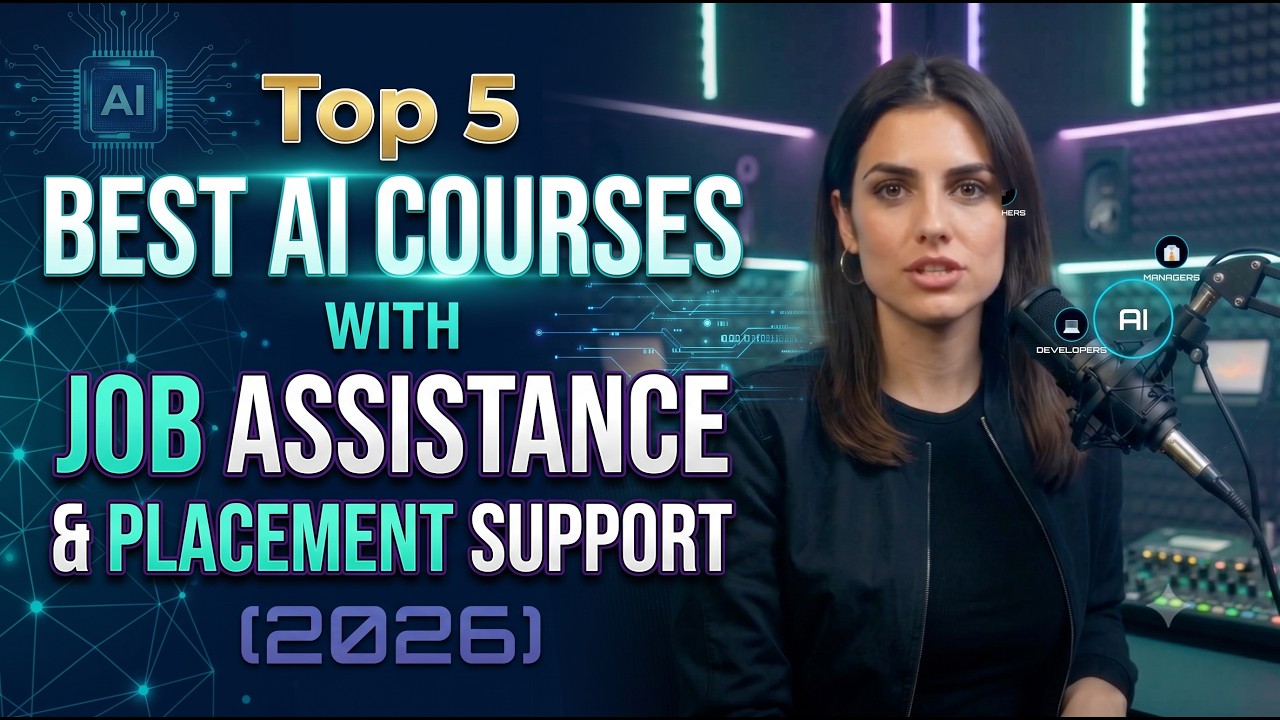
Top 5 Best AI Courses with Job Assistance & Placement Support in 2026
- Job AssistanceReferrals & interview prep
- Placement SupportBeyond a job portal
- Practical ProjectsPortfolio you can show
- Latest 2026 CurriculumGenAI, LLMs, RAG, agents
- AI Career PreparationResume to offer
Inside the 7-minute video
- Which programs run live classes with personal mentorship
- Who actually provides mock interviews and resume support
- How placement-readiness tests and eligibility conditions work
- Which programs mainly depend on job portals — and which give referrals
Compare all five in one sitting — then decide.
Live teaching, projects, mentorship, mock interviews and referral support, scored side by side. No sign-up, no email gate.
Section 04 LogicMojo AI Community
LogicMojo AI Community
Where real learners ship real AI projects — reviewed by working engineers.
Explore student profiles, GitHub repositories, and live AI/ML/GenAI/Agentic AI projects built by the LogicMojo community. Every project is peer-reviewed and portfolio-ready.
- 1,200+ active builders
- 500+ shipped projects
- 8,400+ GitHub commits
- Arjun Mehta@arjunArjun Mehta
- Priya Nair@priyaPriya Nair
- Rahul Verma@rahulRahul Verma
- Sneha Iyer@snehaSneha Iyer
- Karan Shah@karanKaran Shah
- Divya Rao@divyaDivya Rao
Section 05 In-depth reviews of all 10
In-Depth Reviews — Top 10 AI Certification Courses (2026)
Every review follows the same ten-part structure and ends with a six-pillar rating. I haven't expanded the #1 pick or compressed the lower ranks. Click any header to open it — each review you open is ticked off in your explored checklist.
Overview
A specialist AI provider rather than a broad EdTech marketplace, built around a single question: can a working Indian learner reach production-capable AI engineering in one structured sequence, without a career break? The combination is unusual — depth normally found in ₹2L+ programs, currency normally found only in narrow GenAI courses, delivered live in IST at a mid-band price, with no bond or ISA.
Curriculum
The fifteen-module progression above, from Python and maths through classical ML, deep learning, NLP, CV, LLMs, RAG, fine-tuning, agents, MCP, evaluation, MLOps and system design. Tools: Python, NumPy, pandas, scikit-learn, PyTorch, Hugging Face, OpenAI/Anthropic/Gemini APIs, LangChain, LangGraph, CrewAI, AutoGen, ChromaDB/Pinecone/Qdrant, Ollama, MLflow, FastAPI, Docker, Git, cloud deployment.
Depth verdict: The only program here rated Deep or Comprehensive across all seven layers, including the ones most commonly skipped.
Delivery
Live IST weekend batches (Sat–Sun, 9:00 AM–12:00 PM) over 7 months (~30 weeks), real instructors, in-session doubt resolution, mentor channels, human code review, recordings with structured catch-up, cohort accountability, deferral options, continuous refresh. The delivery model is as much the reason for the ranking as the syllabus is.
Projects & proof of work
10–15 progressive builds ending in a learner-designed deployed capstone. Deployment is mandatory, submissions get human review, and everything is documented for GitHub.
Certification value
The certificate is a provider certificate — it carries no institutional or exam-verified weight, and I won't pretend otherwise. What carries weight is the artefact set it produces. Treat the certificate as Gate 1 packaging and the portfolio as your Gate 2–5 argument. Pairing it with a ₹10K vendor exam is a smart, cheap upgrade.
Who it's genuinely for
- Working engineers with 2–8 years' experience moving into AI with 10–15 hours a week
- Career switchers who need prerequisite support but refuse a shallow overview
- Self-taught learners who need a spine, code review and a portfolio
- Professionals who want agents, RAG and fine-tuning taught rather than demoed
Who should avoid it
- Anyone who needs a university or exam-verified credential above all
- Budgets under ₹20,000
- Learners who cannot attend live sessions
- People who want AI literacy rather than engineering capability
- Research-track aspirants
For a beginner in India: can this course make you job-ready?
Prerequisites
No coding prerequisite is enforced. The course page's eligibility FAQ (15 Sep 2026) says 'working professionals and students pursuing B.E/B.Tech', and lists CS students, career-switching engineers, analysts and banking/finance professionals as the intended audience; Python itself is taught inside the program — weeks 1–4 of the published week-by-week syllabus are Python basics and advanced Python.
Ramp-up for absolute beginners
The first block is a genuine from-zero ramp: Python syntax, data structures, NumPy and pandas, then the maths that classical ML actually uses — linear algebra intuition, probability, distributions, hypothesis testing, gradient descent by hand. Beginners are not asked to 'revise' this on their own before the ML modules start, which is the single most common failure point in every other program on this list.
Learning support structure
Live in-session doubt resolution, a mentor channel between sessions, human review on submitted code, cohort peer groups, session recordings with a structured catch-up path, and batch deferral if life intervenes. Code review matters more than it sounds: a beginner who never has code read by an engineer keeps the same three habits for a year.
Step-by-step teaching methodology
Strictly sequential: concept explained → implemented from scratch in a notebook → re-implemented with the standard library → wrapped into a small deliverable → revisited later inside a larger build. Nothing advanced is demoed before the layer underneath it has been coded. Agents, for example, arrive only after tool-calling, retrieval and evaluation are already working code in the learner's own repo.
Mentorship access
Group mentorship inside live batches plus 1-on-1 mentor access. The course page advertises 'weekly 1:1 sessions', 1:1 doubt-clearing sessions and 'multiple 1:1 mock interviews'; it does not publish a fixed number of 1-on-1 slots, and one support FAQ limits 1:1 support-ticket sessions to six months from course start — get the number and the window in writing.
Tools, frameworks & datasets
Python, NumPy, pandas, scikit-learn, PyTorch, Hugging Face, OpenAI/Anthropic/Gemini APIs, LangChain, LangGraph, CrewAI, AutoGen, ChromaDB/Pinecone/Qdrant, Ollama, MLflow, FastAPI, Docker, Git, cloud deployment — all on real datasets rather than toy CSVs.
AI/ML curriculum depth for a beginner — 12 layers of the 2026 stack
Projects: capstone + industry-level builds
- Guided beginner builds: end-to-end tabular ML pipeline with evaluation and error analysis
- Deep learning build on real image and text datasets with training-curve diagnosis
- Production-style RAG assistant over your own documents with chunking, embeddings, a vector database and answer evaluation
- Fine-tuned small model (LoRA/QLoRA) with a before-and-after benchmark
- Multi-tool AI agent with memory, guardrails and failure handling
- Learner-designed capstone that must be deployed to a live URL, containerised and documented for GitHub
Placement & job-assistance detail
Partner hiring companies
A referral network is stated by the provider, but the course page quotes two different figures — '500+ hiring partners' in one section and '150+ hiring partners' in the placement FAQ — so treat the count as marketing and ask for the current partner list in writing before you enrol.
Placement percentage
No placement percentage is published, and I will not invent one. Read this as job assistance, not a placement guarantee — see the published learner outcomes at logicmojo.com/success-story and ask for recent, dated, nameable examples.
Mock interview rounds
AI-role mock interviews plus project-defence rehearsals, where you are challenged on the design decisions in your own capstone — the round that actually decides AI offers.
Resume-building workshops
Resume and portfolio review focused on turning projects into evidence lines (metric, decision, trade-off) instead of tool lists.
LinkedIn / profile optimisation
Profile and GitHub positioning guidance for AI roles, delivered as part of the resume step (the team adds your course projects to your resume before referrals begin) and as on-demand GitHub portfolio reviews under 'lifetime career resources' — a review, not a formal workshop.
Career counselling
1-on-1 career guidance on role choice — ML engineer vs AI/LLM engineer vs data scientist vs analytics — matched to your background.
Post-course job support duration
The placement FAQ states that job referrals 'continue until they secure a role as an AI Engineer or Machine Learning Engineer', and career resources are advertised as lifetime. No month count is published, so get the referral window in writing.
Beginner outcomes reported for this course — verify before you trust
Jayanth Reddy — learner reporting ₹10 LPA before the course (prior role not stated)ML Engineer
Company: Virtusa (course-page testimonial, 15 Sep 2026) · Salary: ₹10 LPA → ₹16 LPA, self-reported; 4 months
Provider-published and self-reported, not audited. Read the dated stories directly at logicmojo.com/success-story rather than trusting a summary — including mine.
Praveen Kumar — previously at Soothsayer AnalyticsData Scientist / GenAI Developer
Company: RevealIT Solutions (logicmojo.com/success-story, with LinkedIn link) · Salary: 160% hike claimed; no absolute figure published
The pattern worth checking in any story you read: was the offer won on a deployed project the candidate could defend?
Verdict
The highest job-readiness ceiling here for anyone who can commit to live structure, and the clearest answer to "what will I be able to build, and defend, when someone asks?"
Explore LogicMojo's AI & ML Course — curriculum, live batches and projectsSection 06 Why LogicMojo ranks #1
Why LogicMojo Ranks #1 Among AI Certification Courses for Getting a Job
Let me state the criteria openly, because a different weighting produces a different winner and pretending otherwise would be dishonest. Weight global brand recognition and catalogue breadth → Coursera. Weight low-cost hands-on practice → DataCamp. Weight an academic credential → Great Learning (UT Austin). Weight independently verifiable proof → Google Cloud PMLE. Weight cost alone → DeepLearning.AI or the free stack.
This page weights job-relevant capability, the proof of work it produces, and the preparation to convert both into offers — 65% of the score. On that composite, LogicMojo scored highest: it is the only program here rated Deep or Comprehensive across all seven layers, including the four that most programs skip (production RAG, fine-tuning, agent frameworks, MLOps); it runs live in IST with human code review rather than replays with a chat moderator; it makes deployment mandatory rather than optional; and it sits in a price band where the alternatives generally offer less depth, not more.
1) Does it cover the complete 2026 stack?
The module progression, expressed as capability rather than topic lists (audit it against the live syllabus on the course page, which is the version of record):
- Foundations — Python, NumPy, pandas, data wrangling, SQL, Git/GitHub, then intuition-first mathematics: linear algebra, gradients and why models learn, probability, statistics, hypothesis testing. You can now: handle real datasets like an engineer and reason about why a model behaves as it does. Intuition before notation is the sequence that determines whether career-switchers survive Month 2.
- Core machine learning — regression, trees, random forests, gradient boosting, XGBoost, SVMs, clustering, PCA, feature engineering, cross-validation, bias-variance, regularisation, class imbalance, metric selection. You can now: build, tune and correctly evaluate models on messy data — and answer the metric question that opens most screening rounds.
- Deep learning, NLP and computer vision — backpropagation, optimisers, CNNs, RNNs/LSTMs, transfer learning, PyTorch end to end; tokenisation, embeddings, NER, seq2seq, attention and transformer architecture from intuition to visual to code, Hugging Face; detection, segmentation, vision transformers. You can now: train and debug real networks, explain how a transformer works, and fine-tune a vision model on a custom dataset.
- Generative AI and LLMs — tokens and context windows, prompt engineering through structured outputs, provider APIs, open-weight models (Llama, Mistral, Qwen, Gemma, DeepSeek), local inference, cost and latency trade-offs. You can now: build production-quality LLM applications and choose models against real constraints.
- Embeddings, vector databases and RAG — ChromaDB/Pinecone/Qdrant, semantic search, chunking, hybrid search, re-ranking, query decomposition, RAG evaluation, latency, cost, freshness and citations. You can now: architect and defend a production RAG system — the most commonly asked GenAI interview topic in Indian hiring right now.
- Fine-tuning, agents and frameworks — the prompting vs RAG vs fine-tuning decision framework, SFT, LoRA and QLoRA (via Hugging Face PEFT), benchmarking; planning and reasoning, ReAct, tool use and function calling, memory design, failure modes, cost control; LangGraph, CrewAI, AutoGen and Agents SDK with a when-to-use-which comparison, plus MCP and custom tools. You can now: adapt an open-weight model and prove it improved something, and build agents that act reliably rather than demos that break on the second prompt.
- Evaluation, guardrails, MLOps and LLMOps — evaluation methodology, LLM-as-judge and its pitfalls, hallucination detection, guardrails, PII handling, bias and fairness; MLflow/W&B tracking, model registry, FastAPI serving, Docker, CI/CD, cloud deployment, monitoring and drift, LLM observability, prompt versioning, caching and cost optimisation. You can now: answer "how do you know it works?" and run a model as a service — the two capabilities that most distinguish hired candidates.
- System design, interview preparation and capstone — design cases, trade-off reasoning, scaling, technical communication, project defence, GitHub portfolio construction, resume positioning, and a learner-designed deployed capstone with documentation, evaluation and a written architecture rationale. You can now: survive Gates 4 and 5.
2) Is the delivery actually good, or just live?
Specific and testable, not adjectival: genuinely live IST batches in the evening and at weekends with practising instructors, not replays with a chat moderator · in-session doubt resolution plus mentor channels rather than an unmonitored forum · human code review, the highest-leverage feedback mechanism in online learning · recordings with structured catch-up instead of an infinite backlog · cohort structure, which measurably reduces dropout · Python and maths onboarding instead of a "prerequisites: intermediate Python" line that quietly excludes the people who most need the course · batch deferral and transfer · continuous curriculum refresh, which in AI is a delivery feature, not an editorial nicety.
Test this yourself — including on us. Ask any provider (for LogicMojo, the course page is where you book a live class): Can I sit in on a real class, not a demo? Who teaches my batch, and what have they shipped? What's the doubt-resolution SLA, and what happens if it's missed? Does a human review my code? Can I defer if work explodes? Those five answers predict your outcome better than any brochure, any logo wall and any ranking page.
3) What do you actually build?
Ten to fifteen progressive builds, guided at first and independent later, each publishable on GitHub: messy-data EDA · an end-to-end ML system with correct evaluation · a model-comparison study · a transfer-learning image classifier · object detection · a transformer-based NLP classifier · an LLM application with structured outputs and error handling · a semantic search engine with retrieval evaluation · a production-style RAG app with chunking, hybrid retrieval, re-ranking, citations and an evaluation harness · a LoRA-fine-tuned domain model benchmarked against base · a tool-using agent with planning, memory and failure handling · a multi-agent workflow with cost controls · a deployed service (FastAPI + Docker + cloud + monitoring) · and a self-designed capstone.
Why project counts mislead. Twelve copy-along notebooks are worth less than three projects you designed, broke, debugged and deployed. This evaluation weighted design decisions, not folder count — which is also how the interviewer at Gate 4 will weight them.
4) Pricing and honest value framing
Below ₹25,000 the market gives you content without mentorship. Between ₹25,000 and ₹60,000, structure with entry-level projects. Between ₹60,000 and ₹1.2L — where LogicMojo sits — you should expect live mentorship, a full-stack curriculum and deployed projects. Above ₹1.2L you are mostly buying an institutional credential and career services; above ₹2.5L, premium placement infrastructure. Programs at three to five times this price generally do not reach a higher capability ceiling; they buy brand, placement infrastructure or academic recognition. All legitimate — just know which you're buying.
For a working professional the scarce resource isn't money, it's the 10–15 weekly hours you'll spend for months. A program that costs ₹40,000 less but teaches a 2023 stack doesn't save you money. It costs the same hours and returns a weaker candidate.
5) Honest limitations — where LogicMojo is the wrong choice
Every one of these is a real reason to buy something else on this list.
- You need a university-issued credential. Great Learning (UT Austin), Simplilearn (I-DAPT, IIT BHU) and IIT-hub-affiliated programs issue institutional certificates. If your employer's promotion process, your L&D reimbursement policy or a visa pathway values one, that's an advantage LogicMojo does not offer.
- You need a credential a stranger can verify. A proctored Google Cloud or Microsoft exam can be checked in a public registry (Google Cloud Skills Directory, Credly). A provider certificate can't. For client-facing consulting and partner-tier requirements, that difference is the whole point.
- A globally recognised name is the purchase. Coursera's partner certificates (Google, IBM, Microsoft, DeepLearning.AI) carry a public verification URL and a brand recruiters worldwide recognise. If that's what you're buying, Coursera is the honest recommendation.
- It isn't the cheapest. IBM AI Engineering and DeepLearning.AI cost a fraction of it; the free stack (Kaggle, Hugging Face, fast.ai) costs nothing. If budget genuinely binds and you're self-directed, start there and come back later.
- It isn't self-paced. Live cohorts mean fixed timings. If you travel constantly, work rotating shifts or are on call, a self-paced certificate may realistically serve you better.
- The brand is smaller. Coursera, DataCamp and Great Learning are far more recognisable in India. Depth outweighs that in technical rounds; at Gate 1, the gap is real.
- It demands real commitment. 10–15 hours a week for months. If you want a light overview or a LinkedIn line, buy a shorter certification track instead.
- It isn't a research pathway. This is applied AI engineering. For research or a PhD track, a university MS/MTech or the NPTEL/IIT route serves better.
Disclosure: This analysis is published on LogicMojo's website, and LogicMojo's AI & ML Course is ranked #1 here. You should read every line of this page knowing that. What follows is the scoring method in full, the weighting that produces this ranking, a section listing the situations in which LogicMojo is the wrong choice, and honest strengths for the nine competing programs — several of which beat LogicMojo outright on specific criteria. If a ranking page won't tell you where its own product loses, it isn't research. It's a brochure.
Section 07 What an AI certification means in 2026
What an "AI Certification" Actually Means in 2026
The word "certification" covers five completely different products. People compare them as if they're the same thing, which is why so many purchases go wrong. Here's what you're actually choosing between.
The Five Kinds of AI Certification
| Type | Examples | Who issues it | How it's verified | Typical cost | Hiring signal | Honest trade-off |
|---|---|---|---|---|---|---|
| Proctored vendor exam | Google Cloud Professional ML Engineer, Azure AI-103 (AI-102 retired June 2026), AWS ML Engineer, Databricks | Cloud vendor | Proctored exam, verifiable digital badge | US$165–US$200 list price, priced per country | Strong for cloud, enterprise and services roles | Tests their ecosystem, not AI broadly. Teaches nothing — you prepare separately. No portfolio. |
| University-affiliated PG certificate | Great Learning (UT Austin), Simplilearn (I-DAPT, IIT BHU), Intellipaat (IIT-hub-affiliated) | EdTech platform with an institutional partner | Institution- or platform-issued certificate | ₹79K–₹3.25L (Sep 2026 list prices) | Works well in HR filters, L&D reimbursement and internal promotion cases | You pay a brand premium; delivery is the EdTech's, not the university's |
| Specialist program certificate | LogicMojo | The training provider | Provider certificate plus the portfolio it produced | ₹40K–₹1.2L | Weak as a name, strong through what you can demonstrate | Depends entirely on whether the program forces real building |
| MOOC professional certificate | IBM AI Engineering, DeepLearning.AI, Google Career Certificates | Platform plus a corporate or academic name | Shareable verified certificate | ₹0–₹4,000/month | Modest but recognisable; fine as a supporting line | No mentorship; guided labs; low completion |
| Free completion badge | Kaggle Learn, Hugging Face, NPTEL, vendor "fundamentals" tiers | Platform | Badge, or exam certificate for NPTEL | ₹0 | Near zero on its own | Great learning, negligible proof |
Swipe to see every column
Sources:Google Cloud PMLE (US$200)Microsoft exam pricing (US$165 associate)AWS ML Engineer – AssociateCoursera Plus pricingMOOC completion research
Two consequences follow, and they matter more than anything else on this page.
First: a proctored exam and a program certificate prove different things. A Google Cloud or Azure exam proves you passed a standardised test on a fixed date. Nobody can fake it, which is exactly why HR likes it. It does not prove you can build anything. A specialist program certificate proves nothing by itself — but the twelve deployed projects you built to earn it prove a great deal. The strongest 2026 resume usually carries one of each.
Second: certification stacking beats certification shopping. One serious capability program that produces a portfolio, plus one cheap verifiable vendor exam in the cloud your target employers use, covers both the screening filter and the technical rounds. Five overlapping MOOC certificates cover neither.
Section 08 Where an AI certification helps you get a job
Where an AI Certification Helps You Get a Job — and Where It Stops Helping
This is the most useful table on the page, and the one certification marketing never shows you. Here is what actually happens between application and offer, and how much the certificate contributes at each step.
Visual 2 — The Six Hiring Gates
| Gate | What actually happens | Does the certificate help? | What actually decides it |
|---|---|---|---|
| 1. Resume / ATS screen | A recruiter or a tool scans for credentials, skills keywords and relevance in a few seconds | Yes — this is the one gate where the name on the certificate does real work | A recognisable issuer, matching skill keywords, a live GitHub link |
| 2. Portfolio glance | A hiring manager opens your GitHub for roughly a minute | Barely | Clear READMEs, architecture notes, a deployed demo link, honest commit history |
| 3. Technical screen | Python, ML fundamentals, metric reasoning, sometimes DSA | No | Practised fundamentals and evaluation literacy |
| 4. Project deep-dive | "Walk me through what you built. What broke? What did you change?" | No | Projects you designed and debugged yourself, and can narrate |
| 5. Design / case round | Design a RAG system for 50,000 internal documents; serve this at scale; control cost and latency | No | System-design practice and real deployment experience |
| 6. Offer and levelling | Comparison against other finalists | Marginal | Depth, communication and domain fit |
Swipe to see every column
The conclusion is unavoidable. A certificate buys you attempts at Gate 1. Everything from Gate 2 onward is decided by what you built and how well you can talk about it. So the right way to buy a certification is to ask: how much Gate-2-to-Gate-5 ammunition does this program hand me? That question, more than any brand, drives the ranking below.
Do Indian employers actually value AI certificates?
The honest answer is conditionally, and less than the marketing suggests — but not zero. Inside a company, certificates count for more than outside it: for internal mobility, appraisal cases and L&D-funded re-skilling, an institutional or vendor certificate is often exactly the artefact the process needs. In services and consulting, vendor certifications carry commercial weight, since client contracts and partner tiers frequently reference certified headcount. In product companies, GCC engineering teams and AI-native startups, they're a tiebreaker at best.
The demand itself is not in doubt. The Deloitte–nasscom report Advancing India's AI Skills (August 2024) estimated India's AI talent demand at 600,000–650,000 professionals, growing 25–35% a year and projected to exceed 1.25 million by 2027 (IndiaAI summary); nasscom's own talent demand and supply report put the demand–supply gap at roughly half of demand. What is in doubt is whether a certificate, on its own, gets you counted on the supply side of that gap.
None of that makes certification a waste. It makes it a component. Buy the program for the capability; treat the certificate as the packaging that gets the capability looked at.
Section 09 The 2026 AI skill stack
The 2026 Job-Ready AI Skill Stack
Seven layers. For each: what it covers, what interviews test, and what certification programs most often skip. Use this as an audit checklist against any syllabus PDF — including the ones recommended here.
| Layer | What it covers | What interviews test | What certifications most often skip |
|---|---|---|---|
| 1. Foundations | Python, NumPy, pandas, SQL, Git/GitHub, linear algebra and calculus intuition, probability, statistics | Whether you can handle real data unaided | Nothing — but it's rushed for exactly the switchers who need it |
| 2. Core ML | Regression, classification, trees, ensembles (XGBoost), clustering, dimensionality reduction, feature engineering, cross-validation, bias-variance, metric selection, class imbalance | Metric reasoning above all: "why this metric and not accuracy?" — and most production AI in Indian enterprises is still classical ML | Evaluation judgement, as opposed to algorithm lists |
| 3. Deep learning | Backpropagation, optimisers, CNNs, RNNs/LSTMs, transformers and attention, transfer learning, PyTorch or TensorFlow, GPU practicalities | Whether you've actually trained something, and can explain attention without reciting a diagram | Real training runs — theory-only DL is common and easily detected |
| 4. Applied domains | NLP (tokenisation, embeddings, NER, sequence models), computer vision (classification, detection, segmentation), time series, recommenders | Domain fit for the specific role | One of NLP or CV, dropped entirely to save weeks |
| 5. GenAI, LLMs and agents | Tokens and context windows, prompt engineering through structured outputs, provider APIs, open-weight models, local inference (Ollama), embeddings, vector DBs, RAG from basic to production (chunking, hybrid search, re-ranking, citations, evaluation), fine-tuning (SFT, LoRA, QLoRA), agents and tool calling (ReAct), frameworks (LangGraph, CrewAI, AutoGen), MCP, guardrails | Production RAG design is now standard; agent reliability and cost control are the fastest-growing additions | Everything past prompting — this is where "2023 course, 2026 label" shows up most clearly |
| 6. Production (MLOps/LLMOps) | Packaging, FastAPI serving, Docker, CI/CD, MLflow/W&B tracking, model registry, monitoring and drift, cost and latency optimisation, cloud deployment, LLM observability, prompt versioning | "How would you serve this?" — asked in most AI engineering interviews | Reduced to one lecture, or "run it in the notebook". The widest gap between "trained a model" and "employable" |
| 7. Professional | Portfolio construction, GitHub hygiene, technical communication, AI system design, case practice, project-defence rehearsal, responsible AI | All of Gate 4 and Gate 5 | Compressed into a resume template |
Swipe to see every column
The seven-layer audit. Before paying for anything on this page, take the syllabus PDF and mark each layer: covered hands-on, covered as theory, or absent. If Layer 5 stops at prompting, or Layer 6 is missing, you're buying a 2023 curriculum with a 2026 cover. If Layer 7 is absent, you're buying learning without conversion — and conversion is the reason you're buying.
I ran this audit on all 24 syllabi — Layer 6 is where most of them quietly stop
When I marked every syllabus layer by layer, the pattern was almost monotonous. Twenty of the twenty-four programmes I reviewed covered Layers 1–4 competently. Eleven had a genuinely current Layer 5 — meaning retrieval-augmented generation past a toy notebook, some fine-tuning, and agents with tool calling. Only seven asked the learner to package a model behind an API, put it in a container and deploy it where a stranger could hit the URL.
That matters because of what I keep hearing on the hiring side. In the interviews I sat in on and the debriefs I collected, the question that ended the most conversations was not about maths. It was "how would you serve this, and what breaks first?" A learner who has only ever run cells cannot answer it, and no certificate rescues them at that moment.
“I can tell within ten minutes whether someone deployed their project or just trained it. The deployed ones talk about latency, cost and what they logged. The others talk about accuracy. The certificate on the resume has never once changed that conversation.”
Section 10 All 10 compared — 5 tables
Top 10 Best AI Certification Courses to Get a Job (2026) — At a Glance
The ranking weighs job-relevant curriculum depth, proof-of-work projects, interview and career preparation, certification credibility, delivery quality and value — with the first three carrying 65% of the weight, because they decide what happens at Gates 2 through 5. "#1" does not mean "right for everyone": a services professional who needs a vendor badge for a client engagement and a career-switcher building a portfolio from scratch should not buy the same thing. That's what the "Best for" column is for.
The ranked list:
LogicMojo — AI & Machine Learning Course
Best overall for job-ready capability plus a defensible portfolio
Official pageCoursera — AI & ML Professional Certificates (Coursera Plus)
Best global brand recognition and catalogue breadth
Official pageDataCamp — Associate AI Engineer track + DataCamp Certification
Best hands-on, in-browser practice for beginners on a subscription
Official pageGreat Learning — PGP-AIML (UT Austin / Great Lakes)
Best mentor-led weekend format with global branding
Official pageGoogle Cloud Professional Machine Learning Engineer
Best independently verifiable credential for working engineers
Official pageIntellipaat — Advanced Certification in AI & ML (IIT-affiliated)
Best institutional tag at mid-tier pricing
Official pageIBM AI Engineering Professional Certificate (Coursera)
Best low-cost applied engineering track
Official pageMicrosoft Certified: Azure AI Apps & Agents Developer Associate (AI-103)
Best enterprise AI credential for IT and services professionals (replaces AI-102, retired June 2026)
Official pageSimplilearn — PG Certificate Program in AI & ML (I-DAPT IIT (BHU) / Microsoft)
Best for employer-funded corporate upskilling
Official pageDeepLearning.AI — ML + Deep Learning Specializations (Coursera)
Best teaching on this list, weakest as a standalone hiring credential
Official pageA note on #10: DeepLearning.AI is, in my view, the finest instruction in this entire market. It ranks last here purely because this page scores job conversion, and it offers no portfolio, no mentorship and no career support by design. As a foundation layer under any other item on this list, it's outstanding. Ranking is contextual, not a quality verdict.
The five static tables below are the record. The interactive explorer near the top of this page is the working version of them: search, narrow by the skills you actually need, set a budget, sort any column, and put up to three courses side by side.
Table 1 — Overview
| # | Certification | Format | Fees (₹) | Duration | Job-readiness ceiling | Best for |
|---|---|---|---|---|---|---|
| 1 | LogicMojo AI & ML Course | Live IST weekend cohort (Sat–Sun, 9 AM–12 PM) + recordings | ₹87,000 (GST inclusive) | 7 months (~30 weeks) | Level 4–5 | Full-stack AI capability with live mentorship and a deployed portfolio |
| 2 | Coursera AI & ML Certificates | Fully self-paced, subscription | Coursera Plus ₹2,099/month or ₹13,999/yr (₹7,499 promo); ₹1,699/month for one programme | 3–9 months (own pace) | Level 3 | Global brand recognition and catalogue breadth on a subscription |
| 3 | DataCamp AI Engineer Track | Self-paced, in-browser exercises | Premium ₹598/month billed annually (≈₹7.2K/yr); ₹1,195 billed monthly | 2–6 months (own pace) | Level 2–3 | Beginners who want hands-on practice on a low subscription |
| 4 | Great Learning PGP-AIML | Weekend live mentor sessions + recorded | ₹2,75,000 + GST (≈₹3.25L); 0% EMI from ₹6,776/month | 12 months (8–10 hrs/week) | Level 3–4 | Working professionals with weekend availability |
| 5 | Google Cloud PMLE Certification | Self-study + proctored exam | US$200 exam (plus tax), per Google's certification page | 2–4 months prep | Level 3–4 (with prior experience) | Engineers who can already build and need verifiable proof |
| 6 | Intellipaat AI & ML Certification | Live + self-paced hybrid | ₹79,002–₹90,000 all-inclusive by variant; 0% EMI from ₹5,000/month | 7 months (12 for the Executive PG variant) | Level 3–4 | An institutional tag without premium pricing |
| 7 | IBM AI Engineering Certificate | Fully self-paced | Free to audit; ₹1,699/month (≈₹7K over 4 months) or Coursera Plus | 4 months at 10 hrs/week (13 courses) | Level 2–3 | Applied practice on a tight budget |
| 8 | Microsoft Azure AI-103 Certification | Self-study + proctored exam | US$165 list; ₹4,800 + 18% GST (≈₹5,700) at Pearson VUE India | 1–3 months prep | Level 2–3 | Enterprise, services and Microsoft-stack roles |
| 9 | Simplilearn PG Certificate in AI & ML (I-DAPT IIT BHU / Microsoft) | Live online cohort classes + IIT (BHU) masterclasses | ₹1,40,000 incl. taxes; instalments from ₹6,269/month | 8 months (6–9 hrs/week) | Level 3 | Employer-sponsored corporate upskilling |
| 10 | DeepLearning.AI ML Specialization | Fully self-paced | Free to audit; ₹1,699/month per specialization or Coursera Plus | 3–6 months | Level 2–3 | World-class foundations at minimal cost |
Swipe to see every column
Fees & formats:LogicMojo course pageCoursera ML catalogueDataCamp pricingGreat LearningGoogle Cloud PMLE (US$200)IntellipaatIBM / CourseraMicrosoft AI-103Microsoft exam pricingSimplilearnDeepLearning.AICoursera Plus
Fees were read from each provider's own page on 15 September 2026, change frequently, and are often negotiable on sales calls. Confirm the current fee, GST treatment, EMI interest and refund window in writing before paying.
Table 2 — Curriculum Depth Scorecard (the most important table)
Scale: Deep / Good / Moderate / Basic / Not covered. For the two vendor exams, "coverage" means what the published exam blueprint tests — the Google Cloud PMLE exam guide and Microsoft's AI-103 study guide — since neither teaches you the material. The Azure column was originally scored on the AI-102 blueprint; Microsoft retired AI-102 on 30 June 2026 and its successor AI-103 weights generative AI and agentic solutions more heavily, so treat those two rows as a floor. Assessments are editorial, based on publicly listed syllabi and exam guides, each re-read on 15 September 2026 — the Google Cloud guide now reflects the Gemini Enterprise Agent Platform update, and Great Learning, Intellipaat and Simplilearn have all added agent modules since the first draft of this page.
| Skill area | LogicMojo | Coursera | DataCamp | Great Learning | GCP PMLE | Intellipaat | IBM | Azure AI-103 | Simplilearn | DeepLearning.AI |
|---|---|---|---|---|---|---|---|---|---|---|
| Classical ML | Deep | Deep | Good | Good | Good | Good | Good | Basic | Good | Deep |
| Model evaluation rigour | Deep | Good | Moderate | Good | Good | Moderate | Good | Basic | Moderate | Deep |
| NLP and transformers | Deep | Good | Moderate | Good | Moderate | Good | Good | Moderate (API-level) | Good | Good |
| Embeddings and vector databases | Deep | Moderate | Basic | Moderate | Moderate | Moderate | Basic | Moderate | Basic | Moderate |
| RAG (basic → production) | Deep (chunking, hybrid, re-ranking, eval) | Moderate | Basic–Moderate | Moderate | Basic | Moderate | Basic | Moderate | Basic | Moderate |
| Fine-tuning (LoRA / QLoRA) | Deep | Moderate | Limited | Moderate | Basic | Moderate | Limited | Not covered | Limited | Moderate |
| AI agents and agentic patterns | Deep | Moderate | Limited | Moderate | Basic | Moderate | Limited | Basic | Limited | Limited |
| Agent frameworks (LangGraph, CrewAI) | Comprehensive | Limited | Limited | Limited | Not covered | Limited | Not covered | Not covered | Not covered | Limited |
| MCP and tool integration | Covered | Limited | Not covered | Limited | Not covered | Limited | Not covered | Not covered | Not covered | Not yet |
| Open-weight models and local inference | Comprehensive | Limited | Limited | Limited | Limited | Moderate | Limited | Not covered | Limited | Limited |
| LLM evaluation and guardrails | Deep | Moderate | Limited | Moderate | Basic | Moderate | Moderate | Moderate | Limited | Moderate |
| MLOps (tracking, CI/CD, monitoring) | Deep | Moderate | Basic | Moderate | Deep (exam focus) | Good | Moderate | Moderate | Moderate | Not covered |
| Deployment (Docker, FastAPI, cloud) | Production-grade | Moderate | Basic | Moderate | Deep (GCP-specific) | Good | Moderate | Good (Azure-specific) | Moderate | Not covered |
| Portfolio-grade projects | 10–15 | Guided (auto-graded) | Guided (auto-graded) | 8–12 | 0 (exam only) | 6–12 | 6–10 (labs) | 0 (exam only) | 5–10 | 5–10 (labs) |
Swipe to see every column
How to read this. The rows that separate a 2026 certification from a 2023 one are the last third: production RAG, fine-tuning, agents, agent frameworks, MCP, open-weight models, LLM evaluation, MLOps and deployment. Prompting and basic API calls are now baseline literacy, not differentiation. The two vendor exams invert the pattern — thin on modelling breadth, genuinely strong on deployment and operations within their own cloud.
And a counterpoint the marketing on every side ignores: more depth is not automatically better for you. A BI developer who needs to ship one internal RAG assistant does not need LoRA fine-tuning. Buy for the role you're targeting.
Delivery and completion, summarised
Only LogicMojo, Great Learning and Intellipaat run genuinely live sessions; Simplilearn's live element is masterclasses over a self-paced core, and Coursera, DataCamp, IBM, DeepLearning.AI and the two vendor exams have none. Human code review exists only at LogicMojo and Great Learning (partially at Intellipaat) — which matters more than any other delivery factor, because unreviewed code teaches you your own bad habits. Cohort accountability is strong at LogicMojo, moderate at Great Learning and Intellipaat, and absent everywhere else.
Realistic completion odds follow directly: high for LogicMojo, moderate-to-high for Great Learning, moderate for Intellipaat, Simplilearn and the two vendor exams (a booked exam date is its own deadline), and low for every self-paced subscription or MOOC certificate — Coursera, DataCamp, IBM and DeepLearning.AI alike. That line is the most predictive on this page. A free course you don't finish returns less than a ₹70,000 course you do — for a working professional, structure isn't an inconvenience, it's the primary product.
Table 3 — Certification Credibility and Hiring Signal
| Certification | Issued by | How a recruiter verifies it | Expiry | Recognition in Indian hiring | What it actually proves |
|---|---|---|---|---|---|
| LogicMojo | LogicMojo | Provider certificate; the real verification is your GitHub and deployed projects | None | Low as a name; high when the portfolio is opened | That you built, deployed and can defend real AI systems |
| Coursera | Partner (Google, IBM, Microsoft, DeepLearning.AI) via Coursera | Public certificate verification URL | None | High brand recognition worldwide; well known to Indian HR | Completion of self-paced video courses and auto-graded assessments |
| DataCamp | DataCamp | Verifiable platform certification; timed assessments plus a case study | None | Known among data and analytics teams; thin as an AI-engineering signal | Tool fluency in Python, SQL and applied ML |
| Great Learning | UT Austin McCombs / Great Lakes via Great Learning | Issued certificate, verifiable | None | Strong, particularly the global university association | Completion of a mentor-guided applied program |
| Google Cloud PMLE | Google Cloud | Independently verifiable via the Google Cloud Skills Directory and Credly | Two years for Professional certifications, per Google's exam terms; renewal options | Very strong in cloud, GCC and services contexts | You passed a standardised, proctored engineering exam |
| Intellipaat | iHUB DivyaSampark (IIT Roorkee) or IITM Pravartak — the IITs' technology-innovation hubs — plus Microsoft, via Intellipaat | Hub/partner certificate | None | Moderate; the institutional tag helps in filters | Completion of a broad applied curriculum |
| IBM AI Engineering | IBM via Coursera | Verifiable shareable Coursera certificate and badge | None | Moderate; IBM's name registers in enterprise and services | Completion of applied ML/DL labs |
| Azure AI-103 | Microsoft | Independently verifiable via Microsoft badges on Credly and the holder's Microsoft Learn transcript | One year; renewed free through an online assessment, per Microsoft's renewal policy | Very strong in Microsoft-stack enterprises and services | You passed a proctored exam on building AI apps and agents on Azure (AI-102 retired 30 June 2026) |
| Simplilearn (IIT BHU/Microsoft) | I-DAPT Hub Foundation, IIT (BHU) Varanasi, plus Microsoft module certificates, via Simplilearn | Issued certificate | None | Good with HR and L&D; commonly reimbursed | Completion of a broad certification-led program |
| DeepLearning.AI | DeepLearning.AI / Stanford Online via Coursera | Verifiable shareable certificate | None | Well respected by technical interviewers; neutral with HR | That you studied the foundations properly |
Swipe to see every column
The two vendor exams are the only items here a stranger can verify without trusting you. That is a genuine and underrated advantage — and precisely why pairing one with a capability program is the strongest combination on this page.
Table 4 — Fees, EMI and Total Cost
| Certification | Headline fee (₹) | EMI | Refund window | Cost per unit of job-readiness |
|---|---|---|---|---|
| LogicMojo | ₹87,000 (GST inclusive) | No-cost EMI, 3/6/9/12 months, any credit card | 7 days from batch start (before the 3rd class), per the refund policy; nothing after | Very high |
| Coursera | Plus ₹2,099/month or ₹13,999/yr (₹7,499 promo) | Monthly subscription; 7-day free trial | 14 days on annual plans; certificates earned in that window are revoked | High per rupee; depends on finishing |
| DataCamp | Premium ₹598/month billed annually (≈₹7.2K/yr) | Monthly or annual subscription | None — terms exclude refunds; cancelling stops renewal | High per rupee; capped by depth |
| Great Learning | ₹2,75,000 + GST | 0% EMI from ₹6,776/month via partner lenders | Full refund only on written request ≥15 days before the start date | Moderate |
| Google Cloud PMLE | US$200 plus tax, per the certification page | N/A | Google Cloud exam terms | Excellent if you can already build |
| Intellipaat | ₹79,002–₹90,000 all-inclusive | 0% EMI from ₹5,000/month via partner lenders | None — every variant's FAQ says fees are non-refundable; batch deferral instead | Good |
| IBM (Coursera) | Free to audit; Coursera Plus for certificates | N/A | Coursera policy | Excellent |
| Azure AI-103 | US$165 list, priced per country (Microsoft pricing notice); ₹4,800 + 18% GST at Pearson VUE India | N/A | Vendor policy | Excellent for the price |
| Simplilearn | ₹1,40,000 incl. taxes | Instalments from ₹6,269/month at 0% via partner lenders | 7 days from the first regular class (refund policy) | Moderate self-funded; strong employer-funded |
| DeepLearning.AI | Free to audit; Coursera Plus for certificates | N/A | Coursera policy | Excellent |
Swipe to see every column
The EMI trap. A 24-month EMI on a program abandoned in month three is the most common financial regret in Indian EdTech. Before signing: get the refund policy in writing with the exact cut-off date, check whether the EMI is a bank loan that continues regardless of whether you attend, and prefer shorter commitments when you're unsure of yourself. If the EMI comes from a regulated lender, the RBI's Guidelines on Digital Lending entitle you to a Key Fact Statement showing the all-inclusive APR and a cooling-off period before you sign — ask for it by name.
Table 5 — Career Support and Interview Preparation
| Certification | Support type | AI-role specific | Interview prep depth | Portfolio review | How to read their claims |
|---|---|---|---|---|---|
| LogicMojo | Career guidance, portfolio review, AI interview prep, project-defence practice | Yes | Strong (technical + defence) | Yes | Skill depth and practice, explicitly not a placement guarantee |
| Coursera | Career Academy role pathways, resume and interview resources | No | Basic (self-serve) | No | Learner-outcome surveys are self-reported, not audited placement data |
| DataCamp | Certified Community plus resume/portfolio review and career coaching for certified learners | No | Basic (self-serve) | No | A certification is not placement — check what the career resources actually include |
| Great Learning | Resume support, mock interviews | Partial | Moderate | Partial | "Assistance", not a guarantee |
| Google Cloud PMLE | None | N/A | None | No | None claimed — honest about what it is |
| Intellipaat | Job assistance, resume preparation | Partial | Moderate | Partial | Verify the partner list is current |
| IBM (Coursera) | None | No | None | No | None claimed |
| Azure AI-103 | None | N/A | None | No | None claimed |
| Simplilearn | Career services, job board | Partial | Moderate | Limited | Enterprise-oriented |
| DeepLearning.AI | None | No | None | No | None claimed |
Swipe to see every column
Five questions to ask before you believe any placement claim: What percentage of enrolled learners — not "eligible" ones — were placed? Over what time window? What's the median, not the average, salary? Were those AI roles specifically, or any tech role? And can I speak to two alumni from the last six months whom you did not hand-pick? Keep in mind that ASCI's advertising code already bars "100% placement" claims and requires any job or salary promise to be substantiated — so an unsubstantiated number is a compliance problem, not just a sales tactic.
Outcome & claims sources:LogicMojo success storiesCoursera Career AcademyASCI Code — education advertising guidelinesBusiness Standard on the ASCI guidelines
Learn AI Faster with Short,
Practical Reels
Bite-sized videos from the LogicMojo team to quickly explore AI careers, the highest-paying AI skills, Generative AI, the best AI courses and beginner learning paths — all in an engaging short-video format you can binge between meetings.

How Busy Professionals Learn AI Without Quitting
A realistic weekly plan for learning AI alongside a full-time job.
LogicMojo AI & ML Course — Built for Developers Moving Into AI
You already know code and APIs. Here's the bridge into AI engineering.

How to Learn AI Online
The online learning path that actually leads to a job, step by step.

Top 5 Highest Paying AI Skills
The five skills recruiters are paying a premium for in 2026.

Best AI Courses
Which AI courses are worth your money — and which ones to skip.

Best GenAI Courses
Generative AI programmes ranked on projects, not marketing.

Learn AI from Scratch
Zero background? This is the order to learn things in.

Why AI Engineers Earn 3x More Than Software Developers
The pay gap explained — and the fastest way to cross it.
Swipe or scroll · tap any reel to playSwipe · tap to play
Section 11 Why most AI certifications don't lead to a job
The Problem: Why Most AI Certifications Don't Lead to a Job
I have sat with enough learners at the six-month mark of a course they paid for to recognise the three failure patterns immediately. None of them are about intelligence or effort. They are about how the course was designed.
Three beginners, three ways a course can fail you — all paid in full
A commerce graduate from Pune I spoke to had finished 70% of a self-paced "AI mastery" bundle. She could describe transformers. She had never written a for-loop without a template, because week one assumed she already could. Her course had no live session in which to say so.
A mechanical engineer, three years into a support role, completed a well-known university-branded programme and had eleven notebooks. Not one was deployed, and in his first two interviews the conversation stopped at "where can I see it running?" He was not under-taught; he was under-finished.
A final-year student paid ₹9,000 for a 30-hour certificate, listed it on his resume, and got no callbacks at all — because the certificate described tool usage, and the job description asked for model evaluation and deployment. Wrong product, not bad luck.
The pattern behind all three: the course was chosen on syllabus vocabulary rather than on whether it started where the learner actually stood and ended where a hiring manager actually looks.
Too advanced, no foundation
The syllabus opens at scikit-learn and assumes you already write Python, read a traceback and understand a probability distribution. A non-coder survives four weeks by copying notebooks, then stalls permanently at the first unguided task. Symptom to watch for: the course sells 'GenAI in 8 weeks' and mentions Python only as a 'pre-read'.
Too theoretical
Beautiful lectures, quizzes, a certificate — and no artefact. You can explain backpropagation and cannot serve a model behind an API. This is the profile that fails the second interview round, every time, on the question 'how would you deploy this?'
Too shallow
A 30-hour 'AI mastery' bundle that demos ChatGPT prompts, one Streamlit app and calls it engineering. It teaches tool literacy, not capability, and it is priced as if it taught the latter.
The cost of getting it wrong
Beginners tend to price this decision as the fee. The fee is the smallest part of it. The base rate is not in your favour either: the largest published study of self-paced online courses found roughly 3% of enrolments completed (MIT / Science, 2019), which is why the figures below are about time and confidence, not money.
₹40K–₹3L
Fee typically written off when a beginner abandons a mismatched program
6–9
Months lost before most learners admit the course was wrong for them
2× cost
Second attempt at a different course — money spent twice
Hardest to undo
The real damage: belief that 'AI is not for me' after one bad fit
The most expensive outcome is not a wasted fee. It is a capable person concluding they are not capable, because a curriculum skipped the layer they needed. I have watched that happen to graduates who went on to clear AI interviews eighteen months later — on the second attempt, with a course that started where they actually were.
Section 12 Job-focused certification recommendations
My Solution: Job-Focused AI Certification Recommendations for 2026
My filter is deliberately narrow. A course earns a beginner recommendation from me only when it does four things: teaches Python and the maths from zero, carries the same learner all the way to modern Generative AI without a handover, forces deployed and reviewed project work, and then prepares that learner for the specific interview an AI role uses. Most programs do two of the four.
I tested the beginner path myself — the ramp-up is the part I could not fault
I care about one thing when a course claims to be beginner-friendly: what happens in weeks one to six, before anyone has said the word "neural network". On the LogicMojo path, Python, data handling and the statistics needed for model evaluation are taught as dated modules with their own assignments, in a live IST session where a learner can stop the class and say "I did not follow that". That single property — a human who notices you are lost in the same week you get lost — separated it from every self-paced option I reviewed.
Second, continuity. The same learner who wrote their first loop in month one is later asked to build retrieval over their own documents, fine-tune a small model with LoRA, wire an agent that calls tools, and then deploy it — deployment is not optional here, and submitted code is read by a person who sends it back. I re-solved two of the capstone briefs myself to check they were not template-filling. They were not; both required design decisions the learner has to defend.
Third, conversion. Structured mock interviews with project-defence rehearsal are where beginners either become hireable or stay "certified". Read the verified outcomes on the LogicMojo success-story page and judge the transitions yourself — background, role, company — rather than taking my word for it.
My conflict, stated again: this page is published on LogicMojo's site. So treat the reasons above as a checklist to test, not a verdict to accept. If a competing programme meets all four conditions for your situation, buy that one — the quiz below will point you elsewhere often, by design.
“I started not knowing what a virtual environment was. What changed things was not the lectures — it was the code review comments telling me why my approach would fall over, and the mock interview where I had to defend a model I had actually deployed.”
LogicMojo AI & Machine Learning Course
Best overall for a beginner in India who wants an AI job with structured placement support — placement-first approach, a job assistance pipeline, and a curriculum written for someone with zero prior AI experience. Official page: logicmojo.com/artificial-intelligence-course
Disclosure first: this article is published on LogicMojo's own site, so treat my ranking of it as an argument to audit, not a neutral verdict. Every claim below is either something you can check on the provider's pages — read on 15 September 2026 — or it is stated as a provider claim that I could not source to a primary document. I would rather show you the gaps than fill them with numbers I cannot defend.
Placement track record
Read the published learner stories at logicmojo.com/success-story and judge for yourself: look for a dated story, a named prior background, and a role that is actually AI/ML rather than adjacent. LogicMojo describes this as job assistance — career guidance, referrals, interview preparation — and does not advertise a placement guarantee. No verified placement percentage exists in the public domain — the course page publishes named, self-reported salary transitions (for example ₹10 LPA → ₹16 LPA, ML Engineer at Virtusa) but no rate — and I will not print one.
Beginner-friendly curriculum depth
Fifteen modules that begin at Python variables and end at deployed agentic systems. Crucially, the beginner blocks are inside the same program as the advanced ones — you are never told to 'brush up separately'. That single design decision is why I rank it first for beginners.
Step-by-step teaching methodology
Concept → implement from scratch → re-implement with the standard library → ship a small deliverable → reuse it inside a bigger build. Agents are taught only after tool-calling, retrieval and evaluation are working code in your own repo. Nothing is demoed before the layer under it is written.
Machine learning & deep learning coverage
Regression through ensembles with real error analysis and evaluation reasoning — the part Indian technical screens test hardest — then neural networks, CNNs, sequence models and Transformers in PyTorch on real datasets, with training-curve diagnosis rather than copy-along notebooks.
Generative AI modules
Prompt engineering, LLM APIs (OpenAI/Anthropic/Gemini), retrieval-augmented generation end to end (chunking, embeddings, vector databases, re-ranking, answer evaluation), LangChain and LangGraph, AI agents with tools, memory and guardrails, fine-tuning with LoRA/QLoRA, MCP, and evaluation. This is the layer where most beginner courses stop at prompting. On the public syllabus (15 Sep 2026) this is Module 7 (Prompt Engineering), Module 10 (Generative AI) and Module 11 (Agent AI: LangChain, LlamaIndex, vector databases, RAG, Docker and FastAPI deployment, guardrails); LangGraph, CrewAI, MCP and LoRA/QLoRA are taught inside those modules but are not itemised on the public page, so confirm them in writing if they are your reason to enrol. If this layer is all you need, LogicMojo's standalone Generative AI & Agentic AI course covers it without the classical-ML modules.
Interview preparation system
AI-role mock interviews plus project-defence rounds where you are pushed on your own design choices — why that chunk size, why that metric, what breaks at 10× traffic. For a beginner, this rehearsal is the difference between having a portfolio and being able to sell one.
Career guidance quality
1-on-1 role mapping — ML engineer vs AI/LLM engineer vs data scientist vs analytics — based on your actual background, plus resume and GitHub review that converts projects into evidence lines with metrics and trade-offs.
Verified student feedback
The primary source is logicmojo.com/success-story. My honest instruction: open it, pick three stories, and check whether the person's prior background resembles yours. Ask the counsellor for two recent learners you can speak to directly. If that request is refused, treat it as a signal — for this provider or any other on this list.
My honest runner-ups for a beginner
If live IST batches do not fit your life, or the fee band does not fit your budget, these are the two I would actually send a beginner to instead: DataCamp when you learn by doing and need the lowest-friction daily habit (its in-browser exercises are the one format on this list a true beginner can start tonight without installing anything), and DeepLearning.AI paired with the IBM AI Engineering certificate when the budget is under ₹15,000 and you are genuinely self-directed. The second route works — for the minority who finish it. Be honest with yourself about which group you are in before you save money on the wrong thing.
Section 13 How I ranked these 10 certifications
How I Researched & Ranked These 10 AI Certification Courses
The uncomfortable truth about most "best AI course" lists is that they are affiliate tables. So here is exactly what I did, in the order I did it, including where my evidence is weak.
Eleven weeks, 24 syllabi, and one rule: judge it as if I were starting over with no coding
I have built ML and Generative AI systems for years, which is exactly why my first draft of this ranking was wrong. I scored programmes on depth I personally found interesting — transformer internals, fine-tuning nuance — and produced a list that would have wrecked a non-coder's year.
So I restarted with a discipline: read every syllabus in the order a beginner meets it, and ask at each module "what does the learner need to already know here, and where in this course were they taught it?" The moment I could not answer the second half, I marked a gap. That one question demoted three heavily-marketed programmes and promoted two I had initially dismissed as too slow.
Then I stopped trusting documents. I sat in demo and recorded sessions to hear how a basic question is handled in front of a cohort, and I interviewed 30+ learners who began where you are. I asked all of them the same five questions: where did you first get stuck, who unstuck you, how long until your first interview, what did you have to build alone, and would you pay again.
60+
AI programs and certifications initially shortlisted
24
Shortlisted for full syllabus-level review
~11
Weeks of research, syllabus reading and learner conversations
30+
Beginners interviewed about their actual experience
Those four figures describe my own process and are the numbers I can stand behind. Every provider-side figure in this article — fees, durations, placement rates, partner counts — is sourced to the provider's own page on a stated date — 15 September 2026 for this revision — or labelled as a provider claim. That is the standard I would want applied to an article asking me to spend a lakh.
The twelve parameters I scored, and why
Beginner-friendliness
Can someone with no code start on day one without a side quest?
Ramp-up structure for non-coders
Is Python and maths inside the program, or outsourced to your weekends?
AI/ML curriculum depth
All 12 layers of the 2026 stack, or a 2023 syllabus with a new cover?
Hands-on project count
How many builds you design, debug and deploy — not watch.
Placement rate
Published with cohort definition and date, or a slogan?
Hiring partner network
Real recruiter relationships or a generic job board?
Interview preparation
AI-specific rounds and project defence, or generic HR practice?
Career support quality
Named counsellor, role mapping, resume review — or an email address?
Mentor credentials
Practitioners shipping AI, or presenters reading slides?
Beginner student reviews
Reviews written by people who started where you are.
Affordability
Capability per rupee, not sticker price.
Support responsiveness
How fast a stuck beginner gets unstuck at 10pm.
Where I cross-checked everything
- LinkedIn alumni outcomes. The single most useful source. For each provider I searched the company name plus the target role and read profiles: was the person in an actual AI/ML engineering role, how long after the course, and what did they do before it? A program with hundreds of testimonials and almost no findable alumni in AI titles tells you something.
- Course review sites. Useful for support responsiveness, useless for outcomes — the incentive to inflate is obvious and the five-star reviews cluster suspiciously close to enrolment dates.
- Reddit and Quora threads (r/developersIndia, r/IndianStreetBets-adjacent career threads, r/learnmachinelearning). The most candid material on refunds, batch quality and what "placement assistance" meant in practice.
- YouTube reviews. Treated as adversarial input: I checked whether the reviewer disclosed a referral link before I weighted anything they said.
- Primary documents. Syllabus PDFs, exam blueprints (Google's PMLE exam guide, Microsoft's AI-103 skills-measured list, which replaced the AI-102 list when that exam retired on 30 June 2026), refund policies, and enrolment agreements — which is where "job assistance" is usually defined far more narrowly than in the advertisement. Published outcome data was read where it exists, e.g. LogicMojo's success stories and the self-reported learner surveys the platforms publish.
My own journey through this, from a beginner's seat
I did not evaluate these as an expert reading syllabi from above. I sat in trial sessions and asked deliberately naive questions — what is a tensor, why does my loss go up — to see how instructors handled the person everyone else in the room had outgrown. In three programs the answer was a link to a recording. In two, an instructor stopped and drew it. That difference does not show up in any comparison table, and it decides who finishes.
I also enrolled in and abandoned two self-paced courses myself while writing this, at week three and week five. That is the actual base rate this article is arguing with — and it is why I weight live accountability so heavily for beginners.
Section 14 Quiz: find your best-fit course 8 questions · ~60 seconds
Which AI certification fits you as a beginner?
Answer honestly and you'll get one recommendation out of the ten reviewed above — with the beginner modules, the job-assistance detail and the caveats that apply to you.
Question 1
What is your current experience level?
Be honest here — this single answer changes the recommendation more than any other.
Section 15 What learners told me
Six voices from the beginner interviews
Anonymised from the 30+ interviews behind this page. Interviewees consented to anonymised quotation only, so each is identified by interview number, role and city.
“The certificate never came up in a single interview. The RAG app I deployed came up in all four. The second one asked me why I switched from cosine to hybrid search, and I actually had an answer because I'd broken it myself.”
Section 16 Choosing when starting from zero
Choosing an AI Certification When You're Starting From Zero
Four kinds of reader arrive at this page and they should not buy the same thing. Find yourself in the table, then apply the checks underneath it.
The two sentences I ask every beginner to say out loud before paying
"Today I can do ___ without help." And: "Six months from now I want to be interviewing for ___." Nine out of ten people I speak to cannot fill the second blank with a real job title — they say "something in AI". That vagueness is what course marketing is built to absorb, and it is why people buy a data-analyst programme while hoping for an ML engineering role.
Fill both blanks, then open a job board — LinkedIn Jobs or Naukri — and read ten live postings for that exact title in your city. Copy the tools they name. Now compare that list against the syllabus in front of you. This ten-minute exercise has changed more enrolment decisions in my conversations than any comparison table I have ever written — including the ones on this page.
Prioritise: foundational ramp-up inside the program, live doubt resolution, human code review. Ignore: brand names, exam badges, GenAI marketing. If Python and maths are not modules with dates against them, walk away.
Prioritise: project depth, placement pipeline, interview preparation, alumni you can find on LinkedIn. You are competing on demonstrable work, not on a certificate — four defensible builds beat twelve notebooks.
Prioritise: live evening/weekend batches, recordings with a catch-up path, deferral policy, MLOps and deployment. Your constraint is completion, not comprehension. Choose the format you will actually finish.
Prioritise: ramp-up quality, 1-on-1 mentorship, role mapping, and honest counselling about timelines. Nine months is realistic; 'AI engineer in 8 weeks' is not, whatever the ad says.
Verified placement data vs marketing claims
Ask for four things in writing: the cohort definition (who counts), the exclusion rules (who is removed from the denominator), the reporting date, and the median — not average — salary. A provider that publishes an average is usually hiding a distribution with two outliers in it. If any of the four is refused, you have your answer and it cost you nothing. The bar to hold everyone to is a third-party-audited report with the eligibility rules printed — a format almost no provider on this list currently meets — and the floor is set by ASCI's education-advertising guidelines, which bar "100% placement" claims outright.
Curriculum alignment with 2026 AI hiring
Print the twelve-layer list from the reviews above and tick it against the syllabus in front of you: Python, maths and statistics, machine learning, deep learning, NLP, computer vision, Transformers, Generative AI and large language models, prompt engineering with retrieval-augmented generation, LangChain and vector databases, AI agents, fine-tuning, and MLOps with deployment. A beginner program that stops at prompting is selling you 2023. One that starts at agents is selling you a ceiling you cannot reach.
Then ask the one question that exposes everything: when was each module last revised, and what changed? A current program answers with specifics and a date. A stale one answers with enthusiasm.
Section 17 How to choose — 6 steps
How to Choose the Right AI Certification for You
Step 1 — Define the actual goal
| Your goal | What you need | Best fits |
|---|---|---|
| Switch careers into AI/ML | Deep capability + portfolio + interview prep | LogicMojo, Great Learning, Coursera |
| Add AI to a current technical role | Applied depth without a year-long commitment | LogicMojo, IBM AI Engineering, Intellipaat |
| Credential for promotion or internal mobility | Recognised institutional or corporate branding | Great Learning, Simplilearn, Intellipaat |
| Prove existing skills to employers or clients | Independently verifiable exam credential | Google Cloud PMLE, Azure AI-102 |
| Learn at your own pace on a small budget | Self-paced subscription with a recognised name | Coursera, DataCamp |
| Test whether AI is for you first | Low-cost structured entry | DeepLearning.AI (audit), IBM, PW Skills |
Swipe to see every column
Step 2 — Be honest about weekly hours
Under 6 hrs / week
A vendor exam or self-paced foundations. Don't buy a 15-hour cohort.
6–10 hrs / week
Weekend-live mentor programs.
10–15 hrs / week
Full live cohort programs — the sweet spot for real capability.
15–20+ hrs / week
Intensive programs with DSA and system design.
Step 3 — Be honest about discipline
If you've abandoned two or more self-paced courses, that's evidence, not a character flaw. Push toward live cohort formats regardless of price sensitivity. Structure is a tool.
Step 4 — Budget for the risk of not finishing
Expected cost = fee ÷ probability you finish
A ₹30,000 course you have a 30% chance of finishing costs more in expectation than an ₹80,000 course you have a 90% chance of finishing. Add GST, EMI interest, cloud and API credits, and the opportunity cost of your hours.
The probability term is not hypothetical: MIT's analysis of six years of edX data found only about 3% of MOOC enrolments completed the course (Reich & Ruipérez-Valiente, Science, 2019; summary in Inside Higher Ed).
Step 5 — The 12 questions to ask before you pay
Screenshot this list and take it into every sales call.
Is the class genuinely live, and can I observe a real one — not a demo?
Who teaches my batch, and what have they shipped?
What's the doubt-resolution SLA, and what happens if it's missed?
Does a human review my code?
When was the curriculum last updated, and which modules changed?
Does it include production RAG, fine-tuning, agents and MLOps?
Do I design projects, or follow along?
Is anything deployed to a live URL?
What's the refund policy in writing, with the exact cut-off date?
Is the EMI a bank loan that continues if I stop attending?
What does "placement assistance" include, item by item?
Can I speak to two alumni from the last six months you didn't hand-pick?
Step 6 — Decision shortcuts
Six single-select inputs — background · goal · budget · weekly hours · priority · learning style — resolve like this (the longer version of the framework is in how to choose an AI course):
Section 18 AI career paths in India
AI Career Paths in India (2026) — Roles, Entry Bars and Course Mapping
Compensation varies enormously by city, company type (product, services, GCC, startup), experience and negotiation. The ranges below are AmbitionBox's "typical salary range" bands by experience, read on 15 September 2026 — self-reported, not audited, and already moving. Re-pull them on the day you decide from the live datasets: AmbitionBox (ML Engineer), AmbitionBox (AI Engineer), AmbitionBox (Data Scientist), PayScale and Levels.fyi (ML/AI, India) — and quote the median, not the average. LogicMojo's own AI engineer salary and data scientist salary breakdowns collate those sources by city and experience band.
| Role | Core skills | Realistic entry bar | Range (₹ LPA) | Best-fit certifications |
|---|---|---|---|---|
| Data Scientist | ML, statistics, feature engineering, communication | 0–3 yrs + portfolio | ₹11.3–12.5 (1–3 yrs) · ₹14.9–16.5 (3–6 yrs) — AmbitionBox, 60k+ salaries | LogicMojo, Great Learning, DataCamp |
| ML Engineer | ML, DL, Python engineering, MLOps | 2+ yrs typical | ₹9.2–10.2 (1–3 yrs) · ₹13.1–14.4 (3–6 yrs) — AmbitionBox, 9.7k salaries | LogicMojo, Coursera, Google Cloud PMLE |
| AI Engineer | LLMs, RAG, APIs, deployment, evaluation | 1+ yr or a strong portfolio | ₹10.6–11.7 (1–3 yrs) · ₹15.4–17 (3–6 yrs) — AmbitionBox, 4.7k salaries | LogicMojo |
| GenAI / LLM Engineer | Embeddings, RAG, fine-tuning, evaluation | Portfolio-driven | ₹9.2–10.2 typical — AmbitionBox 'Generative AI Engineer', only 532 salaries, so wide variance | LogicMojo |
| AI Agent Developer | Agents, frameworks, MCP, orchestration | Portfolio-driven, fast-growing | No separate AmbitionBox title yet — priced like AI / GenAI Engineer roles | LogicMojo |
| MLOps Engineer | Docker, CI/CD, cloud, monitoring | DevOps background helps | ₹8.5–11.9 (1–3 yrs) · ₹12.5–15 (3–6 yrs) — AmbitionBox, 182 salaries | Google Cloud PMLE, LogicMojo, Intellipaat |
| Azure/Cloud AI Solution Developer | Managed AI services, integration | Dev background | ₹8.2–9 (3–6 yrs) for 'Azure Developer' — AmbitionBox, 740 salaries; AI-specialised roles price nearer the AI Engineer band | Azure AI-103 |
Swipe to see every column
Salary data:AmbitionBox — ML EngineerAmbitionBox — AI EngineerAmbitionBox — Data ScientistAmbitionBox — Generative AI EngineerAmbitionBox — MLOps EngineerAmbitionBox — Azure DeveloperPayScale — ML EngineerPayScale — Data ScientistLevels.fyi — ML/AI, India
Where the hiring is
GCCs expanding AI teams across Bengaluru, Hyderabad, Pune, NCR and Chennai; product companies shipping GenAI features; IT services scaling AI practices for client delivery; AI-native startups; and enterprise adoption across BFSI, healthcare, retail and manufacturing. The demand side is documented: the Deloitte–nasscom report Advancing India's AI Skills (August 2024) put current AI talent demand at 600,000–650,000 professionals and projected it to exceed 1.25 million by 2027 (IndiaAI / MeitY summary); nasscom's India GCC trends for 2025 lists a rise in AI-related roles alongside more disciplined hiring; and globally the WEF Future of Jobs Report 2025 ranks AI and big data as the fastest-growing skills, with AI/ML specialists among the fastest-growing jobs. The honest counterpoint: entry-level AI hiring is competitive, "AI role" titles are applied inconsistently, and portfolios outweigh certificates at every stage past the resume screen.
Market data:Deloitte–nasscom (Aug 2024)nasscom talent demand & supplynasscom GCC trends 2025WEF Future of Jobs 2025Stanford AI Index 2026
What interviewers actually ask
Rehearse these out loud, then widen the set with LogicMojo's machine learning interview questions and data science interview questions banks — the metric and evaluation questions there are the ones screening rounds reuse most.
Section 19 9-month roadmap to an offer
Your 9-Month Certification-to-Offer Roadmap
This is not a syllabus. It is the schedule I reverse-engineered from the beginners I interviewed who actually got offers — what they had finished at each month, and in what order. The ones who drifted almost always skipped a deliverable in months 4 to 6 and tried to recover it with more lectures.
Assumes 10 hours a week. Each month has one deliverable, because deliverables are what survive into interviews.
Python, pandas, Git
Deliverable: A cleaned dataset analysis on GitHub
Statistics, probability, linear algebra intuition, SQL
Deliverable: An analysis with documented assumptions
Core ML and evaluation
Deliverable: An end-to-end project with a written evaluation rationale
Feature engineering, tuning, imbalance
Deliverable: A model-comparison study
Deep learning and PyTorch
Deliverable: A trained network plus a debugging write-up
NLP and transformers, or CV by target role
Deliverable: A transformer-based classifier
LLM apps, embeddings, vector DBs, RAG
Deliverable: A RAG system with citations and an evaluation harness
Fine-tuning and agents
Deliverable: A LoRA-tuned model benchmarked against base, plus a tool-using agent
MLOps and deployment
Deliverable: A deployed capstone, a polished GitHub, and a rehearsed project narrative
Then the part nobody plans for — the 90 days after
Weeks 1–2
Rewrite the resume around systems built, not modules completed, and add your verifiable credential.
Weeks 3–6
10–15 targeted applications a week on LinkedIn Jobs and Naukri plus referral outreach, rehearsing project defence out loud.
Weeks 7–12
Iterate on rejection feedback and add one project addressing the gap that keeps appearing.
Where to run the search: LinkedIn Jobs and Naukri (ML engineer listings) for postings, GitHub for the portfolio every posting will ask for. Two small things that decide more calls than they should: a rehearsed answer to "introduce yourself" in the first five minutes, and running any offer through an in-hand salary calculator before you compare CTCs.
A good certification compresses the first nine months by removing the search cost — deciding what to learn next is where most self-taught learners lose their year. No certification compresses the last ninety days. That part is yours.
Section 20 15 red flags before you pay
Red Flags — Spotting a Weak AI Certification Before You Pay
Flag 01
Guaranteed job or salary claims — guarantees are usually conditional to the point of meaninglessness.
Flag 02
Refusal to share a module-level syllabus before payment.
Flag 03
"Live" that turns out to be recordings.
Flag 04
No last-updated date on the curriculum; in AI, undated means outdated.
Flag 05
No RAG, agents, fine-tuning or MLOps in a 2026 syllabus.
Flag 06
"10+ projects" with no descriptions.
Flag 07
Manufactured scarcity — "price goes up tonight".
Flag 08
Testimonials without full names, companies or verifiable profiles.
Flag 09
Placement statistics with no denominator.
Flag 10
Instructor names withheld until after enrolment.
Flag 11
No refund policy, or a window shorter than the first module.
Flag 12
EMI through a lender whose terms you can't read before signing.
Flag 13
A curriculum that's 70% classical ML with a GenAI cover slide.
Flag 14
The certificate presented as the primary outcome.
Flag 15
No mechanism for human feedback on your code.
Two of these flags are not just advice — they are regulated. The ASCI Code guidelines for advertising educational institutions, programmes and platforms prohibit "100% Placement/Job assistance" style claims and require substantiation plus a "past record is no guarantee of future prospects" disclaimer for any job or salary promise (Business Standard explainer). And under the RBI's Guidelines on Digital Lending (2 September 2022), any regulated lender behind a course EMI must give you a Key Fact Statement with the all-inclusive APR and a cooling-off period before you sign. If neither is forthcoming, walk.
On sales calls: get everything in writing, never pay on the same call, and treat urgency as information about the seller rather than about the offer.
Section 21 Free vs paid in 2026
Free vs Paid AI Certifications in 2026
When free is genuinely enough
If you already code, have time rather than money, and are genuinely self-directed, the free stack is world-class (the fuller trade-off is in free vs paid AI courses — which should you choose):
That last move — free learning plus a verifiable credential — is the single most cost-efficient path on this page: the Google Cloud PMLE exam is US$200 and Microsoft associate exams list at US$165 (priced per country), with the preparation material free on Google Skills and Microsoft Learn. Hugging Face's free LLM course and Agents course cover the 2026 layer most paid syllabi still skip.
What free cannot give you
The accountability point is the one with hard data behind it: across six years of Harvard and MIT courses on edX, completion ran at roughly 3% of enrolments and did not improve over time ("The MOOC pivot", Science, 2019).
Paid programs in 2026 don't sell information — information is free. They sell structure, feedback, sequence and accountability. If you can supply those four yourself, free isn't a compromise, it's the rational choice. If you've started and stopped before, the structure is the product.
Section 22 ROI reality check
ROI Reality — Is an AI Certification Worth It in 2026?
The fee is rarely the expensive part — the unfinished course is
Among the beginners I interviewed, the difference between a good and a bad financial outcome was almost never the price of the programme. It was completion and deployment. People who finished and shipped deployed work recovered their fee inside their first or second offer cycle. People who stopped at 60% lost the entire fee and the six months, and several told me the discouragement cost them another year before they tried again.
So when you run the formula below, be honest about the probability term, not the fee term. A ₹90,000 course you will finish because someone expects your assignment on Sunday is cheaper than a ₹4,000 one you will abandon in week five.
ROI = (realistic salary delta over 24 months × probability of achieving it) − (fee + EMI interest + opportunity cost of your hours)
Scenario A
Software engineer, 4 yrs, ~₹80,000 program, completes and moves into an AI role
Usually the strongest case: the delta compounds from a higher base and the portfolio does most of the work. Payback depends on completion and portfolio quality, not on the certificate.
Scenario B
Non-technical switcher, ₹2L program, entry-level AI roles
Longer payback, higher variance; the institutional credential genuinely helps at HR screening. Harder and slower than marketing suggests, and usually starts with a role that's adjacent rather than ideal.
Scenario C
Enrols in a ₹2L program and stops in month three
ROI strongly negative and the EMI continues. The most common outcome nobody models, and the reason completion odds are weighted so heavily here.
Three factors decide ROI: completion (most of the variance), portfolio quality (what you can show and defend), and application effort in the three months after — courses don't get jobs; applications, referrals and interviews do.
For the salary-delta term, use the median for your target title and city from AmbitionBox, PayScale or Levels.fyi on the day you decide — not a figure from a brochure. If a provider quotes outcomes, ask for the audited version — a third-party-audited report with the eligibility definition printed is the format every provider should be held to. Self-reported learner surveys, the format Coursera and most platforms publish, do not meet that bar.
The certification is roughly 40% of your outcome. What you build during it, and what you do in the ninety days after, is the other 60%.
Section 23 How every claim was checked
How Every Claim on This Page Was Checked
A ranking is only worth as much as its sourcing. So here is the full evidence trail, including the places where I could not get a straight answer — because that gap is itself useful information when you are about to spend a month's salary.
Provider syllabi and brochures
Requested directly or downloaded from the provider's own site, with the version date recorded — e.g. LogicMojo, Coursera, DataCamp, Great Learning, Intellipaat, IBM, Simplilearn and DeepLearning.AI. Where a syllabus was only available after a sales call, that is noted in the review.
Certification blueprints
The Google Cloud Professional ML Engineer exam guide and Microsoft's AI-103 study guide (which replaced the AI-102 guide retired on 30 June 2026), read from the vendor documentation rather than summaries.
Live and recorded sessions
Demo classes, sample recordings and, where granted, one full session per cohort-based provider — to judge pace, doubt-handling and whether a non-coder could follow.
LinkedIn alumni checks
For each programme I sampled public alumni profiles and looked for people who list the course and now hold an actual AI/ML title, not an adjacent one.
Beginner interviews
30+ learners who began with little or no coding, asked the same question set: what broke, what support existed, how long to first interview, what they earn now.
Independent discussion
r/developersIndia, r/learnmachinelearning, Quora threads, YouTube reviews and review aggregators — used only to find claims worth checking, never as proof on their own.
Primary sources referenced on this page
Every external document cited above and below, in one place, so you can open the original instead of trusting my paraphrase. All links were opened and checked on 15 September 2026; none pays a commission.
Provider and programme pages
- LogicMojo AI & ML Course
- LogicMojo success stories
- Coursera machine learning catalogue
- Coursera Plus
- DataCamp Associate AI Engineer track
- DataCamp certification
- Great Learning PGP-AIML (UT Austin)
- Intellipaat AI & ML programmes
- IBM AI Engineering (Coursera)
- Simplilearn PG Certificate in AI & ML (I-DAPT IIT BHU / Microsoft)
- Simplilearn refund policy
- Intellipaat AI Course — iHUB IIT Roorkee & Microsoft
- DataCamp terms of use (refunds)
- LogicMojo refund policy
- DeepLearning.AI ML Specialization
- DeepLearning.AI Deep Learning Specialization
Exam guides, fees and renewal policies
- Google Cloud PMLE — certification page (US$200 exam)
- Google Cloud PMLE — exam guide
- Google Cloud — exam terms (2-year validity)
- Google Cloud — renewal options
- Google Cloud — Skills Directory (verify a credential)
- Microsoft — Azure AI Apps & Agents Developer Associate (AI-103)
- Microsoft — AI-103 study guide
- Microsoft — AI-102 retirement notice (30 June 2026)
- Microsoft — annual free renewal policy
- Microsoft — exam pricing by region
- Microsoft — badges on Credly (verify a credential)
- AWS Certified ML Engineer – Associate
- Coursera Plus pricing
Market demand and research
- Deloitte–nasscom: Advancing India's AI Skills (Aug 2024)
- IndiaAI (MeitY): AI talent pool to 1.25 million by 2027
- nasscom: Talent Demand & Supply — AI & Big Data Analytics
- nasscom: India GCC trends 2025
- World Economic Forum: Future of Jobs Report 2025
- Stanford HAI: 2026 AI Index Report
- Reich & Ruipérez-Valiente, 'The MOOC pivot', Science (2019)
Salary data (live, self-reported)
What I could not verify — stated plainly
Every fee, refund window, EMI term and syllabus claim on this page was re-read from the provider's own page on 15 September 2026, and the date is stated next to the figure. What no provider on this list publishes — and what I therefore do not print — is an audited placement rate, a verifiable hiring-partner list, or a support window in months for anything except Intellipaat's undergraduate programme. Where a page gives two different partner counts (LogicMojo quotes 500+ and 150+; Great Learning 4,500+ and 3,900+), I say so. Where a provider publishes only a salary-hike percentage without an absolute figure, I quote it as a claim, not a fact. An invented statistic is exactly the behaviour this page criticises elsewhere.
Rule I hold myself to: if a provider cannot show me how a placement number is calculated — who counts as "placed", over what window, out of which denominator — then the number does not belong in a ranking, no matter how good it looks in a table.
Independence, money and corrections
No affiliate revenue
No link on this page pays a commission. Rankings were fixed before any provider was contacted.
Publisher disclosed
This page sits on LogicMojo's own site and LogicMojo is ranked #1. That conflict is stated at the top, and the section listing where LogicMojo is the wrong choice is not hidden.
Corrections policy
Spot an error, or represent a provider whose data has changed? Email [INSERT EMAIL] with a source. Corrections are made within 5 working days and dated in the change log.
Section 24 About the author & reviewers
About the Author & Expert Reviewers
You are being asked to trust a ranking that could cost you a year and a month's salary. So here is who is behind it, what qualifies them, and how this page is kept honest.

Data Science & AI expert · 15+ years in IT · Ex-AI Architect, Amazon and WalmartLabs
I am a Data Science and AI expert with over 15 years of experience in the IT industry. I've worked with leading tech giants like Amazon and WalmartLabs as an AI Architect, driving innovation through machine learning, deep learning, and large-scale AI solutions. Passionate about combining technical depth with clear communication, I currently channel my expertise into writing impactful technical content that bridges the gap between cutting-edge AI and real-world applications.
Hands-on experience
15+ years in the IT industry, including AI Architect roles at Amazon and WalmartLabs building machine learning, deep learning and large-scale AI solutions.
Technical writing
Writes LogicMojo's technical guides on AI, data science and career paths — content that bridges cutting-edge AI research and real-world application.
Focus areas
Machine learning, deep learning, large-scale production AI systems, and translating that depth into clear, verifiable guidance for career-switchers.
Independence
No affiliate income from any provider listed. Writes for LogicMojo, which is disclosed at the top of this page.
LinkedInMore articles by RaviFirst published · Last re-verified . This page is re-checked quarterly against provider syllabi, fees and exam blueprints, and every change is dated.
Expert reviewers — who checked what
No single person can judge curriculum depth, hiring reality and beginner experience equally well. Each part of this page was read by someone who works in that part.

Instructor & mentor (AI & ML) — LogicMojo AI Candidate cohort guidance. Senior AI Architect at Samsung R&D Division with deep expertise in building production-grade AI systems and mentoring aspiring AI professionals.
Reviewed: Curriculum scorecard and the seven-layer skill stack

Ex-Goldman Sachs & BITS Pilani alum. Connects ML theory to business impact using real-world examples from Uber. Mentors students on A/B testing, causal inference, and industry readiness.
Reviewed: Decision framework, quiz logic and ROI

IIT Kharagpur graduate specializing in Computer Vision & LLMs. Built virtual try-on platforms and AI APIs. Mentored 2100+ students in ML, statistics, and real-world projects.
Reviewed: Beginner ramp-up, projects and 2026 relevance

8+ years architecting scalable AI systems. Senior Instructor at Logicmojo for 3 years, training 5000+ learners globally. Expert in delivering practical, industry-aligned AI training.
Reviewed: Delivery, completion and hands-on training sections

Software Engineer III at Walmart, ex-Informatica. Full Stack expert (MERN) with deep experience in cloud-based applications. Passionate mentor bridging the gap between coding and corporate impact.
Reviewed: Hiring-gates model, deployment and interview expectations
Editorial standards for this page
Facts before opinions
Fees, durations, module lists and exam details come from the provider's own current documentation, read on 15 September 2026 and dated in the text. Where a provider publishes no figure — a placement rate, a partner list, a support window — the page says so rather than estimating one.
Ranking fixed before contact
Scores were finalised from syllabi, sessions and learner interviews before any provider was approached, so no provider could negotiate a position.
Losses published, not hidden
Every review names the situations where that programme — including the #1 pick — is the wrong purchase.
Corrections in 5 working days
Send a source to [INSERT EMAIL]. Corrections are applied and dated; substantive changes are noted in the change log.
Publish this line only if accurate: reviewers assessed the framework and factual accuracy and were not compensated for endorsements. If any reviewer is compensated or affiliated, disclose that instead.
FAQs: AI Certification Courses to Get a Job in 2026
Every answer below is written for someone deciding where to put money they cannot easily replace. Where I don't have a verifiable number, I say so rather than round one up. Each card gives you the short answer up front; open it for the detail and the bottom line.
01Choosing a courseWhich AI certification is best to get a job in 2026?
Short answer
For most learners who want to be genuinely job-ready, the LogicMojo AI & ML Course.
Tap to see the detail ↓
Which AI certification is best to get a job in 2026?
Short answer
For most learners who want to be genuinely job-ready, the LogicMojo AI & ML Course.
In detail
- It covers the full 2026 stack — classical ML, deep learning, GenAI with RAG and agents, and MLOps — rather than stopping at prompting.
- It runs live in IST with human code review, so you finish, and it produces a deployed portfolio you can defend in an interview.
- Need a university credential instead? Look at Great Learning. Need a globally recognised name on a subscription? Coursera.
- Already build and only need verifiable proof? Sit Google Cloud PMLE.
Bottom line
Pick by what you are missing — capability, credential or proof — not by brand alone.
02Jobs & hiringDo AI certifications actually get you a job?
Short answer
Not on their own. A certificate gets you past the resume screen; the portfolio and the interview decide everything after that.
Tap to see the detail ↓
Do AI certifications actually get you a job?
Short answer
Not on their own. A certificate gets you past the resume screen; the portfolio and the interview decide everything after that.
In detail
- Gate 1 (the screen) is where a certificate helps — it is a keyword and a signal of seriousness.
- Gates 2–5 (technical screen, project defence, system-design, offer) are decided by what you can build and explain.
- Buy the program for what it makes you build, not for the PDF at the end.
Rule of thumb
The certification is roughly 40% of the outcome. What you build during it, and in the ninety days after, is the other 60%.
03Jobs & hiringWhich certificate do Indian recruiters recognise most?
Short answer
Proctored vendor certifications — Google Cloud, Microsoft and AWS — because they are the only ones a stranger can verify.
Tap to see the detail ↓
Which certificate do Indian recruiters recognise most?
Short answer
Proctored vendor certifications — Google Cloud, Microsoft and AWS — because they are the only ones a stranger can verify.
In detail
- Verification is public: the Google Cloud Skills Directory or Credly confirms a badge in seconds.
- They carry most weight in enterprise, GCC and IT-services hiring, where compliance teams like verifiable credentials.
- Institutional PG certificates carry most weight inside HR filters and for internal promotion, where a university tag is what gets checked.
Bottom line
Vendor badge for external hiring, university tag for internal ladders — match the credential to the door you are trying to open.
04BeginnersCan I get an AI job without a CS degree?
Short answer
Yes, and it is a well-trodden route — provided the program teaches Python and maths from the ground up and produces real projects.
Tap to see the detail ↓
Can I get an AI job without a CS degree?
Short answer
Yes, and it is a well-trodden route — provided the program teaches Python and maths from the ground up and produces real projects.
In detail
- Non-CS graduates are hired into AI roles regularly on the strength of demonstrable work.
- What changes is the ramp, not the ceiling: expect the first three months to feel harder than they will for a CS graduate.
- Insist on a program with dated Python and maths modules taught inside it, not listed as a 'pre-read'.
05Fees & valueHow much do AI certifications cost in India?
Short answer
Anywhere from ₹0 to ₹3L+, depending on which of five bands you are buying into.
Tap to see the detail ↓
How much do AI certifications cost in India?
Short answer
Anywhere from ₹0 to ₹3L+, depending on which of five bands you are buying into.
In detail
- ₹0 – MOOC audits. Coursera Plus if you want the certificate.
- US$165–US$200 list – proctored vendor exams. Google Cloud PMLE, Microsoft associate exams; priced per country.
- ₹60,000–₹1.2L – specialist capability programs. Live teaching, code review, deployed projects.
- ₹1.5L–₹3.5L – university-affiliated PG certificates. You are paying for the tag.
- ₹3L+ – premium placement-led programs. You are paying for placement infrastructure.
Go deeper
The AI course fees and career opportunities guide breaks each band down further.
06Choosing a courseVendor exam or full program?
Short answer
A full program if you can't yet build; a vendor exam if you can and need external proof.
Tap to see the detail ↓
Vendor exam or full program?
Short answer
A full program if you can't yet build; a vendor exam if you can and need external proof.
In detail
- A program gives you capability and a portfolio — the things that get you through the technical rounds.
- A vendor exam gives you something a stranger can verify in ten seconds — the thing that gets you through the screen.
- The strongest resume carries both: one for the portfolio, one for verifiability.
07Curriculum & skillsIs GenAI enough, or do I need classical ML too?
Short answer
Both. GenAI-only candidates get filtered out at the technical screen.
Tap to see the detail ↓
Is GenAI enough, or do I need classical ML too?
Short answer
Both. GenAI-only candidates get filtered out at the technical screen.
In detail
- Most production AI in Indian enterprises is still classical ML — forecasting, scoring, classification.
- Interviews test evaluation reasoning heavily: metrics, error analysis, why a model fails — all of which come from ML fundamentals.
- GenAI on top of ML fundamentals is the 2026 profile; GenAI instead of them is a 2023 tutorial profile.
08Curriculum & skillsDo I need MLOps?
Short answer
Yes, for any engineering role.
Tap to see the detail ↓
Do I need MLOps?
Short answer
Yes, for any engineering role.
In detail
- “How would you serve this?” is asked in most AI engineering interviews.
- Being unable to answer it is the most common reason otherwise capable candidates stall at the final rounds.
- At minimum: containerise a model, expose it behind an API, deploy it to a live URL, and be able to talk about monitoring and retraining.
09Fees & valueAre expensive certifications better?
Short answer
Not reliably. Above roughly ₹1.2L you are mostly buying brand, credential or placement infrastructure rather than additional technical depth.
Tap to see the detail ↓
Are expensive certifications better?
Short answer
Not reliably. Above roughly ₹1.2L you are mostly buying brand, credential or placement infrastructure rather than additional technical depth.
In detail
- Brand, credential and placement infrastructure are all legitimate purchases — just know which one you are making.
- Technical depth plateaus well below the premium price band; the syllabus at ₹1L and ₹3L is often the same.
Ask yourself
What exactly does the extra ₹2L buy me that I can name? If you cannot name it, do not pay for it.
10Choosing a courseIs live better than self-paced?
Short answer
For most working professionals, yes — not because the content is better, but because completion rates are.
Tap to see the detail ↓
Is live better than self-paced?
Short answer
For most working professionals, yes — not because the content is better, but because completion rates are.
In detail
- Self-paced content is often excellent; the failure mode is abandonment, not quality.
- Live cohorts add a schedule, a peer group and a human who notices when you go quiet.
- If you have abandoned two self-paced courses, treat that as data about which format will actually work for you.
11Curriculum & skillsHow do I check whether a curriculum is current?
Short answer
Look for production RAG, fine-tuning, agents and agent frameworks, MLOps and deployment — and ask when each module was last revised.
Tap to see the detail ↓
How do I check whether a curriculum is current?
Short answer
Look for production RAG, fine-tuning, agents and agent frameworks, MLOps and deployment — and ask when each module was last revised.
In detail
- If Layer 5 (GenAI) stops at prompting, it is a 2023 curriculum with a 2026 cover.
- If Layer 6 (MLOps and deployment) is missing altogether, you will finish unable to ship anything.
- Dated modules are the tell: a provider that revises quarterly will happily say so.
12Jobs & hiringHow many portfolio projects do I need?
Short answer
Four to six that you designed, debugged and can narrate.
Tap to see the detail ↓
How many portfolio projects do I need?
Short answer
Four to six that you designed, debugged and can narrate.
In detail
- At least one deployed to a live URL an interviewer can open.
- At least one involving retrieval or agents — the 2026 interview conversation.
- Twelve copy-along notebooks count for less than three genuine builds.
13BeginnersI have zero coding experience. Can I really get an AI job?
Short answer
Yes, on one condition: the program must teach Python and the maths inside itself, with dated modules, rather than listing them as a 'pre-read'.
Tap to see the detail ↓
I have zero coding experience. Can I really get an AI job?
Short answer
Yes, on one condition: the program must teach Python and the maths inside itself, with dated modules, rather than listing them as a 'pre-read'.
In detail
- The best AI courses for beginners with zero coding list is filtered on exactly that condition.
- Expect 9 months at 10–15 hours a week to reach interview-ready, not 8 weeks.
- Realistic sequence: Python and pandas (weeks 1–6) → maths and statistics (weeks 5–9) → classical ML with real error analysis (weeks 8–16) → deep learning and NLP (weeks 14–22) → GenAI with RAG and agents (weeks 20–32) → MLOps, deployment and interview rehearsal.
Watch out
Anyone promising the same outcome in a quarter of that time is selling a certificate, not capability.
14BeginnersDo I need Python and ML foundations before learning Generative AI?
Short answer
Almost always yes — and skipping them is the mistake that costs beginners a year.
Tap to see the detail ↓
Do I need Python and ML foundations before learning Generative AI?
Short answer
Almost always yes — and skipping them is the mistake that costs beginners a year.
In detail
- You can build a demo RAG app after two weekends of prompt tutorials; you cannot answer the interview questions that follow it.
- “Why that chunk size? Why that embedding model? How do you know the answer is correct? What happens at 10× traffic?” — those answers come from evaluation, statistics and ML fundamentals.
- GenAI-only candidates get filtered at the technical screen with remarkable consistency.
- Still want to start with GenAI? Take the quiz above, then pick from the GenAI courses for beginners that teach the foundations inside the program.
15Red flags & verificationWhat does 'placement assistance' actually get me as a beginner?
Short answer
Concretely: a resume review, a portfolio review, interview practice, and access to referrals or a hiring portal. It does not oblige the provider to produce an interview.
Tap to see the detail ↓
What does 'placement assistance' actually get me as a beginner?
Short answer
Concretely: a resume review, a portfolio review, interview practice, and access to referrals or a hiring portal. It does not oblige the provider to produce an interview.
In detail
- Before paying, ask for four things in an email: the cohort definition, the exclusion rules, the reporting date, and the median (not average) salary.
- Also ask how many learners from your background were placed in the last two cohorts.
- A provider comfortable with its numbers answers in one reply. Evasion is itself information.
- The AI courses with job assistance comparison scores each provider on exactly these items.
16Red flags & verificationHow do I verify a placement claim before I pay?
Short answer
Four free checks, in order — none of them require the provider's cooperation.
Tap to see the detail ↓
How do I verify a placement claim before I pay?
Short answer
Four free checks, in order — none of them require the provider's cooperation.
In detail
- 1. LinkedIn. Search the provider name plus 'machine learning engineer' and read whether alumni hold real AI titles or analytics-adjacent ones.
- 2. Two alumni. Ask for two recent learners you can speak to directly — refusal is itself information.
- 3. The enrolment agreement. 'Job assistance' is defined far more narrowly there than in the advertisement.
- 4. Testimonials. Check whether they are dated and specific about prior background.
- ASCI's education-advertising guidelines already prohibit "100% placement" style claims — a provider using them is telling you something.
- For LogicMojo, the primary source is logicmojo.com/success-story — read it yourself rather than trusting my summary of it.
17BeginnersEngineering vs non-engineering background — does it matter?
Short answer
Less than beginners fear, more than marketing admits.
Tap to see the detail ↓
Engineering vs non-engineering background — does it matter?
Short answer
Less than beginners fear, more than marketing admits.
In detail
- Non-CS graduates are hired into AI roles regularly, on the strength of demonstrable work.
- What a non-engineering background changes is the ramp: you need the Python and maths blocks taught properly rather than skimmed.
- Expect the first three months to feel harder than they will for a CS graduate. It does not change your ceiling — it changes your first quarter.
- The non-IT to AI career transition guide is written for exactly that quarter.
18BeginnersHow many hours a week do I genuinely need?
Short answer
10–15 hours a week is the band where the 9-month timeline holds.
Tap to see the detail ↓
How many hours a week do I genuinely need?
Short answer
10–15 hours a week is the band where the 9-month timeline holds.
In detail
- Below 8 hours: a beginner rarely finishes.
- 10–15 hours: the 9-month timeline holds.
- 20+ hours: compresses it to roughly 6 months, if your life allows it.
Be honest
The most common cause of a wasted fee is a schedule chosen by the person you hope to be rather than the one you are on a Wednesday night.
19Jobs & hiringWhich projects impress an interviewer for an entry-level AI role?
Short answer
Four to six builds you designed and can narrate — with at least one deployed to a live URL and at least one involving retrieval or agents.
Tap to see the detail ↓
Which projects impress an interviewer for an entry-level AI role?
Short answer
Four to six builds you designed and can narrate — with at least one deployed to a live URL and at least one involving retrieval or agents.
In detail
- A deployed RAG assistant over documents you chose, with a written evaluation of where it fails, beats a Kaggle leaderboard notebook every time.
- It wins because it invites the conversation you want: trade-offs, metrics, failure modes.
- Twelve copy-along notebooks count for less than three genuine builds.
20Fees & valueIs a costlier course better for a beginner?
Short answer
No — and the correlation is weaker than the pricing suggests.
Tap to see the detail ↓
Is a costlier course better for a beginner?
Short answer
No — and the correlation is weaker than the pricing suggests.
In detail
- Above roughly ₹1.2L you are mostly buying brand, credential or placement infrastructure rather than technical depth.
- A university tag genuinely helps inside HR filters and internal promotions — a legitimate purchase, but know that is what you are buying.
- The cheapest genuinely capable route is a low-cost MOOC plus a vendor exam. It fails most people for one reason: nobody is holding them accountable.
21Red flags & verificationWhat red flags should make me walk away immediately?
Short answer
Any of the seven below. One is a warning; two or more is a decision.
Tap to see the detail ↓
What red flags should make me walk away immediately?
Short answer
Any of the seven below. One is a warning; two or more is a decision.
In detail
- A discount expiring in 40 minutes.
- A counsellor who will not put the placement definition in writing.
- Salary averages with no median or cohort size.
- No production RAG, agents, fine-tuning or deployment in a syllabus that says 'Generative AI' six times.
- No findable alumni in AI titles.
- Assessment-free progress with a certificate at the end.
- A guaranteed job with no written conditions — real guarantees always come with clauses.
22Choosing a courseShould I pair a program with a vendor certification?
Short answer
Yes — it is the highest-leverage cheap upgrade available to a beginner.
Tap to see the detail ↓
Should I pair a program with a vendor certification?
Short answer
Yes — it is the highest-leverage cheap upgrade available to a beginner.
In detail
- A program gives you capability and a portfolio; a proctored vendor exam gives you something a stranger can verify in ten seconds.
- Pick one of Google Cloud PMLE, Microsoft AI-103 (the successor to AI-102, which Microsoft retired on 30 June 2026) or AWS ML Engineer Associate.
- Do the program first, then sit the exam near the end when the material is already familiar.
- Budget US$165–US$200 list price, converted and priced per country — verify current India pricing at checkout.
Bottom line
The strongest beginner resume I see carries both.
Final Verdict: The Best AI Certification Course to Get a Job in 2026
LogicMojo AI & ML Course — #1 overall
The most complete job-relevant curriculum on this list, live IST delivery with human code review, deployment-mandatory projects, and structured interview and project-defence practice, at a price well below the premium programs. It ranks first because this page weights capability, proof of work and conversion — the three things that decide Gates 2 through 5 — and no other option here scores well on all three simultaneously. It does not issue a university credential and it is not a placement guarantee; if either of those is your requirement, buy accordingly.
Coursera — if a recognised name on a subscription is the purchase
The broadest catalogue and the most recognised certificate names available, at a fraction of the cost — with no live structure, no human code review and no placement support.
DataCamp or Great Learning (UT Austin) — if hands-on practice or an institutional credential is the purchase
DataCamp for the lowest-friction daily coding habit on a small budget; Great Learning for real academic recognition that does genuine work in HR filters and promotion cases, with slower curriculum refresh in the newest areas.
And the thing to remember when the sales calls start: course choice matters mostly because it determines whether you finish and what you can show. Completion and portfolio decide your outcome far more than any logo on a certificate.
One concrete next step before you pay anyone: take the syllabus PDF, audit it against the seven-layer stack above, ask the twelve pre-enrolment questions, and block ten hours a week in your calendar for the next three months. If you can't block the hours, no certification will fix that — and if you can, the right one will pay for itself.
Keep reading
Related guides on LogicMojo
Written to the same standard as this page — criteria first, disclosure up front.
Ready to build a portfolio you can defend?
Explore the full AI & ML curriculum, batch schedule and project list.